Pathum Thani · Thailand · May 2026 | ForensicTimes.com | Human Trafficking · Child Exploitation · Law Enforcement
Table of Contents
- May 2, 2026: The Raid on a Pathum Thani Cat Spa
- “Kwang”: The Survivor Whose Testimony Broke the Case
- Inside the Front: How the Spa Actually Operated
- The Three Suspects and Their Roles
- A Second Victim: Family, Recruitment, and the 17-Year-Old Relative
- Forensic Analysis: What Seven Years of Operation Looks Like in Evidence
- Criminal Psychology: The Front Business Model and Familial Trafficking
- Law and Legal Implications: Charges, Penalties, and the Minors Still Inside
- Global Context: Front Businesses and the NGO Coalition Model
- Investigation: What Remains Unresolved
- Twenty-Two Workers, One Rescued Girl
May 2, 2026: The Raid on a Pathum Thani Cat Spa
On May 2, 2026, police led by Police Major General Witaya Sriprasertphap raided a cat spa in Pathum Thani province, just north of Bangkok, and arrested three people on human trafficking charges. What they found behind the spa’s storefront — cats, massage tables, the ordinary trappings of a wellness business that had advertised openly on Thai online forums for seven years — was a documented child trafficking operation.
Investigators identified 22 workers on the premises. Seven to eight of them were minors. During the raid, officers seized mobile phones, electronic devices, and more than 500 condoms. They also found workers using sponges — colloquially referred to as “chicks” — to allow them to continue providing services to clients during menstruation. The seizure inventory itself reconstructs the operational reality behind the cat spa branding: a business equipped and structured for the systematic delivery of commercial sexual services, including from minors, on a continuous and uninterrupted schedule.
The three people arrested were Waykanyapat, 33, Thawatchai, 32, and Yuwadee, 38. All three were transferred to Police Division 5 for further legal proceedings. The operation that led to their arrest had not begun with a routine inspection or an anonymous tip about the business itself. It began with the testimony of a girl the spa had already lost.
“Kwang”: The Survivor Whose Testimony Broke the Case
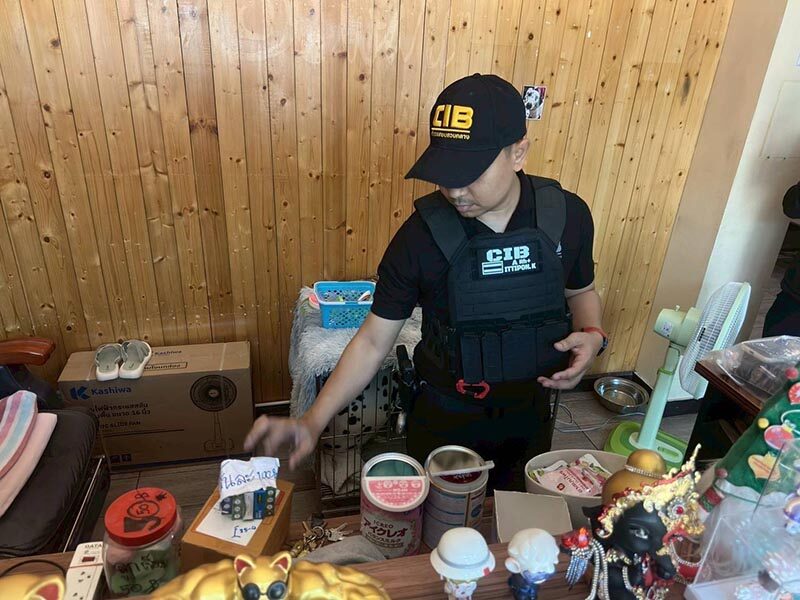
The raid followed a collaboration between Police Division 5, the International Protection Alliance (IPA), and the Our Rescue Foundation — a structure that reflects an increasingly common operational model in Southeast Asian anti-trafficking enforcement, in which specialised non-governmental organisations work alongside police divisions to identify, document, and build cases against trafficking operations that conventional policing resources alone often cannot reach.
The case originated with a 16-year-old girl identified by the pseudonym “Kwang,” who had previously been rescued in a separate intervention. Once safe, she told investigators that she had been hired by Waykanyapat and her husband Thawatchai — the spa’s owners — to work at the premises. Her testimony provided investigators with the specific, named, first-hand account of the spa’s ownership structure and operations that transformed a general suspicion into an actionable case. Without Kwang’s disclosure, there is no indication in the public record that the spa’s seven-year operation would have been identified through any other investigative channel.
The reliance on a single survivor’s testimony to initiate a case of this scale is a documented and recurring pattern in trafficking investigations globally. Trafficking operations are, by design, structured to avoid generating the kind of conventional evidence — financial irregularities, customer complaints, neighbour reports — that triggers routine law enforcement attention. The business operated as an ordinary, even charming, commercial establishment. Its public-facing identity as a cat spa was not incidental camouflage. It was functional: a cat spa is a business type that draws curious customers, generates positive social media attention, and provides zero basis for the kind of suspicion that adult-services advertising would invite, all while requiring the same physical infrastructure — private rooms, massage tables, an appointment booking system — that the actual operation needed.
Inside the Front: How the Spa Actually Operated
The cat spa had been operating for seven years and was advertised on online forums — meaning its existence, and likely some coded version of its actual services, was discoverable by anyone searching in the right channels for an extended period before police intervention. Under questioning, Waykanyapat and Thawatchai confessed to owning the spa and to serving both online and walk-in clients, language that indicates a dual booking channel: a digital advertising and reservation pathway alongside a conventional in-person walk-in service, consistent with how many front businesses in the commercial sex sector in Thailand and across Southeast Asia structure customer access to avoid concentrating risk in any single identifiable channel.
Further investigation revealed the spa generated between 7,000 and 20,000 baht per day after expenses — a daily revenue range that, annualised over a seven-year operating period, represents a substantial and sustained commercial enterprise rather than a marginal or opportunistic operation. The owners claimed the more than 500 seized condoms were for use within the spa — an admission that, combined with the sponge usage documented by investigators, leaves little ambiguity about the nature of the services being provided behind the legitimate-business signage.
The staffing structure documented by investigators reveals an organisation with defined roles and an internal hierarchy rather than an ad hoc arrangement. Yuwadee, one of the three arrested, had worked at the premises for five years, beginning as a masseuse before being promoted to manager at a monthly salary of 35,000 baht. That promotion path — from service-level worker to a managerial position responsible for recruitment and payment — indicates an operation mature enough to have developed internal career progression, a detail that further substantiates the seven-year operational timeline the spa’s owners themselves did not dispute.
The Three Suspects and Their Roles
The roles documented for each of the three arrested suspects reflect a clear functional division within the operation. Waykanyapat and her husband Thawatchai were the spa’s owners, confirmed in their own statements to police, responsible for the establishment’s overall operation and its commercial relationship with both online and walk-in clients. Their ownership position makes them the principal targets of the human trafficking charges, since Thai law and the broader UN Trafficking Protocol framework that Thailand’s domestic legislation incorporates assign primary criminal responsibility to those who own, control, or direct a trafficking operation, rather than treating ownership as a peripheral or administrative role.
Yuwadee’s role, as described by investigators, was distinct and equally significant: she managed recruitment and payments and was specifically responsible for bringing in underage workers. That description — recruitment specifically targeting underage workers as a defined job function — is among the most legally consequential details in the case. It establishes not an incidental presence of minors among a workforce assembled without regard to age, but an active, intentional recruitment practice specifically oriented toward bringing children into the operation. Her five years of employment at the spa, beginning as a masseuse, means she has direct first-hand experience of the business from the inside before her promotion to the recruitment and management role — knowledge that will make her testimony, if she cooperates with prosecutors, substantially valuable to establishing the operation’s full historical scope.
A Second Victim: Family, Recruitment, and the 17-Year-Old Relative
The investigation identified a second trafficking victim during its progress: a relative of Waykanyapat, who began working at the spa at 17 years old for 20,000 baht a month. That victim has been placed under protective custody.
The familial relationship between this victim and one of the spa’s owners adds a specific and forensically significant dimension to the case. Trafficking that occurs within or through family networks — sometimes described in the academic literature as familial or kinship trafficking — presents distinct investigative and prosecutorial challenges compared to trafficking conducted entirely among strangers. Family relationships can suppress disclosure: a minor recruited by a relative may face additional psychological and social barriers to reporting exploitation, including fear of family rupture, loyalty conflicts, and the absence of the stranger-danger framework that public safety education typically equips children to recognise. The same family relationship can also complicate prosecution, since family members may be reluctant witnesses even when they are themselves the victims, and extended family pressure can be brought to bear in ways that pressure from non-family networks cannot replicate.
The fact that this second victim’s recruitment was uncovered during the investigation — rather than being the initiating complaint, as Kwang’s case was — suggests that the scope of the spa’s exploitation of minors extended beyond what was initially apparent from the original tip, and raises the open question of how many additional minors may have passed through the operation across its seven-year history without their cases yet coming to investigators’ attention.
Forensic Analysis: What Seven Years of Operation Looks Like in Evidence
The forensic record assembled in this case demonstrates the kind of physical and documentary evidence that investigators typically rely on to establish both the scale and the duration of a front-business trafficking operation, particularly in cases — like this one — where the operation has been running long enough to generate an extensive paper, digital, and physical trail.
The mobile phones and electronic devices seized during the raid will form the core of the digital forensic analysis, likely containing booking records, client communications, payment confirmations, and potentially direct evidence of the recruitment communications used to bring workers — including the minors specifically targeted by Yuwadee’s recruitment role — into the operation. The seven years of online forum advertising referenced in the case provides investigators with an additional digital archive: historical advertisements, customer reviews, and forum discussion threads that, if preserved or recoverable, can establish a documented timeline of the business’s public-facing operation extending back to its founding.
The financial evidence — the daily revenue range of 7,000 to 20,000 baht after expenses, and Yuwadee’s documented monthly salary of 35,000 baht — provides investigators with a quantifiable economic profile of the operation that supports asset forfeiture proceedings under Thailand’s anti-trafficking legal framework, which permits the seizure of property and proceeds derived from trafficking activity. Establishing seven years of sustained revenue at the documented range produces an aggregate financial benefit to the operation’s owners that, once calculated, will likely become a central element of both the criminal sentencing considerations and any parallel civil or administrative asset recovery action.
The physical evidence — the condoms and the sponges used to enable continuous service delivery — corroborates the confession-based admissions from Waykanyapat and Thawatchai regarding the nature of the services provided, reducing the evidentiary reliance on testimony alone and providing the kind of independently verifiable physical corroboration that strengthens a prosecution’s resilience against any later retraction or defence challenge to witness credibility.
Criminal Psychology: The Front Business Model and Familial Trafficking
The psychological and operational logic of disguising a trafficking operation behind a conventional, even appealing, commercial front is well documented in trafficking research, and the cat spa model in this case exemplifies several of its core dynamics with unusual clarity.
A cat spa, as a business concept, generates a specific kind of social and commercial legitimacy that more conventional massage or spa businesses associated with the adult services sector do not automatically receive. It invites foot traffic from animal-loving customers who have no connection to or knowledge of the operation’s actual function. It generates positive social media content and word-of-mouth referral that operates entirely independently of, and as cover for, the actual commercial activity occurring on the same premises. The juxtaposition of cats — an animal strongly associated in popular culture with comfort, innocence, and harmlessness — against the systematic exploitation occurring in the same building is not coincidental; it reflects a calculated choice by the operators to select a front concept that maximally distances the public perception of the business from any association with exploitation or harm.
The promotion pathway documented for Yuwadee — five years as a masseuse before being elevated to a management role specifically responsible for recruiting minors — illustrates a documented psychological pattern in organised exploitation operations: individuals who begin as workers within an exploitative system can, over time, be promoted into roles that require them to actively perpetuate that same exploitation against others, including children. This progression does not exonerate Yuwadee of culpability for her documented role in recruiting underage workers; Thai prosecutors are proceeding against her on that basis. It does illustrate how trafficking operations sustain themselves operationally by incorporating former victims or vulnerable workers into their management and recruitment structures, a pattern observed across multiple categories of organised exploitation internationally.
The familial trafficking dimension — Waykanyapat’s own relative recruited into the operation at 17 — reflects a documented psychological pattern in which family relationships are instrumentalised as a recruitment and control mechanism precisely because they carry an implicit trust that strangers cannot replicate, and because the social, emotional, and economic ties of family can be leveraged to secure compliance, silence, or both from a minor relative in ways that recruitment of an unrelated child would not as readily achieve.
Law and Legal Implications: Charges, Penalties, and the Minors Still Inside
All three suspects face prosecution under Thailand’s Anti-Trafficking in Persons Act B.E. 2551 (2008), as amended, the principal domestic legal instrument criminalising human trafficking in alignment with the UN Trafficking Protocol’s framework of act, means, and purpose. The presence of minors among the trafficked workers — seven to eight of the 22 identified at the spa, plus the second victim recruited at 17 — triggers the Act’s aggravated penalty provisions specifically applicable to trafficking offences involving children, which carry substantially harsher sentencing exposure than equivalent offences involving adult victims under Thai law.
Yuwadee’s specific role — recruitment and payment management, with explicit responsibility for bringing in underage workers — exposes her to liability not only as a participant in the trafficking operation but potentially as an organiser or facilitator of the specific child-trafficking dimension of the enterprise, a distinction that Thai prosecutors may pursue to establish enhanced culpability separate from her employer-employee relationship with the spa’s owners. Waykanyapat and Thawatchai’s confessed ownership and operational control of the business establishes the foundational liability that the trafficking charges against them rest on, while their admission regarding the condoms — claiming they were “for use within the spa” — functions evidentially as a partial admission to the commercial sexual service dimension of the business, even as it attempts to avoid the more specific admission of facilitating commercial sex with minors.
The legal status and protection of the seven to eight minors identified during the raid, beyond the named survivor “Kwang” and the second victim placed under protective custody, has not been detailed in available reporting. Thai child protection law requires that minors identified in the course of a trafficking investigation be provided protective custody, victim support services, and — where applicable — referral to the formal victim identification and assistance mechanisms established under Thailand’s anti-trafficking framework, which operates in coordination with the UN-aligned National Referral Mechanism for trafficking victims.
Global Context: Front Businesses and the NGO Coalition Model
The use of seemingly innocuous commercial fronts — spas, salons, wellness centres, and in this case a cat spa specifically — to disguise commercial sexual exploitation operations is a well-documented pattern across Southeast Asia, and one that anti-trafficking enforcement agencies and NGOs have increasingly targeted through specialised investigative methodologies designed to penetrate exactly this kind of legitimate-seeming commercial cover.
The operational collaboration in this case — Police Division 5 working directly alongside the International Protection Alliance and the Our Rescue Foundation — reflects a model of public-private anti-trafficking enforcement that has expanded significantly across Thailand and the broader Mekong region over the past decade. Specialised NGOs bring survivor-centred investigative techniques, victim identification expertise, and case-building capacity that complements conventional police investigative resources, particularly in cases — like this one — that originate from a survivor’s disclosure rather than from routine policing activity. The Our Rescue Foundation, founded by Tim Ballard and subject to its own significant public scrutiny and organisational changes in recent years, has continued to operate in partnership with regional law enforcement on specific rescue and investigation operations, and its involvement in this case reflects the continued role that survivor-focused anti-trafficking organisations play in identifying operations that might otherwise escape detection.
The broader pattern of front-business trafficking exposed by cases like the Pathum Thani cat spa connects directly to Thailand’s documented position, in the US State Department’s annual Trafficking in Persons reports, as both a source and destination country for trafficking victims, with commercial sexual exploitation of children remaining one of the most persistent categories of trafficking activity documented within the country despite sustained legislative and enforcement attention over multiple decades.
Investigation: What Remains Unresolved
The full identities, ages, and current status of the seven to eight minors identified among the 22 workers at the spa — beyond “Kwang” and the second named victim placed under protective custody — have not been disclosed in available public reporting. Whether all of them have been removed from the premises, placed in protective custody, and connected to victim support services, or whether some remain in ambiguous status pending further investigation, is not established in the current record.
The full seven-year operational history of the spa — how many workers, including minors, passed through the operation over that period, and whether any of them have already left Thailand, aged out of the operation, or experienced harms not yet documented by the current investigation — is a substantially larger question than what the current arrests and victim identifications address. Investigations into long-running trafficking operations frequently uncover additional victims and additional culpable parties as the inquiry expands beyond its initiating case, and there is no indication in current reporting of whether investigators are actively pursuing that broader historical scope.
Whether the spa’s clientele — described as both online and walk-in — has been or will be investigated for criminal liability under Thailand’s laws addressing the purchase of commercial sexual services from minors is not addressed in the available reporting. Demand-side prosecution in trafficking cases, holding buyers as well as sellers and facilitators criminally liable, remains inconsistently applied across many jurisdictions including Thailand, and whether this case will extend liability beyond the three arrested operators to any of the spa’s clients is an open legal question.
The specific charges that will ultimately be filed against each of the three suspects, and the timeline for their prosecution before Police Division 5 completes its investigation and refers the case to prosecutors, had not been reported as of this publication.
Twenty-Two Workers, One Rescued Girl
A cat spa in Pathum Thani advertised itself for seven years as exactly what its name suggested: a place where customers could relax in the company of cats while receiving a massage. Twenty-two people worked there. Seven or eight of them were children. One of them, a 17-year-old, was a relative of the woman who owned the business.
None of that was visible from the outside, and none of it became visible to investigators through any routine inspection, financial audit, or customer complaint across seven years of continuous operation. It became visible because a 16-year-old girl named Kwang, rescued in an earlier, separate intervention, told investigators what had happened to her — and because a coalition of police and specialised anti-trafficking organisations took that single disclosure seriously enough to build a case from it.
Twenty-two workers were found inside when police finally arrived on May 2, 2026. The spa is no longer operating. Three people are facing trafficking charges. A second victim is in protective custody. Kwang’s testimony is the reason any of this is known. How many other children passed through that building in the seven years before she spoke is the question this case has not yet finished answering.
ForensicTimes · forensictimes.com · Investigative Journalism on Crime, Justice & Forensic Science · © 2026 ForensicTimes. All rights reserved.