Pattaya · Chonburi Province · Thailand · May 2026 | ForensicTimes.com | Human Trafficking · Forensic Technology · AI Surveillance
Table of Contents
- 9:15 a.m., Walking Street: The Arrest
- The Suspect and the Charges Behind the Warrant
- Inside the System: How Thailand’s AI Camera Network Actually Works
- A Pattern, Not an Anomaly: The Network’s Arrest Record
- Forensic Analysis: What Facial Recognition Can Prove and What It Cannot
- Criminal Psychology: Why Trafficking Networks Use Tourist Corridors
- Law and Legal Implications: Thai Trafficking Law and the Charges Saelee Faces
- Global Context: Southeast Asia’s Trafficking Corridor and the Surveillance Arms Race
- Investigation: What Remains Unresolved
- A Face in a Crowd of Thousands
9:15 a.m., Walking Street: The Arrest
At approximately 9:15 a.m. on May 15, 2026, an artificial intelligence surveillance camera positioned near Pattaya’s Walking Street — the city’s most heavily trafficked tourist corridor, lined by bars, restaurants, and street vendors that draw both visitors and the criminal networks that feed on a transient, cash-heavy economy — identified a man walking through the area as matching a face on file against Criminal Court arrest warrant No. 2462/2569, issued April 29, 2026. Tourist police officers monitoring the alert moved in. Within minutes, they had detained 38-year-old Thai national Somchat Saelee without incident.
The arrest itself was unremarkable in its execution — no chase, no resistance, no use of force beyond a standard detention. What made it notable was the warrant Saelee was wanted under: a constellation of charges including jointly committing human trafficking, conspiracy to commit human trafficking, taking a minor for exploitation, coercion, illegally taking a person out of the kingdom, and entering false information into a computer system. Thai-language outlet Naewna, which first reported the case, linked the charges to a broader network accused of unlawfully exploiting people and minors. Following the arrest, officers transferred Saelee to investigators at Thailand’s Anti-Trafficking in Persons Division — the specialised national unit responsible for trafficking case investigation and prosecution — for formal legal proceedings.
The Suspect and the Charges Behind the Warrant

The specific operational details of the network Saelee is alleged to have been part of — how victims were recruited, where they were held, what form the exploitation took, and how many people were affected — have not been disclosed in the public reporting on this case. What the charge sheet itself establishes is a structural picture: this was not framed as an isolated act but as participation in an organised, multi-person enterprise. The charge of “jointly committing human trafficking” and the separate charge of “conspiracy to commit human trafficking” both require, under Thai law, proof of coordination with at least one other person — meaning prosecutors are proceeding on the theory that Saelee operated within a network rather than alone.
The inclusion of “taking a minor for exploitation” as a distinct charge is the most forensically and legally serious element of the warrant. Thailand’s Anti-Trafficking in Persons Act, and the broader penal code provisions it interacts with, treat offences against minors as an aggravating category carrying substantially harsher sentencing exposure than equivalent offences against adult victims — reflecting both the Act’s domestic legislative intent and Thailand’s obligations under the UN Trafficking Protocol, which the country ratified as part of its broader anti-trafficking commitments. The charge of “illegally taking a person out of the kingdom” suggests the network’s operations were not confined to Thailand but involved cross-border movement — consistent with established patterns of trafficking networks operating across the Thailand-Cambodia and Thailand-Myanmar borders, both of which have become significant transit corridors for trafficking and forced-labour scam operations over the past several years.
The final charge — entering false information into a computer system, prosecuted under Thailand’s Computer-Related Crime Act — typically accompanies trafficking and fraud charges where false documentation, falsified online recruitment material, or manipulated records were used to facilitate the underlying offence. Its presence in the warrant suggests the network used some form of digital deception, whether in recruiting victims, falsifying travel or identity documentation, or both.
Inside the System: How Thailand’s AI Camera Network Actually Works
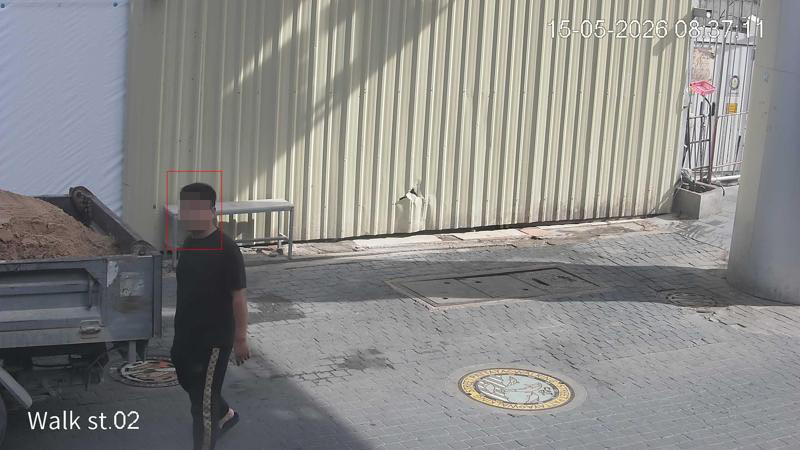
The technology that identified Saelee is part of a national AI-powered surveillance infrastructure that Thailand’s Tourist Police Bureau began deploying in July 2024, initially across ten provinces including Chonburi (where Pattaya is located), Samut Prakan (covering Suvarnabhumi Airport), Nakhon Ratchasima, Chiang Mai, Phuket, Nakhon Phanom, Tak, Udon Thani, and Khon Kaen. The system operates on a straightforward technical architecture: networked cameras, installed in high-traffic public areas, run continuous facial recognition analysis on passersby and cross-reference the results in real time against a centralised database maintained by Thailand’s Central Investigation Bureau — the national body that aggregates outstanding arrest warrants from courts across the country.
When the system identifies a probable match between a face captured on camera and an individual named in an active warrant, it generates an automated alert that is routed to the nearest available police unit, who then move to intercept and verify the match in person before making an arrest. In Pattaya specifically, the system has been progressively expanded beyond fixed camera installations to include CCOC Mobile units — vehicles equipped with the same facial recognition technology, allowing the network to extend coverage into areas without permanent camera infrastructure, particularly during high-density events. The mobile system, nicknamed “Duantaphikat” or the “Deadly Eye,” was deployed during the April 2026 Songkran water festival specifically to manage the surge of both tourists and the opportunistic and organised criminal activity that follows large seasonal crowds.
The system’s underlying technology partnership involves Gorilla Technology, a UK-based security and AI firm contracted to support international security enhancement, artificial intelligence integration, and smart resource management for the Pattaya deployment specifically. Police Lieutenant General Yingos Thepchamnong, chief of Police Region 2, has characterised the broader approach as a deliberate shift from reactive to proactive policing — using continuous, automated identity verification across public space to surface wanted individuals who would otherwise remain unnoticed within the dense foot traffic of Thailand’s tourist economy. The technology now extends beyond facial recognition alone: officials have indicated that newer iterations of the system can detect mobile devices in an area even when those devices are powered off, adding a second layer of identification capability that operates independently of whether a suspect’s face is visible to a camera.
A Pattern, Not an Anomaly: The Network’s Arrest Record
The Saelee arrest is not an isolated success story. It is the latest data point in a now-substantial operational record that Thailand’s Tourist Police Bureau has been compiling since the system’s July 2024 launch, and which the bureau has publicised consistently as evidence of the technology’s effectiveness.
By August 2025, the bureau reported that the AI camera network had facilitated 402 arrests nationally since launch, with Nakhon Ratchasima recording the highest provincial total at 151 arrests. By May 2025, a separate reporting period had already shown 180 foreign fugitives arrested under the system in under a year, with Pattaya recording the highest single-city total at 102 arrests, ahead of Chiang Mai’s 54, Nakhon Ratchasima’s 21, and three at Suvarnabhumi Airport. The bureau has also indicated the system extends beyond formally wanted fugitives: more than 600 known pickpockets, scam operatives, and foreign exchange fraud suspects have reportedly been added to the database for real-time behavioural monitoring, intended to enable intervention before a crime occurs rather than only after a warrant has been issued.
The case-level pattern across these arrests is instructive. In October 2025, the system achieved what Thai authorities described as a national first: simultaneously identifying three separate suspects riding a single motorcycle near the Laem Bali Hai Pier underpass, all three wanted in connection with a mule-account banking fraud network — accounts opened by recruited individuals and sold to brokers for use in laundering proceeds from call-centre scam operations. In January 2026, the same Laem Bali Hai Pier location produced a separate cluster of arrests: two men, ages 20 and 26, both wanted on Bangkok Criminal Court warrants for transnational organised crime, gang robbery, impersonation fraud, and money laundering connected to overseas scam compounds. One of the men told investigators he had been smuggled into Cambodia and forced to work in a compound conducting romance scams and investment fraud targeting Thai victims — a detail that situates Thailand’s domestic AI policing success directly against the backdrop of the regional forced-labour scam compound crisis that has drawn sustained international attention to the Thailand-Cambodia and Thailand-Myanmar border regions.
Forensic Analysis: What Facial Recognition Can Prove and What It Cannot
The forensic function performed by Thailand’s AI camera network is narrower and more specific than the popular framing of “AI solving crimes” suggests, and understanding that distinction is essential to assessing what the technology actually accomplishes in cases like Saelee’s.
Facial recognition surveillance of this kind does not investigate, build evidence, or establish guilt. Its sole forensic function is identity verification at a known location and time — confirming, with a defined statistical confidence threshold, that a specific face captured on camera corresponds to a specific identity already associated with an outstanding warrant in a separate database. The investigative work that produces the warrant itself — establishing probable cause, gathering evidence of the underlying offence, securing the court order — happens entirely upstream of the camera system and through conventional law enforcement and prosecutorial processes. The AI system’s contribution is exclusively logistical: it solves the problem of locating a person whose legal status as a wanted suspect has already been established through other means.
This distinction matters because it defines both the system’s genuine value and its inherent limitations. Its value is substantial in precisely the operational context Thailand has deployed it within: a country with a large, continuously circulating foreign and domestic tourist population, dense urban tourist corridors where conventional foot-patrol identification of a specific wanted individual among thousands of daily visitors is effectively impossible, and a national warrant database large enough that manual cross-referencing would be impractical at scale. Its limitation is equally clear: the system can only locate people who are already the subject of an issued warrant captured on a camera within its coverage area. It contributes nothing to identifying unknown traffickers, uncovering networks that have not yet drawn law enforcement attention, or locating individuals operating outside the geographic footprint of the camera network — which, as of mid-2026, remains concentrated in a limited number of provinces and specific high-traffic locations within them rather than providing comprehensive national coverage.
The false-positive risk inherent in facial recognition technology — the possibility that the system flags an innocent person whose facial features statistically resemble a wanted individual — is a documented limitation of the underlying technology across every jurisdiction that has deployed it, and one that has produced wrongful detentions in other countries’ facial recognition deployments. Thai authorities have not published independent accuracy or false-positive rate data for the system’s Pattaya or national deployment, and no public audit of the system’s error rate by an independent body has been reported.
Criminal Psychology: Why Trafficking Networks Use Tourist Corridors
The decision by trafficking and exploitation networks to operate in and recruit through high-density tourist environments like Pattaya’s Walking Street reflects a documented operational logic that criminologists studying trafficking networks across Southeast Asia have consistently identified.
Tourist corridors offer specific structural advantages to networks engaged in trafficking, exploitation, and associated fraud. The sheer density and transience of foot traffic provides cover: a network member moving through a crowd of thousands of daily visitors is statistically far less conspicuous than the same individual would be in a residential or low-traffic commercial area, where unfamiliar faces and patterns are more readily noticed by both residents and routine law enforcement patrol. The cash-intensive, loosely regulated informal economy that characterises tourist entertainment districts — bars, street vendors, unlicensed services — creates financial channels that can absorb illicit proceeds with less scrutiny than formal banking transactions would attract, even before accounting for the mule-account banking fraud that several of the AI camera system’s prior arrests have specifically targeted.
The cross-border dimension reflected in Saelee’s “illegally taking a person out of the kingdom” charge is similarly consistent with the documented architecture of regional trafficking. Thailand’s land borders with Cambodia and Myanmar have, over the past several years, become significant transit and operational corridors not only for traditional trafficking but for the forced-labour scam compound phenomenon that has drawn growing international attention — operations in which trafficked individuals, including Thai nationals recruited under false employment pretences, are coerced into running online fraud operations from compounds across the border, as documented in several of the cases the same AI camera network has previously surfaced. Whether Saelee’s specific network falls into this scam-compound trafficking pattern, a more conventional trafficking and exploitation model, or some combination of the two, has not been established in available public reporting.
Law and Legal Implications: Thai Trafficking Law and the Charges Saelee Faces
Saelee’s prosecution will proceed under Thailand’s Anti-Trafficking in Persons Act B.E. 2551 (2008), as amended, which establishes the principal domestic legal framework criminalising human trafficking and aligns Thailand’s statutory definitions with the UN Trafficking Protocol’s tripartite framework of act, means, and purpose — broadly, the recruitment or transport of a person, through coercion, deception, or abuse of vulnerability, for the purpose of exploitation. The Act provides for substantially enhanced penalties where the trafficking offence involves a minor victim, which appears to be among the specific charges Saelee faces, and further enhancement where the offence is committed as part of an organised criminal group — consistent with the “joint” and “conspiracy” framing of the charges against him.
The conspiracy and joint-commission charges carry significant evidentiary implications for the prosecution. Establishing these charges requires proving not merely that Saelee personally engaged in exploitative conduct, but that he did so in coordination with identifiable co-conspirators — meaning the prosecution’s case will likely depend substantially on evidence implicating the broader network Naewna’s reporting referenced, including potentially other individuals already in custody, financial records establishing coordinated activity, or victim and witness testimony describing the network’s structure and Saelee’s specific role within it.
The computer-crime charge — entering false information into a computer system — will be prosecuted under Thailand’s Computer-Related Crime Act B.E. 2550 (2007), as amended, which criminalises the input of false data into a computer system in a manner likely to cause damage to a third party or the public. Its presence in Saelee’s charge sheet suggests an evidentiary trail involving digital records — recruitment communications, falsified documentation, or manipulated identity records — that investigators have already identified as part of building the case, since charges of this kind are typically only filed once specific false records have been located and attributed.
Global Context: Southeast Asia’s Trafficking Corridor and the Surveillance Arms Race
Thailand’s deployment of AI facial recognition specifically against trafficking and exploitation networks occurs within a broader regional context that has made Southeast Asia, and Thailand in particular, a focal point of international anti-trafficking attention over the past several years. The US State Department’s annual Trafficking in Persons reports have repeatedly identified Thailand as both a source and transit country for trafficking victims, and more recently as a key transit and operational hub for the forced-labour scam compound networks that have drawn condemnation from the United Nations, INTERPOL, and multiple national governments whose citizens have been trafficked into compound operations across the Thailand-Myanmar and Thailand-Cambodia borders.
Thailand’s response — visible in the AI camera deployment, in joint operations with the Cyber Crime Investigation Bureau against call-centre and mule-account networks, and in periodic high-profile raids on scam compounds along the Myanmar border — reflects significant diplomatic and economic pressure on the Thai government to demonstrate enforcement capacity against networks that have increasingly implicated Thai territory and Thai nationals, even where the most severe compound operations themselves are based across the border in areas outside direct Thai jurisdiction. The facial recognition system’s emphasis on Pattaya, Bangkok, and other major tourist and transit hubs reflects a strategic choice to concentrate technological enforcement capacity at the points where trafficking networks’ logistics — recruitment, document fraud, cross-border movement, and the laundering of proceeds through tourist-economy cash flows — intersect with the parts of the country where Thai law enforcement retains full and unimpeded jurisdiction.
Thailand’s approach also sits within a wider global trend of states deploying facial recognition surveillance for public safety and immigration enforcement purposes, a trend that has generated substantial civil liberties debate in jurisdictions including the European Union, the United Kingdom, and the United States, where courts and regulators have grappled with questions of consent, data retention, accuracy, and discriminatory impact. Thailand’s public framing of the technology has been almost uniformly promotional, emphasising arrest totals and tourist safety rather than addressing these broader civil liberties questions, and no significant domestic Thai legal or regulatory challenge to the system’s privacy implications has been reported as of this publication.
Investigation: What Remains Unresolved
The full scope of the trafficking network Saelee is alleged to have participated in — the number of victims involved, the specific nature of the exploitation, the identities and status of any co-conspirators, and whether other members of the network remain at large — has not been disclosed in available public reporting and will presumably emerge as the Anti-Trafficking in Persons Division’s investigation proceeds.
The specific mechanism by which the minor victim referenced in the charges was recruited or taken — whether through deception, coercion, family complicity, or another means — and that victim’s current status and safety have not been reported. The cross-border dimension of the case, reflected in the charge of illegally taking a person out of the kingdom, raises an open question about whether Thai authorities are coordinating with counterpart agencies in Cambodia or another neighbouring jurisdiction, and whether any international or multilateral anti-trafficking mechanism has been engaged in the case.
No independent accuracy audit of the AI facial recognition system’s false-positive or false-negative rate has been published, despite the system’s expanding role in an increasing volume of arrests across multiple Thai provinces. Whether the system’s identification of Saelee, or any of the more than 400 other individuals it has flagged since 2024, has ever produced a wrongful detention that did not result in publicly reported correction is not addressed in any available official disclosure.
The legal proceedings against Saelee — including his formal indictment, any plea, and the eventual judicial outcome — had not been reported as of this publication, consistent with the early stage of the post-arrest legal process under Thai criminal procedure.
A Face in a Crowd of Thousands
Walking Street on a Friday morning carries a particular kind of anonymity — thousands of people moving through a half-kilometre of bars, vendors, and storefronts, locals and tourists indistinguishable at a glance, the kind of dense, transient crowd that has made tourist corridors attractive operating environments for criminal networks for as long as tourist economies have existed. For thirty-eight years, Somchat Saelee was, to any human observer, simply one more face in that crowd. To a camera trained to recognise one specific face among the warrant database’s accumulated thousands, he was identifiable within seconds.
The system that caught him does not investigate trafficking, does not rescue victims, and does not dismantle the networks that recruit and exploit them. It does one narrow thing with increasing reliability: it finds people that courts have already decided need to be found. In a tourist economy built on the deliberate anonymity of crowds, that narrow function has become, over less than two years, one of the more consequential law enforcement tools Thailand has deployed against the networks that exploit exactly the conditions tourism creates.
Whatever else emerges about the network behind warrant No. 2462/2569 — the victims, the co-conspirators, the cross-border logistics that charge sheet implies — the arrest itself took nine minutes from detection to detention. The investigation into everything the warrant represents will take considerably longer.
ForensicTimes · forensictimes.com · Investigative Journalism on Crime, Justice & Forensic Science · © 2026 ForensicTimes. All rights reserved.