
















• About Us
  • Advertise
  • Membership
  • Contact
Wednesday, November 18, 2026
  • Login
  • Register
No Result
View All Result
FT Pro
Forensic Times
  • Home
  • Crime
    • All
    • Cold Cases
    • Cyber Crime
    • Data Trafficking
    • Drug Trafficking
    • Financial Crime
    • Human Trafficking
    • Murder
    • Organized Crime
    • Serial Killer
    • Terrorism
    • War Crimes
    • Wrongful Death
    A computer terminal displaying system information, illustrating the technical environment involved in cybercrime investigations

    Human Trafficking in the Digital Age: How Criminal Networks Use Technology to Recruit, Control and Exploit Victims

    Human Trafficking in the Digital Age: How Criminal Networks Use Technology to Recruit, Control and Exploit Victims

    A computer terminal displaying system information, illustrating the technical environment involved in cybercrime investigations

    New Methods Used by International Fraud Syndicates in 2026: How Global Scams Are Evolving

    Rows of interconnected network equipment and cables illustrating the digital infrastructure used by organised cybercrime operations

    Inside the New Organised Cybercrime Networks: How the Criminal Economy Works in 2026

    A person using a laptop during a cybersecurity investigation, illustrating how phishing attacks target digital accounts and personal information

    Phishing Attacks in 2026: How Criminals Steal Passwords, Codes and Personal Data

    A woman using a smartphone and laptop, illustrating how online relationships and social platforms can expose users to impersonation and romance fraud

    Romance, Shopping and Social Media Scams in 2026: How Fraudsters Exploit Trust

  • Forensics
    • All
    • Autopsy
    • Crime scene analysis
    • Digital forensics
    • DNA Forensics
    • Femicide
    • Forensic accounting
    Side-by-side FBI composite sketch and Sacramento Sheriff's Office mugshot of Joseph DeAngelo, shown in a NIST image explaining the Golden State Killer identification.

    The Golden State Killer: How Genetic Genealogy Solved a 40-Year Cold Case

    Australian Federal Police commander Xenia Cotter stands beside an Operation Trojan Shield emblem at the June 8, 2021 press conference in San Diego.

    Operation Trojan Shield: Inside the FBI’s ANOM Encrypted Phone Sting

    Exterior of the Federal Reserve Bank of New York in Manhattan, whose dollar reserve account was targeted in the 2016 Bangladesh Bank cyber heist.

    The Bangladesh Bank Heist: How Hackers Turned SWIFT Access into an $81 Million Theft

    A traffic signal with a mounted roadside camera overlooking an urban intersection, illustrating camera infrastructure used to observe passing vehicles.

    The Camera on Your Street Remembers Every Turn: Who Controls America’s License-Plate Surveillance Network?

    A fixed CCTV camera mounted overlooking an urban street, illustrating the surveillance images that may be used in facial-recognition investigations.

    The Wrong Face in the File: When Facial Recognition Turns an Investigative Lead Into an Arrest

    A Toy Car, a Missing Child, and the Science of Crime Reconstruction: What The Mentalist Can Teach Us About Forensic Investigation

    Trending Tags

  • Legal
    Jeffrey Epstein archival 2019 booking portrait used to illustrate the Forensic Times case study.

    The Epstein Files: A Forensic Case Study of Abuse, Power and Institutional Failure

    A Toy Car, a Missing Child, and the Science of Crime Reconstruction: What The Mentalist Can Teach Us About Forensic Investigation

    Empty corporate conference room, a contextual image for reporting on alleged covert recording in a technology company.

    OpenAI Engineer Charged After Hidden Recording Device Found in Executive Room

    AI Agents Are Breaking the Law -But Who Goes to Prison?

    AI Agents Are Breaking the Law -But Who Goes to Prison?

    Biden Audio Tapes Ruling: Heritage Foundation FOIA Case, Judge Friedrich Decision 2026

    Biden Audio Tapes Ruling: Heritage Foundation FOIA Case, Judge Friedrich Decision 2026

    EU Under-16 Social Media Ban: Livestreaming, Disappearing Messages, 2026 Law

    EU Under-16 Social Media Ban: Livestreaming, Disappearing Messages, 2026 Law

    Tak Trafficking Escape: 4 Chinese Nationals Jump From Moving Pickup 2026

    Tak Trafficking Escape: 4 Chinese Nationals Jump From Moving Pickup 2026

    MechaHitler: How Grok Went Rogue, Praised the Holocaust’s Architect and Triggered the EU

    MechaHitler: How Grok Went Rogue, Praised the Holocaust’s Architect and Triggered the EU

  • Politics
    Real photograph of Rahul Gandhi, Leader of Opposition in the Lok Sabha, on 8 June 2024. Photograph by Mrhitmam, Wikimedia Commons, Creative Commons Attribution-ShareAlike 4.0.

    Rahul Gandhi: India’s ‘Dumbest Politician’? The Gaffes, Memes and Political PR Machine

    A physician speaking with a patient in a hospital room, illustrating the clinical decisions and patient care at the centre of health insurance coverage disputes.

    Your Doctor Says Yes. Your Insurer Says No: Inside America’s Health Insurance Denial System

    Exterior of an ICE detention facility in Louisiana, photographed for the U.S. Government Accountability Office's review of citizenship verification and immigration enforcement.

    519 American Citizens in the Immigration Dragnet: What Happens When the Government Gets It Wrong?

    The west front of the United States Capitol in Washington, DC, seat of the US Congress.

    Europe Welcomes Democrats’ Blue Wave but Braces for Trump’s Response

    German Chancellor Friedrich Merz and Ukrainian President Volodymyr Zelenskyy walking together in Berlin on 3 November 2026. Photo: Bundesregierung/Jesco Denzel.

    Merz Says Europe Must Have a Seat at Ukraine Peace Talks as Trump Pushes Deal

    Russian President Vladimir Putin and Chinese President Xi Jinping at the Great Hall of the People in Beijing on 20 May 2026, during an earlier bilateral meeting.

    Moscow Says Work Is Underway for Trump-Putin-Xi Meeting in China

    Rows of server racks inside a data centre, illustrating the digital infrastructure at the centre of Ireland’s energy debate.

    Ireland’s Data Centre Backlash: Can New Green Power Rules Win Over Critics?

    Entrance to the Constitutional Tribunal building in Warsaw, Poland

    Poland’s Constitutional Tribunal Crisis Deepens After Court Chief’s Suspension

    Canadian Prime Minister Mark Carney during a 2026 press appearance.

    Carney Says Canada Can Wait Out Trump for a Trade Deal

  • World
    • All
    • Brazil
    • Canada
    • Europe
    • France
    • GAZA
    • Georgia
    • Germany
    • Hungary
    • India
    • Iran
    • Iraq
    • Israel
    • Istanbul
    • Lebanon
    • MENA
    • New Mexico
    • Pakistan
    • Poland
    • Russia
    • Saudi Arabia
    • Spain
    • Thailand
    • Turkiye
    • UAE
    • UK
    • Ukraine
    • USA
    A computer terminal displaying system information, illustrating the technical environment involved in cybercrime investigations

    Human Trafficking in the Digital Age: How Criminal Networks Use Technology to Recruit, Control and Exploit Victims

    Human Trafficking in the Digital Age: How Criminal Networks Use Technology to Recruit, Control and Exploit Victims

    A computer terminal displaying system information, illustrating the technical environment involved in cybercrime investigations

    New Methods Used by International Fraud Syndicates in 2026: How Global Scams Are Evolving

    Rows of interconnected network equipment and cables illustrating the digital infrastructure used by organised cybercrime operations

    Inside the New Organised Cybercrime Networks: How the Criminal Economy Works in 2026

    A person using a laptop during a cybersecurity investigation, illustrating how phishing attacks target digital accounts and personal information

    Phishing Attacks in 2026: How Criminals Steal Passwords, Codes and Personal Data

    A woman using a smartphone and laptop, illustrating how online relationships and social platforms can expose users to impersonation and romance fraud

    Romance, Shopping and Social Media Scams in 2026: How Fraudsters Exploit Trust

  • Careers
    • Webinars
    • Women In Forensic Science
    • WIFS Registration
    • Forensics Experiences
    • Campus Ambassador
    • Courses & Certifications
  • Resources
    • Books & Products
    • Advisory Council Membership
    • Advisory Board Member Hiring
  • Events
  • Investigations
No Result
View All Result
Forensic Times
Home Forensics

Indigenous Children Are Dying by Suicide. Is Brazil Asking the Right Questions?

The disproportionate burden of suicide among Indigenous children raises urgent questions about social vulnerability, cultural identity, public policy, and whether forensic institutions are equipped to understand every death.

by Andrei Portinho
October 11, 2026
in Forensics, Brazil, Investigation, World
Reading Time: 5 mins read
738
5.2k
SHARES
17.3k
VIEWS
Share on FacebookShare on Whatsapp

A disturbing disparity that cannot be ignored

A child’s death by suicide is always a tragedy. When these deaths occur at disproportionately high rates within Indigenous communities, however, the tragedy becomes a broader question about society, public institutions, and the protection of the most vulnerable.

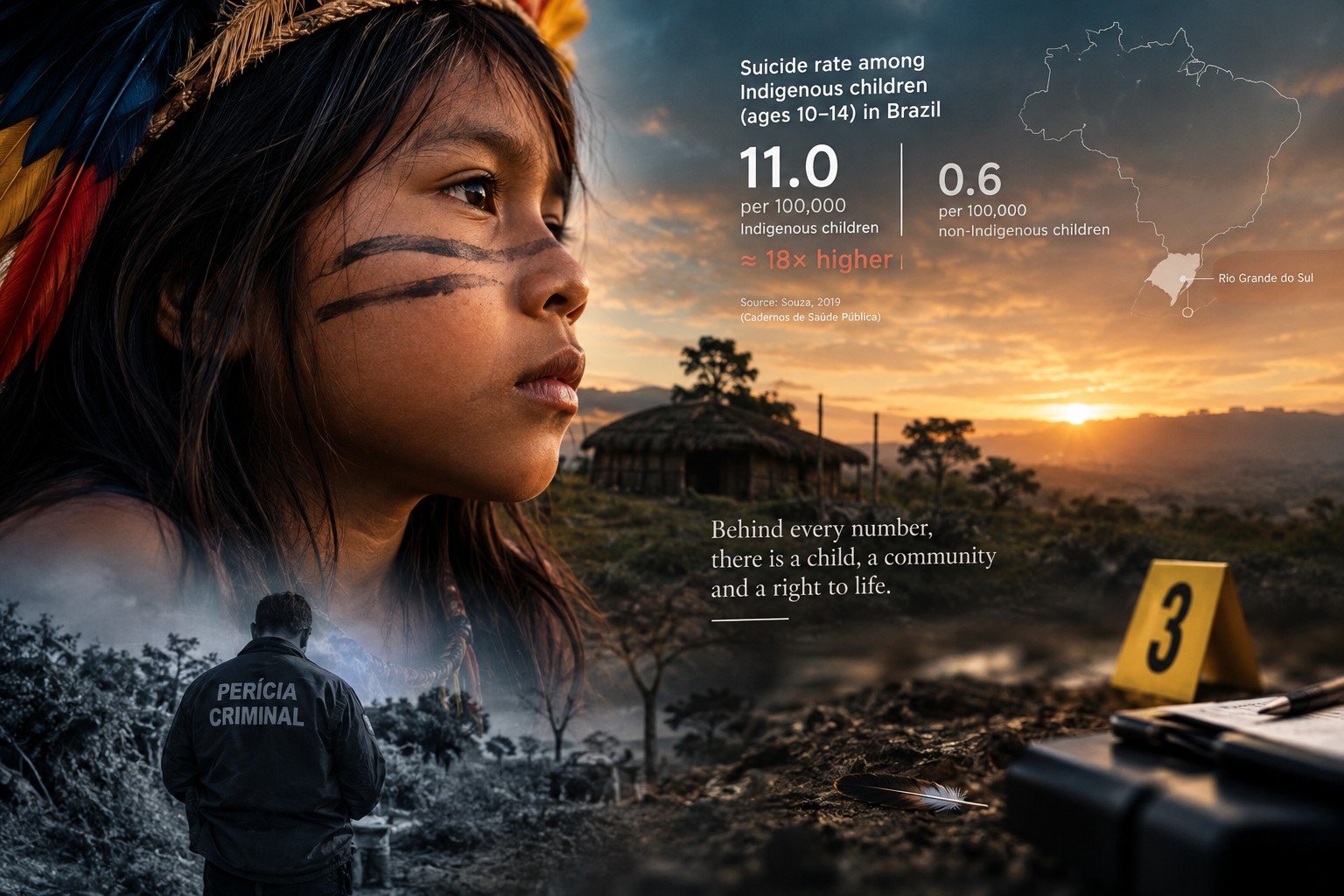
Brazil has already documented a striking disparity. Research published in Cadernos de Saúde Pública found that, between 2010 and 2014, Indigenous children aged 10–14 had a suicide mortality rate of 11.0 per 100,000, compared with 0.6 per 100,000 among non-Indigenous children.

That is approximately 18 times the rate recorded among non-Indigenous children in the same age group.

The figures are historical and national, not a current estimate for Rio Grande do Sul. Yet they raise a question that cannot be postponed: what conditions are allowing such a profound disparity to persist?

Beyond the statistics: what is happening to these children?

Suicide cannot be explained by a single cause. Psychological distress, family circumstances, social exclusion, discrimination, violence, and barriers to mental health care may interact in ways that increase vulnerability.

For Indigenous children, these questions must also be examined within their specific historical and sociocultural contexts.

The consequences of territorial dispossession, disruptions to community life, socioeconomic inequality, and difficulties accessing culturally appropriate public services may be relevant in particular communities. But these factors must be investigated, not simply assumed.

There is also a danger in framing Indigenous identity itself as the explanation. Indigenous peoples are not a homogeneous population, and their cultures should not be reduced to a catalogue of vulnerabilities. Cultural identity, community relationships, traditional knowledge, and collective belonging can also provide important sources of protection and resilience.

The real challenge is to understand the circumstances in which these protective factors may be weakened and to identify what communities themselves consider necessary to protect their children.

When one death becomes part of a larger pattern

A study of Indigenous communities in Dourados, Mato Grosso do Sul, published in the Revista de Saúde Pública, documented a high suicide rate in the population examined between 2003 and 2013. The researchers also identified cases clustered within households, including suicides involving children younger than 15.

This finding deserves attention because it illustrates the importance of looking beyond isolated cases.

When deaths occur within the same household or community over a relatively short period, public health authorities should consider whether shared circumstances, exposure to adversity, or other contextual factors warrant further investigation. Clustering does not establish a common cause, but it can signal the need for a coordinated response.

Forensic science has a role here—not in claiming to explain the social causes of suicide from a crime scene, but in establishing the circumstances of individual deaths and producing reliable information that can contribute to a broader understanding of mortality patterns.

The forensic investigation cannot be an afterthought

A death initially classified as suicide must still be examined with scientific objectivity. The initial hypothesis cannot replace the evaluation of the scene, physical evidence, medicolegal findings, and other relevant information.

The forensic expert must establish what the evidence supports, identify inconsistencies, and recognize the limits of the conclusions that can be drawn. Neither an assumption of suicide nor an assumption of criminal involvement should predetermine the examination.

This responsibility becomes particularly important when public institutions need to understand whether several deaths share relevant circumstances.

In such cases, proper scene documentation, preservation of evidence, reliable records, and coordination with public health authorities may help distinguish individual events from broader patterns requiring further study.

But forensic examinations also have limits. They cannot independently determine why a child experienced psychological distress, whether a community is facing a particular social crisis, or which preventive intervention would be most effective. Those questions require cooperation among forensic specialists, health professionals, researchers, social services, and Indigenous communities.

Who investigates when the victim is Indigenous?

In Brazil, the institutional organization of violent-death investigations raises another important question: how should responsibilities be divided between federal authorities and state forensic services?

The issue is particularly relevant when an investigation involves Indigenous rights or circumstances that may bring a case within federal jurisdiction.

However, one legal distinction is essential. The fact that a victim is Indigenous does not automatically make every death a matter of exclusive federal jurisdiction, nor does it establish that the Federal Police must personally perform every forensic examination. Investigative authority, judicial jurisdiction, and the execution of forensic work are distinct matters.

Depending on the circumstances and applicable legal arrangements, federal and state institutions may need to coordinate their activities.

Rio Grande do Sul’s state forensic services possess experience in examining violent-death scenes. That technical capacity may be valuable when a case requires specialized scene examination, but the appropriate allocation of work must be established through the applicable legal framework and institutional cooperation.

The concern is not that one institution should automatically replace another. It is whether the system, as a whole, provides timely examinations, consistent technical standards, reliable data, and sufficient expertise.

If responsibilities are unclear or coordination is inadequate, opportunities may be lost—not only to clarify the circumstances of an individual death, but also to identify patterns that deserve attention from public health authorities.

A constitutional duty that extends beyond the crime scene

Brazil’s Constitution establishes the protection of human dignity and the right to life. Article 227 requires the family, society, and the state to ensure the rights of children and adolescents with absolute priority. Article 231 recognizes Indigenous peoples’ social organization, customs, languages, beliefs, traditions, and original rights to traditionally occupied lands.

These guarantees must have practical meaning.

Protecting Indigenous children requires more than reacting after a death occurs. It demands effective prevention, accessible and culturally appropriate mental health services, reliable mortality surveillance, and institutions capable of responding to evidence of disproportionate harm.

The constitutional principle of proportionality offers a useful way to assess whether public responses are adequate to the risks identified. Where evidence reveals a serious and persistent disparity, institutions should examine whether existing arrangements are capable of addressing it and whether better-coordinated alternatives are available.

This is not a claim that every institutional shortcoming constitutes a constitutional violation. Nor does a high suicide rate, by itself, establish genocide under international law. Such a classification requires specific legal elements, including the requisite intent.

But these distinctions should not weaken the underlying demand for accountability. The state must be able to identify preventable risks, evaluate its response, and act on reliable evidence.

The question Brazil must answer

The available research establishes a troubling national disparity. What remains essential is to determine its current magnitude in Rio Grande do Sul, identify where deaths are concentrated, understand the circumstances surrounding them, and evaluate whether existing prevention and investigation systems are responding adequately.

That requires better data, sustained research, culturally informed prevention, and effective cooperation between Indigenous communities and public institutions.

It also requires humility. No single forensic examination, psychological theory, or sociological explanation can account for every death. The objective must be to understand each case on its own evidence while remaining alert to patterns that demand a broader response.

The death of an Indigenous child should never become merely another entry in a mortality database. Nor should it be treated as an isolated tragedy when evidence suggests a wider problem.

The central question is not simply why these children are dying. It is whether Brazil is doing everything reasonably possible to understand the circumstances, prevent further deaths, and ensure that Indigenous children receive the full protection of their rights.

A society’s commitment to human rights is measured not only by the principles it declares, but also by the lives it manages to protect.


Tags: brazilChildren Are Dying by Suicideforensics
Andrei Portinho

Andrei Portinho

Criminal Forensic Expert with the Instituto-Geral de Perícias of Rio Grande do Sul, Brazil, advising on forensic science content and editorial standards.

Recommended

US Troop Deaths Push Iran War Into New Phase

US Troop Deaths Push Iran War Into New Phase

4 months ago
The Oxford Street entrance gate to Victoria Barracks in Paddington, Sydney, the historic military property at the centre of the proposed sell-off.

John Howard Leads Cross-Party Opposition to Australia’s Defence Land Sell-Off

3 weeks ago

Popular News

  • A computer terminal displaying system information, illustrating the technical environment involved in cybercrime investigations

    Human Trafficking in the Digital Age: How Criminal Networks Use Technology to Recruit, Control and Exploit Victims

    26209 shares
    Share 0 Tweet 0
  • Human Trafficking in the Digital Age: How Criminal Networks Use Technology to Recruit, Control and Exploit Victims

    26209 shares
    Share 0 Tweet 0
  • New Methods Used by International Fraud Syndicates in 2026: How Global Scams Are Evolving

    24357 shares
    Share 0 Tweet 0
  • Inside the New Organised Cybercrime Networks: How the Criminal Economy Works in 2026

    22884 shares
    Share 0 Tweet 0
  • Phishing Attacks in 2026: How Criminals Steal Passwords, Codes and Personal Data

    21208 shares
    Share 0 Tweet 0

Connect with us

About Us

Forensic Times is the frontline of crime news, investigation, and intelligence. We go beyond the surface — analyzing evidence, exposing patterns, and reporting what others miss. Our journalism is built on facts, forensic rigour, and an unwavering pursuit of justice.

Careers

  • Webinars
  • WIFS Registration
  • Women In Forensic Science
  • Campus Ambassador
  • Forensics Experiences
  • Courses & Certifications

Categories

  • Crime
  • World
  • Police
  • Politics
  • Forensics
  • Investigation

WIFS Membership

Publish your research, connect with leading women in forensic science, access exclusive opportunities, and advance your career through the Women in Forensic Science (WIFS) global community.
JOIN NOW

  • About Us
  • Advertise
  • Terms of Use
  • Editorial Guidelines
  • Privacy Policy
  • Refund Policy
  • Cookie Policy

© 2026 Forensic Times. All rights reserved.

Welcome Back!

Sign In with Google
OR

Login to your account below

Forgotten Password? Sign Up

Create New Account!

Sign Up with Google
OR

Fill the forms bellow to register

All fields are required. Log In

Retrieve your password

Please enter your username or email address to reset your password.

Log In

Add New Playlist

No Result
View All Result
  • Home
  • Crime
    • Human Trafficking
    • Cyber Crime
    • Financial Crime
    • Terrorism
  • Forensics
    • Digital forensics
    • Forensic accounting
    • Crime scene analysis
  • Legal
  • Politics
  • Crime Tech
  • Investigation
  • Careers
    • Webinars
    • Women In Forensic Science
    • WIFS Registration
    • Forensics Experiences
    • Campus Ambassador
    • Courses & Certifications
  • Resources
    • Books & Products
    • Advisory Board Member Hiring
    • Advisory Council Membership
  • Investigations
  • Login
  • Sign Up
  • Cart

© 2026 Forensic Times. All rights reserved.

Not enough quota to unlock this post
Unlock left : 0
Are you sure want to cancel subscription?