Nearly a year of quiet negotiation produced a trilateral pledge that a nuclear-armed Pakistan, oil-rich Saudi Arabia, and NATO’s second-largest army will treat an attack on any one of them as an attack on all three, sealed in Islam’s holiest city as missiles keep flying across the wider region.
Table of Contents
- The Signing
- What the Pact Actually Says
- Built on an Existing Bilateral Deal
- What Each Side Brings
- Nearly a Year in the Making
- The Regional Backdrop
- “Purely Defensive,” Officials Say
- How Analysts Are Reading It
- Law and Legal Implications
- Does the Pact Actually Get Tested
The Signing
Saudi Arabia, Pakistan, and Türkiye signed a trilateral defense agreement Friday, August 7, 2026, in the Saudi holy city of Mecca. Turkish President Recep Tayyip Erdoğan, Saudi Crown Prince and Prime Minister Mohammed bin Salman, and Pakistani Prime Minister Shehbaz Sharif signed the pact, dubbed the Mecca Joint Defence Agreement by Saudi media outlet Al Arabiya, accompanied by their respective ministers of foreign affairs and defense.
What the Pact Actually Says
A joint statement shared by Pakistan’s Ministry of Foreign Affairs and Saudi state media said the agreement stipulates that an armed attack against any one of the three countries would be regarded as an attack against all three, a collective-defense clause intended to strengthen deterrence against any act of aggression. Turkish media reports indicated the agreement would likely allow joint military exercises and training, technology transfers, and intelligence sharing, though the full text of the pact has not been published in detail.
Built on an Existing Bilateral Deal
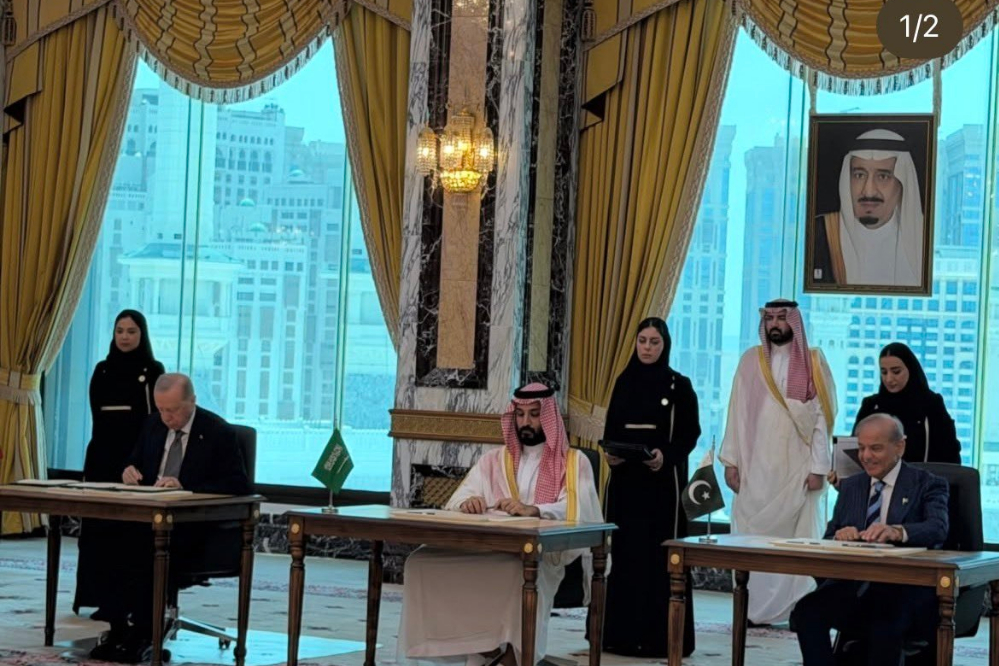
The trilateral pact builds directly on the Strategic Mutual Defence Agreement, a bilateral collective-defense commitment Saudi Arabia and Pakistan signed on September 17, 2025, at Al-Yamamah Palace in Riyadh, which similarly declared that any aggression against either country would be treated as aggression against both. That earlier agreement formalized decades of military cooperation during which Pakistan had provided training and technical assistance to Saudi forces, and Friday’s Mecca agreement effectively extends a comparable mutual-defense commitment to include Türkiye.
What Each Side Brings
The three signatories bring distinct capabilities to the pact: Türkiye has NATO’s second-largest army and a rapidly growing defense industry, Saudi Arabia brings substantial financial resources and strategic geography, and Pakistan brings nuclear weapons capability. Türkiye and Pakistan had separately deepened their own bilateral defense ties in recent years, exchanging warships and training aircraft, while Saudi Arabia agreed in 2023 to purchase Turkish-made drones in what Ankara described at the time as its largest defense export contract.
Nearly a Year in the Making
The Mecca Joint Defence Agreement followed nearly a year of negotiations between the three countries, according to reporting on the pact’s background, meaning the deal predates the most recent escalation phase of the US-Iran war and reflects a longer-term strategic realignment rather than a snap response to any single event.
The Regional Backdrop
The pact was signed against a backdrop of continued regional turmoil, with the Iran-backed Houthis stepping up attacks on Saudi-linked targets and Iran and Oman reportedly nearing an agreement on Strait of Hormuz shipping passage around the same period. The wider war involving Iran, which began in February 2026, has seen Saudi Arabia and other Gulf states come under repeated missile and drone attack, a pattern that has directly shaped the security calculus behind the agreement. Türkiye and Pakistan have avoided significant direct attacks from the conflict themselves but have both expressed concern about calming regional tensions that threaten their own security and economic interests.
“Purely Defensive,” Officials Say
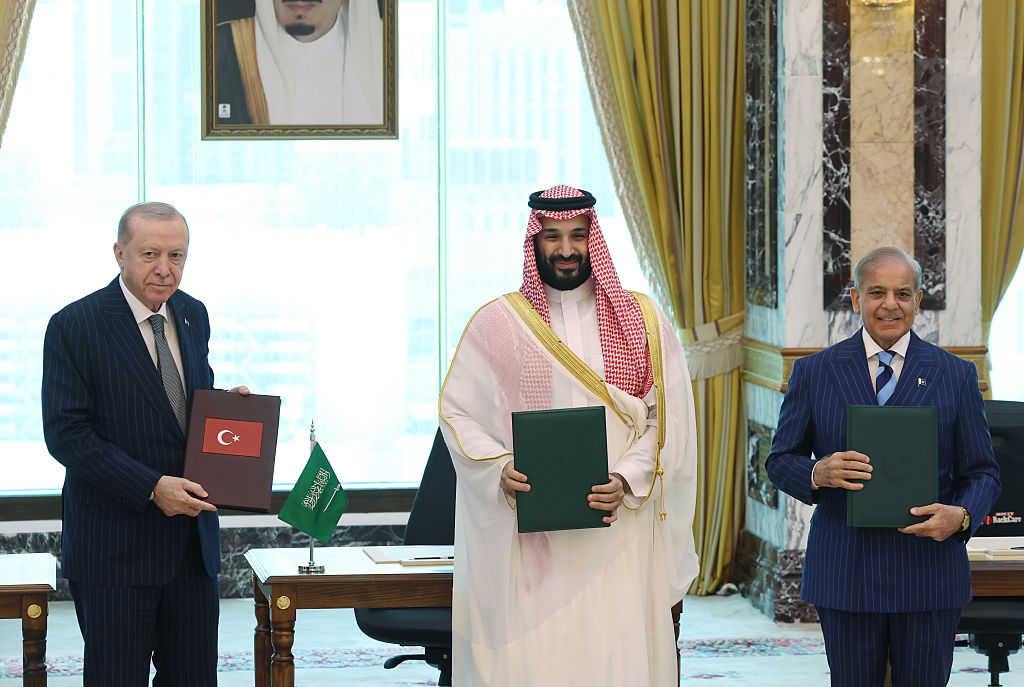
A Turkish government official described the agreement as purely defensive in nature, saying the three sides have pledged mutual support only for defense. Saudi Arabia’s Deputy Minister for Public Diplomacy, Rayed Krimly, said the pact is not a threat to any country in the region, a characterization aimed at pre-empting concerns from other regional actors, particularly Iran and Israel, about the alliance’s intent.
How Analysts Are Reading It
Experts cited by Al Jazeera said the pact will reshape the security architecture of the region, combining Türkiye’s military scale, Saudi Arabia’s financial and geographic weight, and Pakistan’s nuclear deterrent into a single collective framework for the first time. Separately, a Daily Sabah column by editorial coordinator Mehmet Çelik characterized the deal as a new axis of stability, arguing it reflects a deliberate move by the three states to build collective security capacity independent of what the column described as growing uncertainty over the reliability of the United States as a security partner, a characterization reflecting one Turkish commentator’s interpretive framing rather than an official statement from any of the three governments.
Law and Legal Implications
Informed Turkish sources told The New Arab that the defense agreement is based on Article 51 of the UN Charter, which recognizes the inherent right of individual or collective self-defense in the event of an armed attack against a UN member, giving the pact a specific legal grounding under international law similar to that invoked by other collective-defense arrangements such as NATO’s Article 5. Because the full text of the Mecca agreement has not been published in detail, the precise scope of what constitutes a triggering armed attack, and what specific obligations each party would owe the others in response, remain publicly unclear beyond the general mutual-defense principle both joint statements described.
Does the Pact Actually Get Tested
It remains unclear how the collective-defense clause would be triggered and implemented in practice, given that the full text of the agreement, including any specific consultation or response mechanisms, has not been made public. Whether the pact will actually deter further attacks on Saudi Arabia from Iran-backed groups such as the Houthis, or whether it primarily serves a longer-term strategic signaling function, has not been tested by events since the signing. The extent to which this trilateral framework might expand to include other regional states, or whether it remains limited to its three founding signatories, is not yet known. Forensic Times continues to monitor the agreement’s implementation and regional reaction from Iran, Israel, and other Gulf states.
ForensicTimes · forensictimes.com · Global Investigative Journalism on Crime, Justice, and Forensic Science · This report reflects verified open-source and wire reporting current as of publication. © 2026 ForensicTimes. All Rights Reserved.