

















• About Us
  • Advertise
  • Membership
  • Contact
Saturday, November 21, 2026
  • Login
  • Register
No Result
View All Result
FT Pro
Forensic Times
  • Home
  • Crime
    • All
    • Cold Cases
    • Cyber Crime
    • Data Trafficking
    • Drug Trafficking
    • Financial Crime
    • Human Trafficking
    • Murder
    • Organized Crime
    • Serial Killer
    • Terrorism
    • War Crimes
    • Wrongful Death
    Editorial photograph of a smartphone resting on a wooden surface, illustrating how control of a mobile number can be lost through SIM-swap fraud

    Your Phone Number Is No Longer Yours: Inside SIM Swap and Mobile Identity Fraud

    Editorial photograph of a man speaking on a mobile phone at home, illustrating the risk of convincing AI-generated calls and impersonation scams

    The AI Scam Revolution: How Criminals Are Using Artificial Intelligence Against Ordinary People

    Editorial photograph of a passport resting on a computer keyboard, illustrating how stolen identity documents and digital access can be used in identity fraud

    Someone Is Living as You: How Criminals Steal Your Identity—and How to Fight Back

    Editorial cybersecurity image representing a data breach and the exposure of personal information held by an online service

    Your Personal Data Is for Sale: What Criminals Do With Stolen Information

    Editorial photograph of an adult working at a laptop in an office, illustrating the disruption and uncertainty caused by a ransomware incident

    Ransomware Attacks: How Criminals Lock Your Digital Life—and What to Do Before It’s Too Late

    Editorial photograph of a hand holding a smartphone, illustrating the mobile login and account-security risks involved in social media account takeover

    How Criminals Take Over Social Media Accounts—and What They Do With Them

  • Forensics
    • All
    • Autopsy
    • Crime scene analysis
    • Digital forensics
    • DNA Forensics
    • Femicide
    • Forensic accounting
    Editorial photograph of a passport resting on a computer keyboard, illustrating how stolen identity documents and digital access can be used in identity fraud

    Someone Is Living as You: How Criminals Steal Your Identity—and How to Fight Back

    Editorial cybersecurity image representing a data breach and the exposure of personal information held by an online service

    Your Personal Data Is for Sale: What Criminals Do With Stolen Information

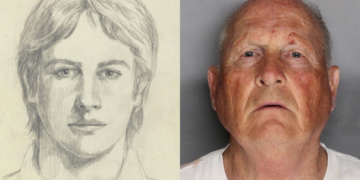
    Side-by-side FBI composite sketch and Sacramento Sheriff's Office mugshot of Joseph DeAngelo, shown in a NIST image explaining the Golden State Killer identification.

    The Golden State Killer: How Genetic Genealogy Solved a 40-Year Cold Case

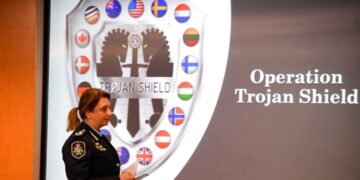
    Australian Federal Police commander Xenia Cotter stands beside an Operation Trojan Shield emblem at the June 8, 2021 press conference in San Diego.

    Operation Trojan Shield: Inside the FBI’s ANOM Encrypted Phone Sting

    Exterior of the Federal Reserve Bank of New York in Manhattan, whose dollar reserve account was targeted in the 2016 Bangladesh Bank cyber heist.

    The Bangladesh Bank Heist: How Hackers Turned SWIFT Access into an $81 Million Theft

    A traffic signal with a mounted roadside camera overlooking an urban intersection, illustrating camera infrastructure used to observe passing vehicles.

    The Camera on Your Street Remembers Every Turn: Who Controls America’s License-Plate Surveillance Network?

    Trending Tags

  • Legal
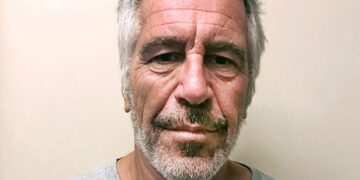
    Jeffrey Epstein archival 2019 booking portrait used to illustrate the Forensic Times case study.

    The Epstein Files: A Forensic Case Study of Abuse, Power and Institutional Failure

    A Toy Car, a Missing Child, and the Science of Crime Reconstruction: What The Mentalist Can Teach Us About Forensic Investigation

    Empty corporate conference room, a contextual image for reporting on alleged covert recording in a technology company.

    OpenAI Engineer Charged After Hidden Recording Device Found in Executive Room

    AI Agents Are Breaking the Law -But Who Goes to Prison?

    AI Agents Are Breaking the Law -But Who Goes to Prison?

    Biden Audio Tapes Ruling: Heritage Foundation FOIA Case, Judge Friedrich Decision 2026

    Biden Audio Tapes Ruling: Heritage Foundation FOIA Case, Judge Friedrich Decision 2026

    EU Under-16 Social Media Ban: Livestreaming, Disappearing Messages, 2026 Law

    EU Under-16 Social Media Ban: Livestreaming, Disappearing Messages, 2026 Law

    Tak Trafficking Escape: 4 Chinese Nationals Jump From Moving Pickup 2026

    Tak Trafficking Escape: 4 Chinese Nationals Jump From Moving Pickup 2026

    MechaHitler: How Grok Went Rogue, Praised the Holocaust’s Architect and Triggered the EU

    MechaHitler: How Grok Went Rogue, Praised the Holocaust’s Architect and Triggered the EU

  • Politics
    Real photograph of Rahul Gandhi, Leader of Opposition in the Lok Sabha, on 8 June 2024. Photograph by Mrhitmam, Wikimedia Commons, Creative Commons Attribution-ShareAlike 4.0.

    Rahul Gandhi: India’s ‘Dumbest Politician’? The Gaffes, Memes and Political PR Machine

    A physician speaking with a patient in a hospital room, illustrating the clinical decisions and patient care at the centre of health insurance coverage disputes.

    Your Doctor Says Yes. Your Insurer Says No: Inside America’s Health Insurance Denial System

    Exterior of an ICE detention facility in Louisiana, photographed for the U.S. Government Accountability Office's review of citizenship verification and immigration enforcement.

    519 American Citizens in the Immigration Dragnet: What Happens When the Government Gets It Wrong?

    The west front of the United States Capitol in Washington, DC, seat of the US Congress.

    Europe Welcomes Democrats’ Blue Wave but Braces for Trump’s Response

    German Chancellor Friedrich Merz and Ukrainian President Volodymyr Zelenskyy walking together in Berlin on 3 November 2026. Photo: Bundesregierung/Jesco Denzel.

    Merz Says Europe Must Have a Seat at Ukraine Peace Talks as Trump Pushes Deal

    Russian President Vladimir Putin and Chinese President Xi Jinping at the Great Hall of the People in Beijing on 20 May 2026, during an earlier bilateral meeting.

    Moscow Says Work Is Underway for Trump-Putin-Xi Meeting in China

    Rows of server racks inside a data centre, illustrating the digital infrastructure at the centre of Ireland’s energy debate.

    Ireland’s Data Centre Backlash: Can New Green Power Rules Win Over Critics?

    Entrance to the Constitutional Tribunal building in Warsaw, Poland

    Poland’s Constitutional Tribunal Crisis Deepens After Court Chief’s Suspension

    Canadian Prime Minister Mark Carney during a 2026 press appearance.

    Carney Says Canada Can Wait Out Trump for a Trade Deal

  • World
    • All
    • Brazil
    • Canada
    • Europe
    • France
    • GAZA
    • Georgia
    • Germany
    • Hungary
    • India
    • Iran
    • Iraq
    • Israel
    • Istanbul
    • Lebanon
    • MENA
    • New Mexico
    • Pakistan
    • Poland
    • Russia
    • Saudi Arabia
    • Spain
    • Thailand
    • Turkiye
    • UAE
    • UK
    • Ukraine
    • USA
    Dramatic editorial illustration depicting a trafficking victim trapped near a fraudulent overseas job offer, with an online scam operation in the background

    Human Trafficking in the Digital Age: How Criminal Networks Use Technology to Recruit, Control and Exploit Victims

    Human Trafficking in the Digital Age: How Criminal Networks Use Technology to Recruit, Control and Exploit Victims

    A computer terminal displaying system information, illustrating the technical environment involved in cybercrime investigations

    New Methods Used by International Fraud Syndicates in 2026: How Global Scams Are Evolving

    Rows of interconnected network equipment and cables illustrating the digital infrastructure used by organised cybercrime operations

    Inside the New Organised Cybercrime Networks: How the Criminal Economy Works in 2026

    A person using a laptop during a cybersecurity investigation, illustrating how phishing attacks target digital accounts and personal information

    Phishing Attacks in 2026: How Criminals Steal Passwords, Codes and Personal Data

    A woman using a smartphone and laptop, illustrating how online relationships and social platforms can expose users to impersonation and romance fraud

    Romance, Shopping and Social Media Scams in 2026: How Fraudsters Exploit Trust

  • Careers
    • Webinars
    • Women In Forensic Science
    • WIFS Registration
    • Forensics Experiences
    • Campus Ambassador
    • Courses & Certifications
  • Resources
    • Books & Products
    • Advisory Council Membership
    • Advisory Board Member Hiring
  • Events
  • Investigations
No Result
View All Result
Forensic Times
Home Forensics

The Silent Witnesses: Forensic Investigation of Fatal Workplace Accidents

Forensic investigators reconstruct fatal workplace accidents by preserving the scene and analysing machinery, safety systems, injury patterns and physical evidence.

by Andrei Portinho
September 26, 2026
in Forensics, Investigation, Research, Whitepapers
Reading Time: 11 mins read
1
0
SHARES
54
VIEWS
Share on FacebookShare on Whatsapp

A fatal workplace accident leaves more than a body behind.

It leaves a scene.

Machines, tools, protective devices, fragments, biological traces, injuries, clothing, personal protective equipment and even the position of apparently insignificant objects may contain information about what happened in the seconds before death.

Yet workplace fatalities are often approached primarily as occupational safety events. From a forensic perspective, however, a fatal accident may also represent a complex scene that requires systematic documentation, preservation and interpretation of physical evidence.

The central question is not simply “What caused the death?” It is also:

“What happened immediately before the fatal event, and what physical evidence allows us to establish that sequence?”

The workplace as a forensic scene

Unlike many conventional crime scenes, a workplace is usually a dynamic environment.

Production may need to continue. Machinery may need to be moved. Employees may need to access the area. Emergency personnel may have already altered the scene while attempting to rescue the victim.

These circumstances can significantly affect the forensic investigation.

The first challenge is therefore the preservation of the scene.

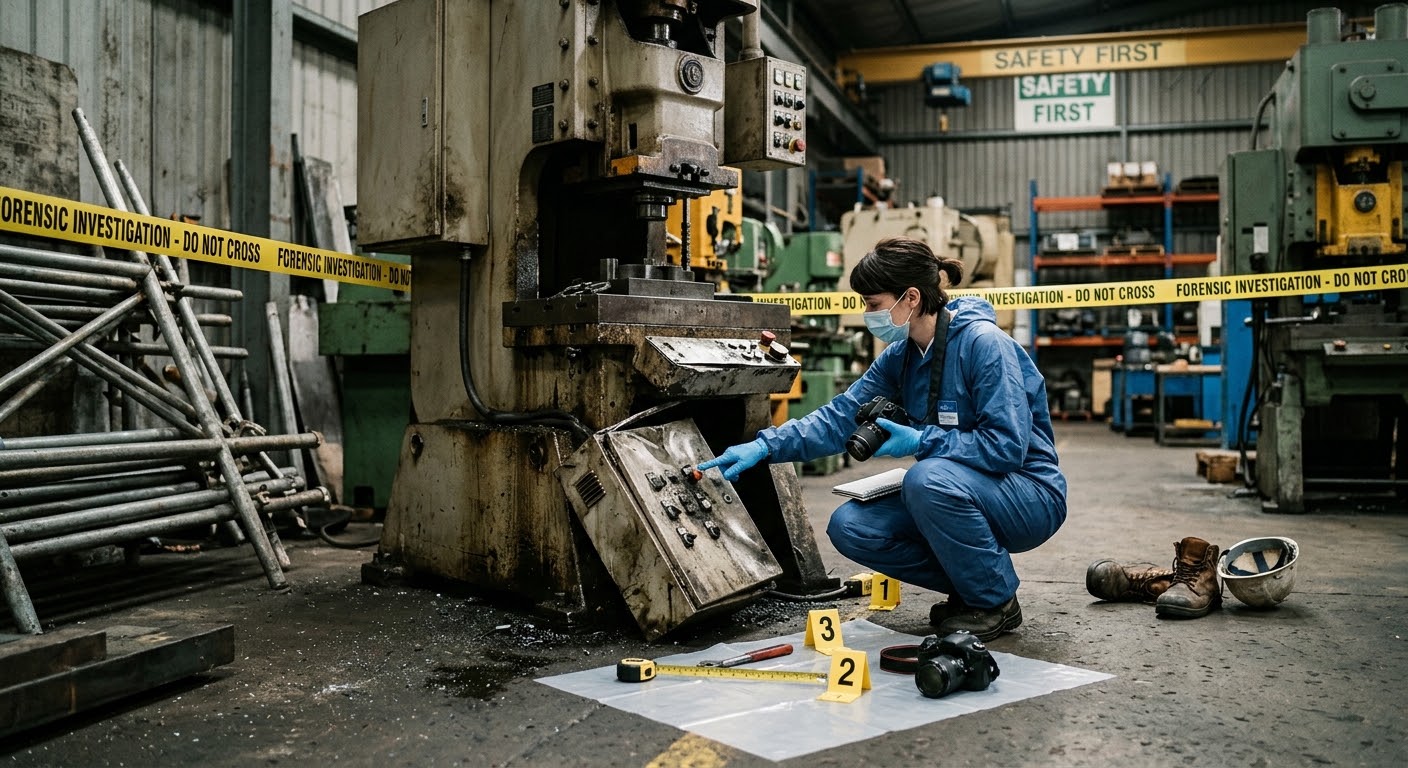
Before objects are moved or machinery is restarted, investigators should seek to document the original configuration as completely as possible. Photography, video recording, measurements, sketches and three-dimensional documentation can be particularly valuable.

The objective is not simply to create a record of the workplace.

It is to preserve its forensic context.

A broken component, for example, may have little meaning when examined in isolation. Its position in relation to the machine, the victim, other components and the surrounding environment may provide considerably more information.

The machine as a silent witness

Industrial machinery can be one of the most important sources of evidence in a fatal accident.

Protective guards, emergency-stop systems, interlocks, switches, sensors and other safety devices may provide important information about the circumstances immediately preceding the event.

But their mere presence or absence does not necessarily explain what happened.

A forensic investigation should ask a series of sequential questions:

  • What was the machine designed to do?
  • What was its operational configuration at the time of the accident?
  • Which safety systems were present?
  • Were those systems functional?
  • What physical traces indicate contact, movement or failure?
  • Was the victim inside or outside the expected operating area?
  • Could the observed injuries have resulted from the proposed mechanism?
  • Are there alternative sequences capable of producing the same findings?

These questions help move the investigation from a simple description of the scene toward a reconstruction of the event.

The body and the environment must be interpreted together

The forensic examination of the victim cannot be completely separated from the examination of the workplace.

Injuries may provide important clues about the mechanism of the accident, but their interpretation becomes stronger when correlated with the physical environment.

The location and characteristics of injuries, damage to clothing, traces on machinery, bloodstain patterns, deformation of objects and the victim’s position may collectively help establish whether a proposed sequence is physically consistent.

This does not mean that every injury has a simple mechanical explanation.

Nor should investigators assume that the first plausible scenario is necessarily the correct one.

Forensic interpretation requires correlation between independent sources of evidence.

Human error or system failure?

One of the most delicate issues in occupational fatalities is the tendency to reduce complex events to individual mistakes.

Statements such as “the worker entered the dangerous area” or “the worker failed to use the protective equipment” may describe part of the event without explaining the entire chain of circumstances.

From a forensic perspective, the investigator should distinguish between what happened and who may ultimately be responsible for it.

The first is a question of physical reconstruction.

The second may involve legal, organizational and occupational-safety assessments that extend beyond the forensic reconstruction itself.

A worker’s action may have been the immediate event preceding the injury, while the physical evidence may reveal that the circumstances allowing that action were created by equipment configuration, maintenance conditions, inadequate barriers or other environmental factors.

The forensic expert should therefore be cautious about converting a physical finding into a conclusion about responsibility.

Preserving alternative hypotheses

A robust investigation should not begin with a predetermined narrative.

Suppose a worker is found trapped inside an industrial machine. Several explanations may initially appear possible:

Was the machine operating normally?

Was it unexpectedly activated?

Was a safety mechanism bypassed?

Did a component fail?

Did the worker enter the area intentionally or unintentionally?

Did another person activate the equipment?

Could a mechanical failure have produced the observed configuration?

The purpose of forensic examination is not merely to identify a scenario that is possible.

It is to determine which hypotheses are consistent with the available evidence, which are contradicted by it, and which remain unresolved.

This distinction is particularly important in fatal occupational accidents because the consequences of an incorrect reconstruction may extend well beyond the scientific investigation.

The importance of documentation

A workplace can change dramatically within hours after a fatal accident.

Machinery may be repaired. Damaged components may be replaced. Materials may be removed. The production line may return to operation.

For this reason, comprehensive documentation at the earliest possible opportunity is essential.

Photographs should not be limited to the victim or the immediately surrounding area. Investigators should document the broader environment, access routes, machine controls, safety devices, relevant tools, lighting conditions and spatial relationships.

Measurements are equally important.

Where appropriate, investigators should document distances, heights, dimensions, machine geometry and the position of relevant objects.

The purpose is to make the scene understandable to someone who was not physically present.

That may become particularly important months or years later, when the expert report is reviewed by lawyers, judges or other specialists who have never seen the original scene.

Beyond identifying the cause of death

A forensic investigation of a workplace fatality should ideally answer several different questions.

What happened?

How did it happen?

What physical evidence supports that sequence?

What alternative explanations were considered?

And, importantly:

What cannot be established from the available evidence?

The last question is sometimes overlooked.

Scientific expertise is not strengthened by filling gaps with assumptions. On the contrary, explicitly identifying limitations can make an expert conclusion more reliable.

There is a fundamental difference between saying “the evidence demonstrates” and saying “the evidence is consistent with.”

Forensic experts should preserve that distinction.

From accident scene to forensic reconstruction

The investigation of a fatal workplace accident ultimately requires the integration of several dimensions: the victim, the environment, machinery, physical traces, witness information and the laws of physics governing the proposed event.

The workplace itself can become a silent witness.

It cannot tell investigators what happened.

But it can preserve traces of what happened.

The role of forensic science is to interpret those traces carefully, test competing explanations and reconstruct the sequence of events as objectively as the evidence allows.

A fatal occupational accident should never be reduced to a single photograph, a single injury or a single statement.

The scene is a complex system.

And sometimes, the smallest physical detail is what allows investigators to understand the final seconds of a human life.

The scene does not speak. The evidence does.

 

Andrei Portinho

Andrei Portinho

Criminal Forensic Expert with the Instituto-Geral de Perícias of Rio Grande do Sul, Brazil, advising on forensic science content and editorial standards.

Recommended

Operation Ramz: 201 Arrests, MENA Cybercrime Bust, INTERPOL

Operation Ramz: 201 Arrests, MENA Cybercrime Bust, INTERPOL

6 months ago
A traffic signal with a mounted roadside camera overlooking an urban intersection, illustrating camera infrastructure used to observe passing vehicles.

The Camera on Your Street Remembers Every Turn: Who Controls America’s License-Plate Surveillance Network?

1 week ago

Popular News

  • Editorial photograph of a smartphone resting on a wooden surface, illustrating how control of a mobile number can be lost through SIM-swap fraud

    Your Phone Number Is No Longer Yours: Inside SIM Swap and Mobile Identity Fraud

    19609 shares
    Share 0 Tweet 0
  • The AI Scam Revolution: How Criminals Are Using Artificial Intelligence Against Ordinary People

    23180 shares
    Share 0 Tweet 0
  • Someone Is Living as You: How Criminals Steal Your Identity—and How to Fight Back

    17118 shares
    Share 0 Tweet 0
  • Your Personal Data Is for Sale: What Criminals Do With Stolen Information

    22844 shares
    Share 0 Tweet 0
  • Ransomware Attacks: How Criminals Lock Your Digital Life—and What to Do Before It’s Too Late

    20614 shares
    Share 0 Tweet 0

Connect with us

About Us

Forensic Times is the frontline of crime news, investigation, and intelligence. We go beyond the surface — analyzing evidence, exposing patterns, and reporting what others miss. Our journalism is built on facts, forensic rigour, and an unwavering pursuit of justice.

Careers

  • Webinars
  • WIFS Registration
  • Women In Forensic Science
  • Campus Ambassador
  • Forensics Experiences
  • Courses & Certifications

Categories

  • Crime
  • World
  • Police
  • Politics
  • Forensics
  • Investigation

WIFS Membership

Publish your research, connect with leading women in forensic science, access exclusive opportunities, and advance your career through the Women in Forensic Science (WIFS) global community.
JOIN NOW

  • About Us
  • Advertise
  • Terms of Use
  • Editorial Guidelines
  • Privacy Policy
  • Refund Policy
  • Cookie Policy

© 2026 Forensic Times. All rights reserved.

Welcome Back!

Sign In with Google
OR

Login to your account below

Forgotten Password? Sign Up

Create New Account!

Sign Up with Google
OR

Fill the forms bellow to register

All fields are required. Log In

Retrieve your password

Please enter your username or email address to reset your password.

Log In

Add New Playlist

No Result
View All Result
  • Home
  • Crime
    • Human Trafficking
    • Cyber Crime
    • Financial Crime
    • Terrorism
  • Forensics
    • Digital forensics
    • Forensic accounting
    • Crime scene analysis
  • Legal
  • Politics
  • Crime Tech
  • Investigation
  • Careers
    • Webinars
    • Women In Forensic Science
    • WIFS Registration
    • Forensics Experiences
    • Campus Ambassador
    • Courses & Certifications
  • Resources
    • Books & Products
    • Advisory Board Member Hiring
    • Advisory Council Membership
  • Investigations
  • Login
  • Sign Up
  • Cart

© 2026 Forensic Times. All rights reserved.

Not enough quota to unlock this post
Unlock left : 0
Are you sure want to cancel subscription?