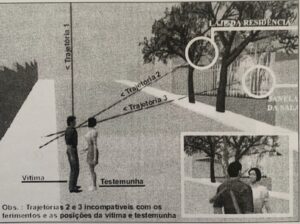
Crime reconstruction occupies a unique position within forensic science. Unlike many forensic examinations that focus primarily on physical traces, reconstruction seeks to understand how an event could have occurred by integrating physical evidence, spatial relationships, scientific principles, witness accounts and other elements contained in the case file.
In this context, one question is particularly sensitive: should the accused person participate in the reconstruction of the alleged crime?
The answer cannot be reduced to a simple “yes” or “no.” It requires an understanding of the relationship between forensic methodology, criminal procedure and fundamental rights.
Reconstruction is not a reenactment
The expression “crime reconstruction” can sometimes create the impression that investigators are simply asking someone to reproduce what happened.
Scientifically, however, reconstruction is much more than a reenactment.
Its purpose is to test hypotheses concerning the dynamics of an event. The forensic expert may analyze trajectories, positions, distances, visibility, movements, timing, physical limitations and the compatibility between different pieces of evidence.
The central question is not necessarily “Did the accused do it this way?”
It is often:
“Is the proposed sequence of events physically and scientifically compatible with the evidence?”
This distinction is fundamental.
A scientifically conducted reconstruction should not become an exercise designed to confirm a previously established investigative theory. Its purpose should be to test hypotheses — including hypotheses favorable to the defense.
The Brazilian legal framework
In Brazil, the Criminal Procedure Code provides, in Article 7, that the police authority may conduct a simulated reproduction of the facts in order to verify whether an offense could have been committed in a particular manner, provided that the procedure does not violate morality or public order.
The provision is relatively concise. The more complex question arises when the reconstruction involves the person suspected or accused of the crime.
Participation may provide potentially valuable information. The accused may demonstrate a movement, indicate a position, reproduce a sequence or provide information concerning the circumstances of the event.
At the same time, that participation can potentially produce information with evidentiary consequences.
This creates a fundamental tension:
the forensic value of participation versus the individual’s protection against self-incrimination.
The right to remain silent does not disappear at the crime scene
The privilege against self-incrimination — commonly expressed through the principle nemo tenetur se detegere — establishes an important boundary for criminal investigations.
An accused person should not be compelled to actively contribute to the production of evidence against himself merely because the information could be useful to the investigation.
Brazilian jurisprudence has recognized this distinction. The Supreme Federal Court has held that the alleged perpetrator cannot be compelled to participate in a simulated reproduction of the crime. The issue has also appeared in cases involving the admissibility and evidentiary value of reconstruction when the accused did not participate.
This does not mean that a reconstruction cannot be performed without the accused.
Quite the opposite.
A reconstruction can — and frequently should — be based on the objective evidence already available.
The accused’s absence does not necessarily invalidate the reconstruction
One important misconception is that the absence of the accused automatically makes a reconstruction scientifically or legally useless.
It does not.
A forensic reconstruction may be developed from:
- crime-scene documentation;
- photographs and videos;
- bloodstain patterns;
- ballistic evidence;
- biological evidence;
- fingerprints and other traces;
- measurements and spatial data;
- autopsy findings;
- medical records;
- digital evidence;
- witness statements;
- surveillance footage;
- environmental conditions; and
- other scientifically relevant information.
The reconstruction should therefore be understood as an evidence-based analytical process, rather than as a performance dependent upon the accused’s physical participation.
Recent Brazilian case law also illustrates that courts may evaluate whether a reconstruction is actually necessary and relevant to resolving disputed aspects of the case. In one recent decision, the Superior Court of Justice discussed a defense request for reconstruction and emphasized the technical character of the procedure and its relationship to unresolved aspects of the event.
Participation can be useful — when it is voluntary
None of this means that the accused should never participate.
A voluntary and properly safeguarded participation may have significant forensic value.
For example, the accused may demonstrate a movement that investigators could not otherwise reconstruct, clarify a disputed position, or provide information allowing the expert to test the physical plausibility of competing versions.
But there is an essential distinction between voluntary participation and compelled participation.
From a forensic perspective, the expert should also recognize that the accused is not merely another source of physical evidence.
The accused is a participant in a criminal proceeding who possesses fundamental procedural rights.
Therefore, scientific methodology cannot be separated from the legal framework governing the acquisition of evidence.
Reconstruction should test hypotheses, not manufacture certainty
Perhaps the greatest danger in crime reconstruction is confirmation bias.
If investigators begin with the assumption that a particular person committed the crime in a particular manner, the reconstruction may inadvertently become an exercise in finding physical elements that support that assumption.
A rigorous reconstruction should work differently.
It should ask:
What does the evidence demonstrate?
What does it merely suggest?
What remains uncertain?
Which competing hypotheses remain physically possible?
And, perhaps most importantly:
What evidence could falsify the proposed reconstruction?
This approach transforms reconstruction from a demonstrative exercise into a genuine forensic examination.
The defense must also be part of the scientific equation
The reconstruction of a crime should not be conceived exclusively as an investigative tool for the prosecution.
Its methodology can equally serve the defense.
If a prosecution hypothesis is physically impossible, inconsistent with the scene or incompatible with established scientific evidence, reconstruction may reveal that contradiction.
In this sense, reconstruction can contribute directly to the right to a full defense.
The forensic expert’s role is not to determine guilt or innocence. It is to provide scientifically grounded information that allows the justice system to evaluate competing explanations of an event.
That responsibility becomes particularly important when the reconstruction concerns the accused’s own movements or actions.
A multidisciplinary problem
The participation of the accused in crime reconstruction therefore lies at the intersection of several disciplines:
forensic science, criminal procedure, evidence law, human rights and investigative methodology.
The solution cannot come exclusively from forensic science, nor exclusively from legal doctrine.
Forensic practitioners need to understand the legal limits of their examination.
Legal professionals need to understand what reconstruction can — and cannot — scientifically establish.
And investigators need to recognize that the search for truth cannot be separated from the procedural guarantees that legitimize the criminal justice system.
From reconstruction to scientific reconstruction
The future of crime reconstruction should move beyond the traditional idea of “re-enacting” an event.
Modern reconstruction increasingly incorporates three-dimensional scene documentation, photogrammetry, laser scanning, video analysis, biomechanical assessment, digital evidence and computational modeling.
These technologies offer enormous potential.
But technology does not eliminate the fundamental question:
What is the evidentiary basis of the reconstruction?
A sophisticated 3D model can still reproduce an incorrect investigative assumption.
A highly precise simulation can still be based on incomplete data.
Scientific reconstruction therefore requires not only technological sophistication, but also methodological transparency, reproducibility and awareness of uncertainty.
Conclusion
The participation of the accused in crime reconstruction should never be treated as a purely operational question.
It is simultaneously a forensic, procedural and constitutional issue.
The accused may voluntarily contribute to the reconstruction, and that participation can sometimes provide valuable information. However, the protection against self-incrimination establishes an important limit: the forensic investigation cannot transform the accused into a compulsory instrument for producing evidence against himself.
At the same time, the absence of the accused does not prevent a scientifically rigorous reconstruction.
The strongest reconstruction is not necessarily the one in which the accused participates.
It is the one in which the evidence is capable of supporting, challenging or falsifying competing hypotheses — regardless of who benefits from the result.
That is where forensic science meets due process.
And that is where crime reconstruction can fulfill its most important function: not merely recreating a story, but scientifically testing whether that story could actually have happened.
By Andrei Portinho
Criminal Expert | Forensic Specialist | Professor of Forensic Sciences | Brazil