Americans reported more than 20 billion dollars in fraud losses to the FBI last year. Fabricated crypto platforms now account for the single largest share of it.
Table of Contents
- Pig Butchering and Crypto Investment Fraud
- Ponzi Operations and Unregistered Investment Funds
- Advance-Fee, Lottery, and Imposter Fraud
- Business Email Compromise and Mule Account Networks
- Identity Theft and Fraudulent Financing
- Forensic Analysis and Intelligence
- Why Losses Keep Accelerating Year Over Year
1. Pig Butchering and Crypto Investment Fraud

Risk Score: 5/5
The Offense
Pig butchering is not a hack. It is a con built entirely on patience: a stranger builds a relationship with a target for weeks, sometimes months, before steering that trust toward a fabricated cryptocurrency platform. The name comes from the method, fatten the victim with fake early gains, then take everything at once.
Red Flags
- An unsolicited contact, often a wrong-number text or a dating app match, that pivots to talk of investing
- A trading platform not registered with the SEC or a recognized exchange
- A dashboard showing steady, compounding gains with no losing days, ever
- A withdrawal request suddenly met with a new fee, tax, or technical delay
Modus Operandi
Nothing about this con moves fast. The relationship comes first, warm, attentive, often framed as romantic. Only once trust is set does the counterpart introduce a trading app dressed up to look legitimate, one that shows real-looking returns on a modest first deposit. Small withdrawals go through, on purpose, to prove the platform “works.” Larger deposits follow. Then the account freezes, a fee appears from nowhere, and the counterpart vanishes. Americans lost more than 11 billion dollars to crypto fraud last year, and victims 60 and older absorbed the largest single share of it.
Law
Federal prosecutors charge this as wire fraud under 18 U.S.C. Section 1343 and conspiracy to launder money under Section 1956, both carrying decades of potential prison time. Coordinated FBI and Secret Service operations have already produced dozens of arrests tied to compounds running this exact playbook against American victims.
Prevention
Any investment pitch that arrives through a personal relationship, rather than one you went looking for, deserves more scrutiny, not less.
What to Do
Confirm the platform’s registration with the SEC or FINRA before a single dollar moves. If funds are already gone, call your bank or exchange immediately to flag the transfer, then file with the FBI’s Internet Crime Complaint Center at ic3.gov.
2. Ponzi Operations and Unregistered Investment Funds
Risk Score: 4/5
The Offense
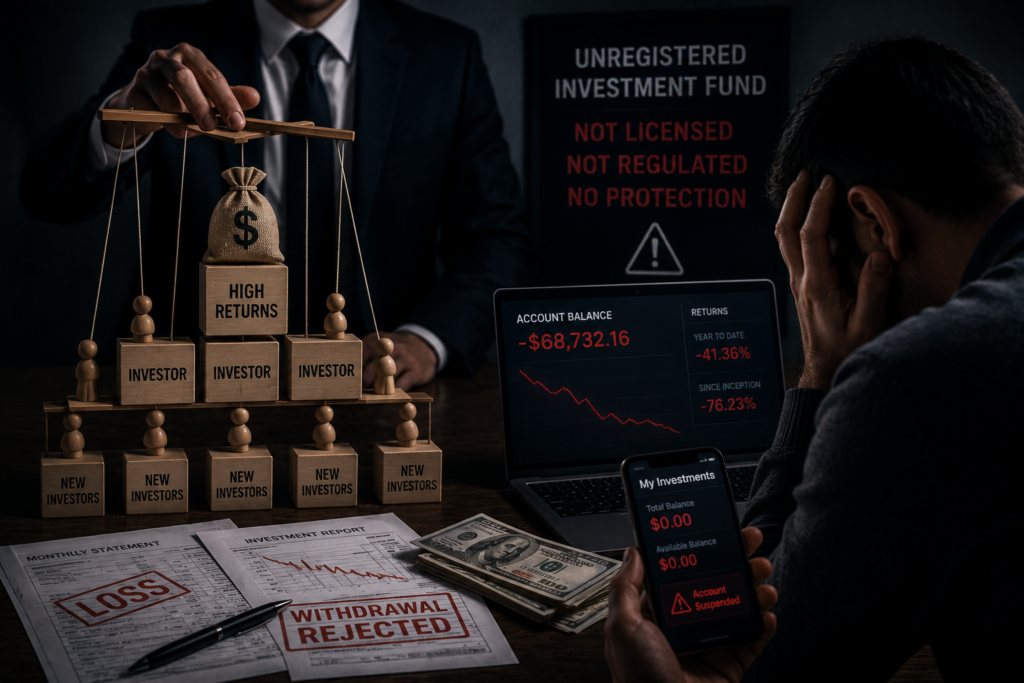
A Ponzi operation pays yesterday’s investors with today’s deposits, not profit. It survives only as long as new money keeps arriving, and it collapses the moment recruitment slows. Any fund promising a fixed, unusually high return with no registered, verifiable strategy behind it fits this exact profile.
Red Flags
- A guaranteed or fixed high return, regardless of what the market is doing
- Pressure to bring in friends or family as new investors
- Vague, unverifiable answers about how the fund actually makes money
- No registration with the SEC or a state securities regulator
Modus Operandi
Operators present themselves as boutique fund managers, often recruiting through private groups, churches, or investment clubs, promising monthly returns no legitimate fund could sustain. Early investors get paid on time, and they do the recruiting for free, bragging to their own circle. The fund needs an ever-expanding base of fresh capital to keep the illusion running, and it ends one of two ways: recruitment dries up, or the operator empties the account and disappears.
Law
This is prosecuted as securities fraud under the Securities Exchange Act of 1934 and as wire fraud under 18 U.S.C. Section 1343. The SEC runs civil enforcement and asset freezes alongside any criminal case, and soliciting investment without registration is its own separate violation.
Prevention
A return that never moves with the market is, by itself, reason enough to walk away, no matter who is selling it.
What to Do
Check the operator’s registration through the SEC’s EDGAR database or your state securities regulator before investing a cent. If you’re already in and payouts have gone erratic, demand full documentation of the underlying trades, then report to the SEC and the FBI immediately.
3. Advance-Fee, Lottery, and Imposter Fraud
Risk Score: 3/5
The Offense
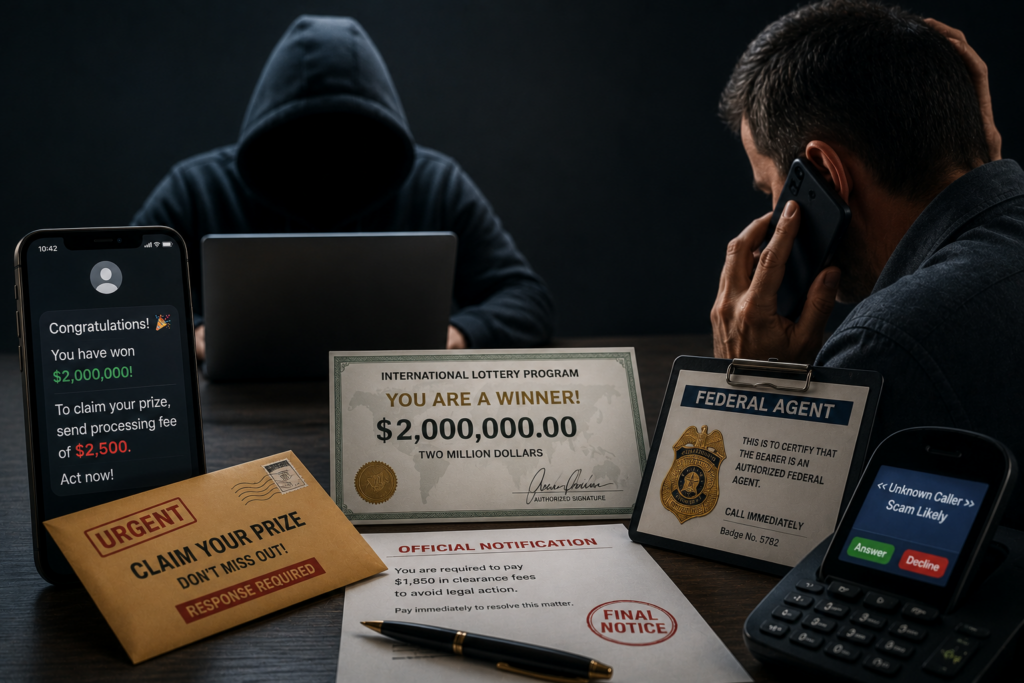
An advance-fee con demands an upfront payment, dressed up as a tax, customs charge, or processing fee, to unlock a prize, inheritance, or loan that was never real to begin with. Imposter fraud runs the same play from a different angle, a caller posing as a government agent, a relative, or a trusted business to pull money directly.
Red Flags
- Notice of a prize, inheritance, or loan approval for something you never entered or applied for
- A request to pay a fee before any funds can be released, especially by gift card or wire
- A caller claiming to be the IRS, Social Security, or a relative in sudden distress
- Rising pressure and urgency the moment the first payment lands
Modus Operandi
It arrives by email, text, or phone call, announcing an unexpected windfall or an emergency, and asks for personal and payment details on the spot. Once trust is established, a fee gets requested to cover some invented administrative cost. Pay it, and a bigger one follows. The cycle runs until the victim refuses to pay again or has nothing left. Imposter fraud is now the single most reported category to the FTC, generating well over a million complaints last year.
Law
Prosecutors charge this as mail or wire fraud under 18 U.S.C. Sections 1341 and 1343, and the FTC pursues civil action under the FTC Act for deceptive practices. Investigators treat a gift card or wire transfer demand as close to a definitive fraud signal on its own.
Prevention
No legitimate prize, agency, or lender ever demands an upfront fee paid by gift card or wire. Treat that as a fixed rule, not a judgment call.
What to Do
Do not respond, and do not send anything. Report it at reportfraud.ftc.gov, and if a payment already went out, file with the FBI’s IC3, including the sender’s details and any account information given.
4. Business Email Compromise and Mule Account Networks
Risk Score: 4/5
The Offense
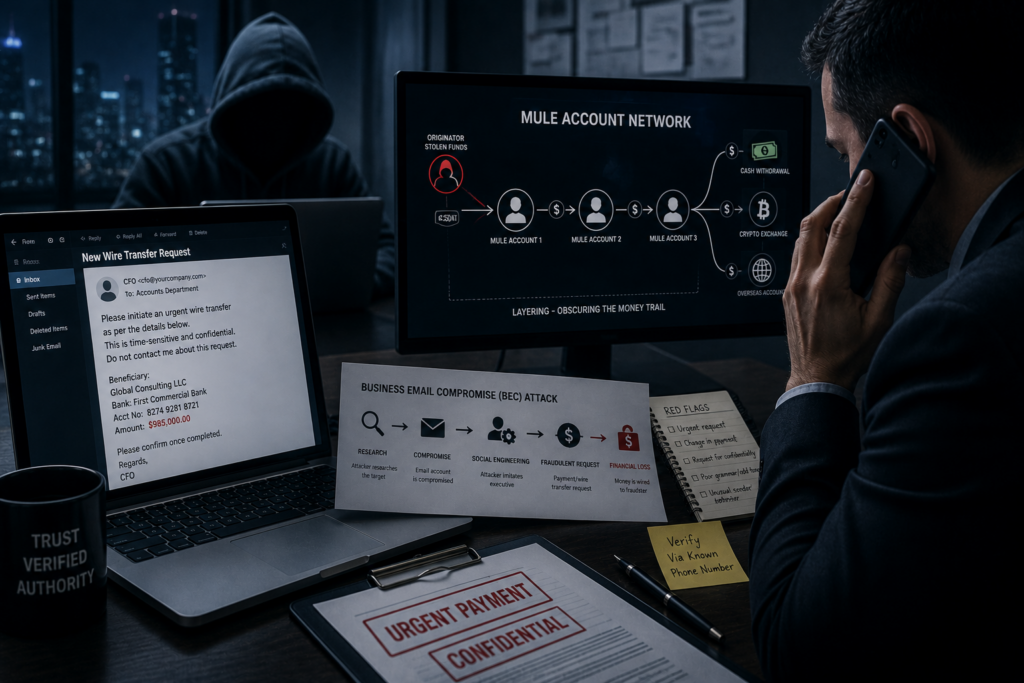
Business email compromise is not really a hacking story, it is a laundering story with a phishing email at the front of it. A fraudulent invoice diverts a payment into a mule account, one built specifically to receive stolen funds and move them along before anyone notices.
Red Flags
- A supplier payment suddenly redirected to a new or personal account
- A beneficiary name that does not match the actual supplier
- Funds that leave a receiving account almost the moment they arrive
- A payment request built around urgency, discouraging the usual verification call
Modus Operandi
After spoofing or compromising a business email account, the attacker sends a finance team a payment instruction that looks routine. The receiving account is a mule, opened with a stolen or synthetic identity, built for one purpose: take the money and forward it fast, often split across several smaller transfers to dodge a single large-transaction alert. Business email compromise losses to the FBI crossed one billion dollars in a single year for the first time recently, and the number has only climbed since.
Law
The underlying fraud falls under 18 U.S.C. Section 1343, wire fraud, and moving the proceeds through mule accounts falls under Section 1956, money laundering. Both the fraudster and a knowing mule account holder can face separate federal charges, and banks are required to flag accounts showing this pattern through suspicious activity reports.
Prevention
Any change to a supplier’s bank details needs a phone call to a number you already have on file, never one from the email making the request.
What to Do
Call your bank immediately to attempt a recall, speed is everything here. Report to your bank’s fraud department and the FBI’s IC3, and hold onto every email header and transaction record for investigators.
5. Identity Theft and Fraudulent Financing

Risk Score: 3/5
The Offense
This one steals a person, not a password. Your Social Security number, tax ID, or financial documents get used to open credit, file a tax return, or secure a loan in your name, without you knowing, until the debt or the delayed refund lands on you.
Red Flags
- Credit inquiries or new accounts on your report that you never opened
- An IRS notice about a return you never filed
- Mail, bills, or statements that simply stop arriving
- Credit denials with no explanation tied to your actual financial history
Modus Operandi
Fraudsters get identifying information through phishing, breach data, or a purchase on a stolen-records market, then use it to apply for credit, a loan, or a refund with a lender or agency that skips real verification. The money moves out fast, and the victim finds out only once a lender, the IRS, or a credit bureau finally calls. Identity fraud losses in the US run into the tens of billions annually.
Law
This is prosecuted under 18 U.S.C. Section 1028, aggravated identity theft, which carries a mandatory consecutive prison term when paired with another federal felony like wire or bank fraud. Lenders face their own exposure when weak verification let the fraud through in the first place.
Prevention
Check your credit file across all three bureaus regularly, and freeze it. A freeze is still the single strongest wall against a new account opened in your name.
What to Do
Notify your bank, all three credit bureaus, and the IRS the moment you spot unauthorized activity. File at IdentityTheft.gov and with local police to put it on the record.
Forensic Analysis and Intelligence
Strip away the surface story in each of these five, and the same choke point shows up every time: the money has to pass through a bank or an exchange to become usable, and that is exactly where investigators now train their attention. Flagging mule account behavior, rapid transfers in and out, deposits structured to duck reporting thresholds, accounts opened right before a big transaction, matters as much now as catching the original lie. The FBI’s IC3 and the FTC’s Consumer Sentinel Network cross-reference reports to turn scattered victim complaints into a single traceable network, and AI-driven fraud, already responsible for more than 890 million dollars in reported losses last year, is being used both to run these operations and to slip past the identity checks meant to stop them.
Why Losses Keep Accelerating Year Over Year
US fraud losses climbed from roughly 5.8 billion dollars in 2021 to more than 20 billion last year, and federal regulators no longer call that a spike, they call it a trend line. Scam operations now run at industrial scale, AI has made convincing fake documents and voices cheap to produce, and money still moves faster than most victims can recognize they have been had. Enforcement has not caught up, even as agencies deepen cross-border cooperation. The real question is whether reporting systems and bank-level detection close that gap before the number climbs again.
ForensicTimes · forensictimes.com · Global Investigative Journalism on Crime, Justice, and Forensic Science · This report reflects verified open-source and wire reporting current as of publication. © 2026 ForensicTimes. All Rights Reserved.