























• About Us
  • Advertise
  • Membership
  • Contact
Wednesday, November 18, 2026
  • Login
  • Register
No Result
View All Result
FT Pro
Forensic Times
  • Home
  • Crime
    • All
    • Cold Cases
    • Cyber Crime
    • Data Trafficking
    • Drug Trafficking
    • Financial Crime
    • Human Trafficking
    • Murder
    • Organized Crime
    • Serial Killer
    • Terrorism
    • War Crimes
    • Wrongful Death
    A computer terminal displaying system information, illustrating the technical environment involved in cybercrime investigations

    Human Trafficking in the Digital Age: How Criminal Networks Use Technology to Recruit, Control and Exploit Victims

    Human Trafficking in the Digital Age: How Criminal Networks Use Technology to Recruit, Control and Exploit Victims

    A computer terminal displaying system information, illustrating the technical environment involved in cybercrime investigations

    New Methods Used by International Fraud Syndicates in 2026: How Global Scams Are Evolving

    Rows of interconnected network equipment and cables illustrating the digital infrastructure used by organised cybercrime operations

    Inside the New Organised Cybercrime Networks: How the Criminal Economy Works in 2026

    A person using a laptop during a cybersecurity investigation, illustrating how phishing attacks target digital accounts and personal information

    Phishing Attacks in 2026: How Criminals Steal Passwords, Codes and Personal Data

    A woman using a smartphone and laptop, illustrating how online relationships and social platforms can expose users to impersonation and romance fraud

    Romance, Shopping and Social Media Scams in 2026: How Fraudsters Exploit Trust

  • Forensics
    • All
    • Autopsy
    • Crime scene analysis
    • Digital forensics
    • DNA Forensics
    • Femicide
    • Forensic accounting
    Side-by-side FBI composite sketch and Sacramento Sheriff's Office mugshot of Joseph DeAngelo, shown in a NIST image explaining the Golden State Killer identification.

    The Golden State Killer: How Genetic Genealogy Solved a 40-Year Cold Case

    Australian Federal Police commander Xenia Cotter stands beside an Operation Trojan Shield emblem at the June 8, 2021 press conference in San Diego.

    Operation Trojan Shield: Inside the FBI’s ANOM Encrypted Phone Sting

    Exterior of the Federal Reserve Bank of New York in Manhattan, whose dollar reserve account was targeted in the 2016 Bangladesh Bank cyber heist.

    The Bangladesh Bank Heist: How Hackers Turned SWIFT Access into an $81 Million Theft

    A traffic signal with a mounted roadside camera overlooking an urban intersection, illustrating camera infrastructure used to observe passing vehicles.

    The Camera on Your Street Remembers Every Turn: Who Controls America’s License-Plate Surveillance Network?

    A fixed CCTV camera mounted overlooking an urban street, illustrating the surveillance images that may be used in facial-recognition investigations.

    The Wrong Face in the File: When Facial Recognition Turns an Investigative Lead Into an Arrest

    A Toy Car, a Missing Child, and the Science of Crime Reconstruction: What The Mentalist Can Teach Us About Forensic Investigation

    Trending Tags

  • Legal
    Jeffrey Epstein archival 2019 booking portrait used to illustrate the Forensic Times case study.

    The Epstein Files: A Forensic Case Study of Abuse, Power and Institutional Failure

    A Toy Car, a Missing Child, and the Science of Crime Reconstruction: What The Mentalist Can Teach Us About Forensic Investigation

    Empty corporate conference room, a contextual image for reporting on alleged covert recording in a technology company.

    OpenAI Engineer Charged After Hidden Recording Device Found in Executive Room

    AI Agents Are Breaking the Law -But Who Goes to Prison?

    AI Agents Are Breaking the Law -But Who Goes to Prison?

    Biden Audio Tapes Ruling: Heritage Foundation FOIA Case, Judge Friedrich Decision 2026

    Biden Audio Tapes Ruling: Heritage Foundation FOIA Case, Judge Friedrich Decision 2026

    EU Under-16 Social Media Ban: Livestreaming, Disappearing Messages, 2026 Law

    EU Under-16 Social Media Ban: Livestreaming, Disappearing Messages, 2026 Law

    Tak Trafficking Escape: 4 Chinese Nationals Jump From Moving Pickup 2026

    Tak Trafficking Escape: 4 Chinese Nationals Jump From Moving Pickup 2026

    MechaHitler: How Grok Went Rogue, Praised the Holocaust’s Architect and Triggered the EU

    MechaHitler: How Grok Went Rogue, Praised the Holocaust’s Architect and Triggered the EU

  • Politics
    Real photograph of Rahul Gandhi, Leader of Opposition in the Lok Sabha, on 8 June 2024. Photograph by Mrhitmam, Wikimedia Commons, Creative Commons Attribution-ShareAlike 4.0.

    Rahul Gandhi: India’s ‘Dumbest Politician’? The Gaffes, Memes and Political PR Machine

    A physician speaking with a patient in a hospital room, illustrating the clinical decisions and patient care at the centre of health insurance coverage disputes.

    Your Doctor Says Yes. Your Insurer Says No: Inside America’s Health Insurance Denial System

    Exterior of an ICE detention facility in Louisiana, photographed for the U.S. Government Accountability Office's review of citizenship verification and immigration enforcement.

    519 American Citizens in the Immigration Dragnet: What Happens When the Government Gets It Wrong?

    The west front of the United States Capitol in Washington, DC, seat of the US Congress.

    Europe Welcomes Democrats’ Blue Wave but Braces for Trump’s Response

    German Chancellor Friedrich Merz and Ukrainian President Volodymyr Zelenskyy walking together in Berlin on 3 November 2026. Photo: Bundesregierung/Jesco Denzel.

    Merz Says Europe Must Have a Seat at Ukraine Peace Talks as Trump Pushes Deal

    Russian President Vladimir Putin and Chinese President Xi Jinping at the Great Hall of the People in Beijing on 20 May 2026, during an earlier bilateral meeting.

    Moscow Says Work Is Underway for Trump-Putin-Xi Meeting in China

    Rows of server racks inside a data centre, illustrating the digital infrastructure at the centre of Ireland’s energy debate.

    Ireland’s Data Centre Backlash: Can New Green Power Rules Win Over Critics?

    Entrance to the Constitutional Tribunal building in Warsaw, Poland

    Poland’s Constitutional Tribunal Crisis Deepens After Court Chief’s Suspension

    Canadian Prime Minister Mark Carney during a 2026 press appearance.

    Carney Says Canada Can Wait Out Trump for a Trade Deal

  • World
    • All
    • Brazil
    • Canada
    • Europe
    • France
    • GAZA
    • Georgia
    • Germany
    • Hungary
    • India
    • Iran
    • Iraq
    • Israel
    • Istanbul
    • Lebanon
    • MENA
    • New Mexico
    • Pakistan
    • Poland
    • Russia
    • Saudi Arabia
    • Spain
    • Thailand
    • Turkiye
    • UAE
    • UK
    • Ukraine
    • USA
    A computer terminal displaying system information, illustrating the technical environment involved in cybercrime investigations

    Human Trafficking in the Digital Age: How Criminal Networks Use Technology to Recruit, Control and Exploit Victims

    Human Trafficking in the Digital Age: How Criminal Networks Use Technology to Recruit, Control and Exploit Victims

    A computer terminal displaying system information, illustrating the technical environment involved in cybercrime investigations

    New Methods Used by International Fraud Syndicates in 2026: How Global Scams Are Evolving

    Rows of interconnected network equipment and cables illustrating the digital infrastructure used by organised cybercrime operations

    Inside the New Organised Cybercrime Networks: How the Criminal Economy Works in 2026

    A person using a laptop during a cybersecurity investigation, illustrating how phishing attacks target digital accounts and personal information

    Phishing Attacks in 2026: How Criminals Steal Passwords, Codes and Personal Data

    A woman using a smartphone and laptop, illustrating how online relationships and social platforms can expose users to impersonation and romance fraud

    Romance, Shopping and Social Media Scams in 2026: How Fraudsters Exploit Trust

  • Careers
    • Webinars
    • Women In Forensic Science
    • WIFS Registration
    • Forensics Experiences
    • Campus Ambassador
    • Courses & Certifications
  • Resources
    • Books & Products
    • Advisory Council Membership
    • Advisory Board Member Hiring
  • Events
  • Investigations
No Result
View All Result
Forensic Times
Home Crime Drug Trafficking

UAE Busts Drug Ring: 24 Criminals, RAK Dubai Abu Dhabi Ajman

UAE narcotics authorities dismantled a 24-member drug ring spanning Ras Al Khaimah, Dubai, Abu Dhabi, and Ajman - directed by a ringleader based outside the country. The full forensic and legal anatomy of the multi-emirate operation.

by Forensic Times Desk
June 16, 2026
in Drug Trafficking, Crime, UAE
Reading Time: 12 mins read
7.8k
UAE Busts Drug Ring: 24 Criminals, RAK Dubai Abu Dhabi Ajman
17.6k
SHARES
609k
VIEWS
Share on FacebookShare on Whatsapp

Ras Al Khaimah · Dubai · Abu Dhabi · Ajman · UAE ·  |  ForensicTimes.com  |  Drug Trafficking · Organised Crime · UAE Law

Table of Contents

  1. June 16, 2026: The Announcement and the Scale
  2. The Tip: How It Started and Who Was Watching
  3. Phase One: The First Two Arrests and the Confession
  4. Phase Two: Eleven More, Linked to the Ringleader Abroad
  5. Phase Three: Ten Arrests Across Dubai, Abu Dhabi, and Ajman
  6. What Was Seized: Two Storage Sites and a Variety of Substances
  7. Forensic Analysis: How a Remote-Directed Network Gets Dismantled
  8. Criminal Psychology: The Offshore Ringleader Model
  9. Law and Legal Implications: UAE Narcotics Law and the 24 Named Suspects
  10. Global Context: The UAE as a Transit and Destination Market
  11. Investigation: What Remains Unresolved
  12. Before the First Delivery

June 16, 2026: The Announcement and the Scale

The UAE’s narcotics authority announced on Tuesday, June 16, 2026, that it had thwarted a criminal plot to distribute drugs across the country, revealing the identities of all 24 individuals involved in the network. The announcement confirmed that suspects had been apprehended, that large quantities of narcotics and psychotropic substances had been seized before they could reach the street, and that the operation had spanned multiple emirates in a coordinated sequence of arrests and searches that unfolded across several investigative phases.

The Federal Narcotics Control Prosecution led the investigative and legal dimension of the operation, working in coordination with Ras Al Khaimah Police — indicating that the initial intelligence or the first physical evidence emerged within Ras Al Khaimah emirate specifically, before the investigation expanded to encompass Dubai, Abu Dhabi, and Ajman as the network’s broader footprint was established through surveillance and successive arrests. A team from the Federal Narcotics Prosecution was subsequently formed to conduct investigations and take the necessary legal measures. Seized suspects and materials were referred to the competent forensic laboratory for examination.

The Tip: How It Started and Who Was Watching

The operation’s origin lay in information received by authorities indicating that narcotics were hidden at a location in one of the emirates. The specific source and nature of that information has not been disclosed — consistent with standard UAE law enforcement practice of protecting intelligence channels — but the characterisation of it as a “tip” rather than a surveillance-generated lead suggests a human intelligence source rather than a purely technical detection pathway. Upon receipt of that information, specialised teams immediately launched search and investigation operations and, after obtaining the necessary legal warrants, carried out the security operation that produced the first arrests.

The obtaining of legal warrants before executing the search is a procedurally significant detail: it establishes that the operation was conducted within the formal legal authorisation framework required by UAE criminal procedure, ensuring that any evidence recovered during the searches is admissible in subsequent prosecutorial proceedings and cannot be challenged on grounds of unlawful search or seizure. In cases involving large-scale narcotics operations where the prosecution will eventually rely on physical evidence of the seized substances, maintaining a legally unimpeachable chain of custody from the first moment of physical engagement with the crime scene is essential to the prosecution’s ability to prove both the quantity and the custodial ownership of the seized material.

Phase One: The First Two Arrests and the Confession

The initial security operation produced the arrest of two members of the criminal gang who were detained while attempting to transport a quantity of narcotics — a timing of interdiction that is forensically significant. Catching suspects in the act of physically moving narcotics from a storage location toward a distribution point provides the clearest possible evidence of both possession and the intent to supply: the suspects were not found in static possession of drugs at a fixed address but in active transit, with the drugs, on a route consistent with distribution rather than personal use.

Under questioning, the two arrested suspects admitted that they had received instructions to distribute the drugs from a key suspect residing outside the country, who was managing the criminal activity remotely. This admission was the pivot point of the entire subsequent operation: it transformed a two-person arrest into the beginning of a network takedown. The suspects’ identification of a ringleader based abroad gave investigators the organisational intelligence needed to map the network’s structure — the ringleader above, the two in custody, and the unknown number of additional members in between — and to design the surveillance and arrest operations that would follow.

Phase Two: Eleven More, Linked to the Ringleader Abroad
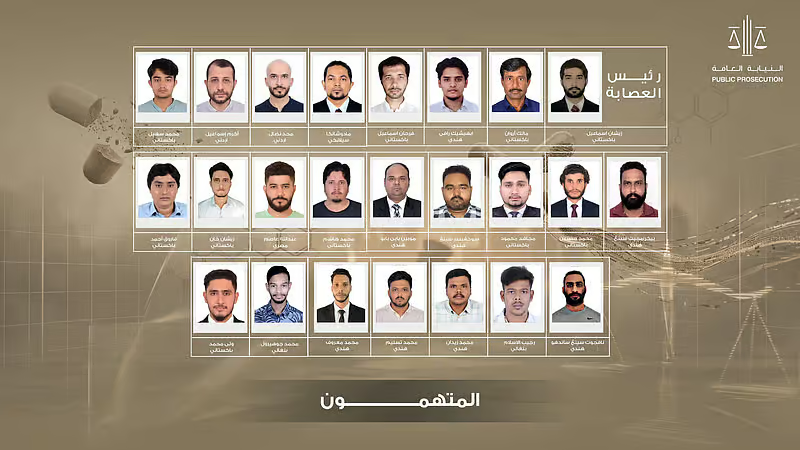
Following the initial arrests and the intelligence generated by the two suspects’ admissions, authorities conducted extensive investigation and surveillance of the site identified in the original tip. That sustained surveillance — the operational phase between the first two arrests and the next enforcement action — produced the identification of eleven additional suspects linked to the ringleader and involved in the distribution of narcotics within the UAE. All eleven were subsequently arrested.

The eleven-member second-wave arrest group represents the mid-tier of the network’s apparent structure: individuals who were neither the ringleader (operating remotely from outside the UAE) nor the lowest-level couriers (the two initially arrested in transit) but the distribution-level operators who translated the ringleader’s remote instructions into physical movement of narcotics across the UAE. Their identification through surveillance of the initial storage site, rather than through further confessions or informant information, indicates that the site itself was being actively used by multiple network members — creating the foot traffic that surveillance could map into individual identities and arrest-ready intelligence.

Phase Three: Ten Arrests Across Dubai, Abu Dhabi, and Ajman

Subsequent arrest and search operations conducted across Dubai, Abu Dhabi, and Ajman — three of the UAE’s seven emirates, spanning the country’s most densely populated central corridor from the capital to the northern emirates — led to the arrest of ten additional suspects and the seizure of various quantities of narcotic drugs and psychotropic substances. This third phase of the operation extended the network’s documented footprint beyond Ras Al Khaimah, where the original intelligence and initial arrests had been concentrated, across the broader multi-emirate geography that the network was apparently using for distribution.

The geographic spread of the third-phase arrests — Dubai, Abu Dhabi, and Ajman simultaneously — indicates a coordinated enforcement action rather than sequential individual arrests, with teams deployed across multiple emirates concurrently to prevent any network members in one emirate from being alerted by enforcement activity occurring in another. This kind of simultaneous multi-emirate enforcement requires close real-time coordination among the respective emirate police forces and the Federal Narcotics Control Prosecution, a coordination architecture that the operation’s announcement explicitly credited.

What Was Seized: Two Storage Sites and a Variety of Substances

The seizure record across all phases of the operation encompasses two distinct storage sites and a range of substance categories that together reveal a network supplying multiple segments of the UAE’s illicit drug market rather than a single substance to a single customer demographic.

The first storage location was the site identified in the original tip — the location where narcotics were hidden and where the two initial couriers were arrested in transit. Quantities seized from this location have not been individually itemised in available reporting but formed part of the broader seizure referred to the forensic laboratory for examination. The second storage site, uncovered during the investigation’s subsequent phases, contained large quantities of marijuana, hash oil, and synthetic cannabinoid papers — a combination of cannabis-derived substances and synthetic alternatives that targets a distinct consumer segment from the narcotics and psychotropic substances seized in other phases of the operation.

The presence of synthetic cannabinoid papers specifically — sheet material infused with synthetic cannabinoid compounds that can be smoked directly or used to roll cigarettes indistinguishable in appearance from ordinary tobacco products — reflects one of the more forensically challenging dimensions of modern narcotics enforcement: synthetic cannabinoids are designed to mimic the psychoactive effects of cannabis while being structurally distinct from the natural compounds detected by standard drug tests, creating both a detection challenge for enforcement and a significant health risk for users, since the potency and pharmacological profiles of synthetic cannabinoids vary dramatically across preparations and are associated with severe acute adverse effects not typically seen with natural cannabis.

Forensic Analysis: How a Remote-Directed Network Gets Dismantled

The operational structure documented in this case — a ringleader directing distribution from outside the UAE, with a layered network of approximately 23 ground-level operatives managing storage, transport, and distribution across four emirates — is a well-documented model in contemporary transnational drug trafficking, designed specifically to insulate the organisational leadership from the physical evidence and jurisdictional reach that make ground-level operatives vulnerable to arrest and prosecution.

Dismantling this model forensically requires investigators to work upward through the network’s layers rather than simply across them: each arrested operative is a potential source of intelligence about the layer above, and the investigation’s documented progression — from the two initial couriers, to the eleven distribution-level members, to the ten additional operatives across three emirates — reflects exactly this upward intelligence development methodology. Each arrest wave generated the intelligence that enabled the next, with the ringleader’s remote position providing the operational goal that shaped the investigation’s direction throughout.

The referral of seized materials to the forensic laboratory is not merely a procedural formality. Laboratory examination of seized narcotics serves multiple evidentiary functions: confirming the chemical identity and purity of the substances, establishing the precise quantities by weight (which directly determines the sentencing range under UAE narcotics law), and potentially identifying the substances’ geographic or chemical origin through isotopic or precursor analysis — information that may support the investigation of the supply chain above the ringleader level, including the source country from which the narcotics entered the UAE.

Criminal Psychology: The Offshore Ringleader Model

The operational choice to manage a UAE drug distribution network from a location outside the country reflects a calculated risk-management strategy that has become increasingly prevalent in transnational organised crime as law enforcement agencies across the Gulf and globally have improved their capacity to identify and prosecute drug network leadership. By remaining physically outside the jurisdiction where the criminal activity occurs, a ringleader eliminates their exposure to arrest during any enforcement operation targeting the ground-level distribution network, maintains effective operational control through remote communication channels, and creates a jurisdictional barrier between their own person and the prosecutorial authority of the state whose laws the network is violating.

The psychological and operational costs of this model are also documented. Remote management depends entirely on the loyalty and competence of the ground-level operatives who carry out the actual physical activity, and the ringleader’s inability to directly oversee operations creates vulnerability to exactly the kind of network collapse that occurred here: once the two initial couriers were arrested and provided information about the ringleader’s remote role and the network’s broader structure, the ringleader’s physical distance provided no protection against the systematic arrest of every other network member they had recruited and directed. The ringleader’s location outside the country does not appear in available reporting to have prevented investigators from identifying them — only from immediately arresting them.

Law and Legal Implications: UAE Narcotics Law and the 24 Named Suspects

The prosecution of this case falls under the UAE’s Federal Law No. 14 of 1995 on the Countermeasures against Narcotic Drugs and Psychotropic Substances, as amended by subsequent legislation, which establishes the comprehensive UAE legal framework for narcotics offences including possession, trafficking, and distribution. The law applies a sentencing structure scaled to the nature of the offence and the quantity of substances involved, with trafficking and distribution offences — as opposed to simple possession for personal use — carrying substantially more severe penalties including mandatory custodial sentences and, in cases involving large quantities or organised criminal enterprise, the possibility of life imprisonment or capital punishment.

The specific charges that will be brought against each of the 24 identified suspects have not been detailed in available reporting, pending the completion of the Federal Narcotics Prosecution’s investigations and the formal referral of cases to the competent courts. The fact that the Public Prosecution has publicly revealed the identities of all 24 individuals involved is itself a significant procedural step, reflecting a determination that the evidentiary basis for proceeding against each named individual is sufficiently established to justify public identification. The ringleader’s location outside the UAE creates a separate and more complex legal challenge — their prosecution will depend either on voluntary return, extradition under applicable bilateral treaties, or the UAE’s capacity to pursue proceedings in absentia under its criminal procedure framework.

Global Context: The UAE as a Transit and Destination Market

The UAE occupies a specific and well-documented position in the global narcotics trafficking landscape — simultaneously a significant destination market, driven by its large expatriate population, high disposable incomes across multiple demographic segments, and the anonymity that a major international city and logistics hub provides to both buyers and sellers — and a transit point, given its position as one of the world’s busiest air and sea cargo hubs and the volume of international freight that passes through its ports and airports.

The multi-substance nature of the seized materials in this case — narcotics, psychotropic substances, marijuana, hash oil, and synthetic cannabinoid papers — reflects the breadth of the UAE drug market rather than a network specialising in a single substance or serving a single consumer segment. Synthetic cannabinoid papers in particular have become a documented and growing enforcement concern across the Gulf, driven by their relative detectability advantage compared to natural cannabis products and by the ease with which they can be concealed in ordinary paper products during import. Their specific presence in this seizure suggests a network deliberately diversifying its product range to serve multiple buyer demographics and potentially to manage supply-chain risk by not depending on a single substance category.

Prior UAE enforcement actions demonstrate both the scale of the challenge and the consistency of the response: a 13-member gang arrested with over 56,000 kilogrammes of drugs worth Dh3.3 million; a joint UAE-Kuwait operation dismantling an international drug network with over 14 million pills hidden in grain sacks; a UAE-Saudi Arabia operation foiling the smuggling of 267,300 amphetamine pills. Each operation illustrates both the ambition of the networks attempting to penetrate the UAE market and the multi-emirate, multi-agency enforcement infrastructure that the country has assembled to intercept them.

Investigation: What Remains Unresolved

The ringleader’s identity, nationality, and current location outside the UAE — and whether any enforcement action to secure their arrest, extradition, or prosecution is underway — have not been disclosed in available reporting. Whether the ringleader’s location is known to UAE authorities and is the subject of active extradition proceedings, or whether identifying and locating the ringleader remains an open investigative objective, is not established in current public reporting.

The specific quantities, types, and assessed street values of the narcotics and psychotropic substances seized across all phases of the operation have not been individually itemised. The forensic laboratory examination of the seized materials is ongoing, and its results — which will establish the precise chemical identity, purity, and quantity of each substance — have not been made public.

The nationalities of the 24 identified suspects, and the specific roles each individual played within the network’s distribution hierarchy, have not been detailed. Whether any of the suspects are UAE nationals or are exclusively foreign nationals, and whether the network had any connections to other active trafficking operations operating in or through the UAE, are open questions that the ongoing investigation may eventually address.

Whether the two storage sites identified during the operation represent the full extent of the network’s physical infrastructure, or whether additional storage or staging locations exist that have not yet been located, has not been confirmed.

Before the First Delivery

The most significant fact in this case is the one stated plainly in the UAE authorities’ own announcement: the narcotics were seized before they could be distributed. Twenty-four people are identified. A ringleader is directing operations from abroad. Two stash sites found. Large quantities of multiple substances removed from circulation. The network did not complete a single delivery after the tip was received.

That outcome — a distribution network dismantled entirely in the pre-delivery phase — reflects the specific operational value of human intelligence that arrives early enough to allow investigators to map the network’s structure before enforcement action collapses it. The two initial couriers were caught in transit, not at a delivery point. The eleven mid-tier members were identified through surveillance before any of them were alerted that the network was being watched. The ten additional suspects across three emirates were arrested simultaneously, preventing any cross-emirate warning. The ringleader abroad issued instructions that were intercepted and acted on by a network that no longer existed to carry them out.


ForensicTimes · forensictimes.com · Investigative Journalism on Crime, Justice & Forensic Science · © 2026 ForensicTimes. All rights reserved.


Source: Forensic Times
Tags: Federal Narcotics Control Prosecution UAEforensic laboratory UAE drugsmarijuana hash oil synthetic cannabinoid UAEmulti-emirate drug operation Dubai Ajman Abu DhabiRas Al Khaimah drug bustremote-managed drug ring UAEUAE anti-narcotics operation June 2026UAE drug distribution network seizedUAE drug ringleader abroadUAE narcotics psychotropic substances seizure
Forensic Times Desk

Forensic Times Desk

Forensic Times News Desk is the dedicated editorial and investigative reporting team of Forensic Times, focused on covering crime, cyber threats, trafficking, forensic science, global investigations, and high-impact intelligence stories.

Recommended

The €34 Billion Reset: Magyar, Brussels, and the Price of Hungary’s Return

The €34 Billion Reset: Magyar, Brussels, and the Price of Hungary’s Return

7 months ago
UAE Busts Drug Ring: 24 Criminals, RAK Dubai Abu Dhabi Ajman

UAE Busts Drug Ring: 24 Criminals, RAK Dubai Abu Dhabi Ajman

5 months ago

Popular News

  • A computer terminal displaying system information, illustrating the technical environment involved in cybercrime investigations

    Human Trafficking in the Digital Age: How Criminal Networks Use Technology to Recruit, Control and Exploit Victims

    26209 shares
    Share 0 Tweet 0
  • Human Trafficking in the Digital Age: How Criminal Networks Use Technology to Recruit, Control and Exploit Victims

    26209 shares
    Share 0 Tweet 0
  • New Methods Used by International Fraud Syndicates in 2026: How Global Scams Are Evolving

    24357 shares
    Share 0 Tweet 0
  • Inside the New Organised Cybercrime Networks: How the Criminal Economy Works in 2026

    22884 shares
    Share 0 Tweet 0
  • Phishing Attacks in 2026: How Criminals Steal Passwords, Codes and Personal Data

    21208 shares
    Share 0 Tweet 0

Connect with us

About Us

Forensic Times is the frontline of crime news, investigation, and intelligence. We go beyond the surface — analyzing evidence, exposing patterns, and reporting what others miss. Our journalism is built on facts, forensic rigour, and an unwavering pursuit of justice.

Careers

  • Webinars
  • WIFS Registration
  • Women In Forensic Science
  • Campus Ambassador
  • Forensics Experiences
  • Courses & Certifications

Categories

  • Crime
  • World
  • Police
  • Politics
  • Forensics
  • Investigation

WIFS Membership

Publish your research, connect with leading women in forensic science, access exclusive opportunities, and advance your career through the Women in Forensic Science (WIFS) global community.
JOIN NOW

  • About Us
  • Advertise
  • Terms of Use
  • Editorial Guidelines
  • Privacy Policy
  • Refund Policy
  • Cookie Policy

© 2026 Forensic Times. All rights reserved.

Welcome Back!

Sign In with Google
OR

Login to your account below

Forgotten Password? Sign Up

Create New Account!

Sign Up with Google
OR

Fill the forms bellow to register

All fields are required. Log In

Retrieve your password

Please enter your username or email address to reset your password.

Log In

Add New Playlist

No Result
View All Result
  • Home
  • Crime
    • Human Trafficking
    • Cyber Crime
    • Financial Crime
    • Terrorism
  • Forensics
    • Digital forensics
    • Forensic accounting
    • Crime scene analysis
  • Legal
  • Politics
  • Crime Tech
  • Investigation
  • Careers
    • Webinars
    • Women In Forensic Science
    • WIFS Registration
    • Forensics Experiences
    • Campus Ambassador
    • Courses & Certifications
  • Resources
    • Books & Products
    • Advisory Board Member Hiring
    • Advisory Council Membership
  • Investigations
  • Login
  • Sign Up
  • Cart

© 2026 Forensic Times. All rights reserved.

Not enough quota to unlock this post
Unlock left : 0
Are you sure want to cancel subscription?