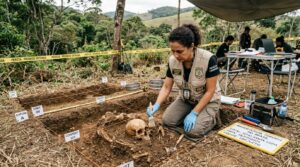
Forensic archaeology occupies a particularly important position at the intersection of science, history, criminal investigation and human rights. In cases involving missing persons, clandestine burials, mass graves or human remains affected by the passage of time, archaeological methods can become essential for transforming material traces into scientifically reliable evidence. In this sense, forensic archaeology is not limited to the technical recovery of human remains: it can also contribute directly to the realization of fundamental rights, especially the rights to truth, memory, justice, dignity and an effective investigation.
In Brazil, this relationship acquired particular significance in the context of investigations into serious human rights violations committed during the period of authoritarian rule. The creation of the National Truth Commission (Comissão Nacional da Verdade – CNV), established by Law No. 12,528/2011, represented an important institutional effort to investigate and clarify serious human rights violations committed between 1946 and 1988, with particular attention to the military dictatorship. Among its objectives was the promotion of the right to memory and historical truth. (Serviços e Informações do Brasil)
This subject was already addressed by me in the article “Forensic Anthropology and Human Rights in Brazil: Considerations on the National Truth Commission and Criminal Forensics”, published in Revista Âmbito Jurídico, No. 115, Volume XVI, in August 2013. In that work, I examined the relationship between the newly established National Truth Commission, the investigation of past human rights violations and the role of forensic sciences—particularly forensic anthropology and forensic archaeology—in producing scientifically reliable evidence concerning historical events. (Âmbito Jurídico)
The discussion was later developed in the book chapter “Direitos humanos e as ciências forenses no Brasil: o contributo dos trabalhos da Comissão Nacional da Verdade para a prova pericial criminal” [Human Rights and Forensic Sciences in Brazil: The Contribution of the Work of the National Truth Commission to Criminal Forensic Evidence], published in 2015, in the book Inquietações sobre Direitos Fundamentais, edited by Mateus Marques et al., and published in Porto Alegre by Livraria do Advogado, pp. 13–18. In that chapter, I argued that the work of the CNV demonstrated the importance of forensic sciences for the protection and effective realization of human rights and highlighted the need to strengthen Brazil’s scientific and institutional capacity in this field.
Science as an Instrument for the Confirmation of Rights
Human rights are often discussed primarily as legal or philosophical principles. However, their effective protection frequently depends on the ability of institutions to establish facts. A person cannot always be protected merely through the formal recognition of a right. In cases of disappearance, extrajudicial execution, torture or clandestine burial, the State must also be capable of investigating what occurred and producing reliable evidence.
This is where forensic archaeology becomes particularly relevant. By applying archaeological methods to the location, documentation, excavation and recovery of human remains and associated evidence, forensic archaeologists contribute to reconstructing events that may otherwise remain hidden. Internationally, forensic archaeology is recognized as an important component of investigations involving missing persons, clandestine graves and concealed human remains. Its work may contribute both to establishing the identity of victims and to reconstructing the circumstances surrounding the disposal of bodies and the dynamics of crime scenes. (icmp.int)
The scientific recovery of evidence is therefore inseparable from the protection of fundamental rights. Poorly conducted excavations can destroy contextual information, compromise the interpretation of evidence and weaken future judicial investigations. Conversely, the careful documentation of stratigraphy, spatial relationships, associated objects and the position of human remains can preserve information that may be decisive for identifying victims and understanding how, when and under what circumstances events occurred.
Forensic archaeology thus demonstrates an essential principle: the protection of human rights also requires the preservation of evidence.
The Brazilian Experience and the National Truth Commission
The investigations carried out during and around the work of the CNV illustrated the importance of integrating historical investigation with forensic science. One of the most significant examples was the exhumation of the remains of former Brazilian President João Goulart in 2013. The investigation involved Brazilian and international specialists and included archaeological, anthropological, toxicological and DNA-related procedures. (Serviços e Informações do Brasil)
From a forensic perspective, cases such as this demonstrate that the passage of time does not eliminate the need for scientific investigation. On the contrary, historical distance often makes specialized forensic methods even more important. Human remains, burial sites and associated materials may constitute the last surviving witnesses of events that occurred decades earlier.
This was one of the central concerns expressed in my 2013 article and subsequently developed in the 2015 book chapter. The investigation of historical human rights violations requires not only political and legal recognition but also technical capacity. Truth commissions, prosecutors, courts and human rights institutions may depend on forensic specialists to transform historical allegations into scientifically documented findings.
The work of the CNV therefore helped demonstrate that forensic sciences—including forensic medicine, criminalistics, forensic anthropology and forensic archaeology—can play an important role in transitional justice. Their contribution extends beyond the identification of individual victims. Scientific evidence can also assist in reconstructing patterns of violence, challenging inaccurate official narratives and preserving the material foundations of collective memory.
Forensic Archaeology, Dignity and the Right to Identity
One of the most fundamental contributions of forensic archaeology is its role in the search for identity. The recovery and identification of human remains may restore an individual’s name and personal history after decades of uncertainty.
For families of missing persons, the forensic process can provide answers to questions that are simultaneously personal, historical and legal. The identification of a victim may confirm death, allow for the return of remains, enable a dignified burial and contribute to the historical reconstruction of what happened.
This work therefore has a profound human dimension. Human remains are not merely objects of scientific examination. They represent individuals whose dignity persists after death and whose families retain legitimate interests in knowing their fate. Forensic science, when conducted according to rigorous scientific and ethical standards, can help transform uncertainty into knowledge and silence into documented history.
The experience of the Argentine Forensic Anthropology Team (EAAF), which has worked for decades on the search, recovery and identification of disappeared persons and has contributed evidence to judicial proceedings involving crimes against humanity, demonstrates the broader Latin American significance of a forensic approach grounded in human rights. (EAAF)
The Need for Stronger Forensic Capacity in Brazil
More than a decade after the publication of my first article on this subject, the issue remains highly relevant. The challenge is not simply to investigate violations of the past but also to develop permanent forensic structures capable of responding to present and future cases involving missing persons, unidentified human remains and serious human rights violations.
Recent developments in Brazil continue to demonstrate the importance of this work. The investigations involving the clandestine grave discovered in Perus, São Paulo, illustrate both the extraordinary evidentiary value of human remains and the difficulties created by the passage of time. The continuing efforts to identify victims reinforce the urgency of preserving remains and maintaining adequate scientific and institutional capacity. (Serviços e Informações do Brasil)
This challenge requires more than technology. It requires properly trained professionals, standardized protocols, institutional independence, interdisciplinary cooperation and an understanding that forensic evidence can have consequences extending far beyond an individual criminal case.
My more recent work on forensic archaeology and the chain of custody of evidence has also emphasized the importance of preserving the context in which evidence is found and recovered. Archaeological methodology can help ensure that evidence buried in the soil—particularly in cases involving historical or clandestine burials—is scientifically documented from the moment of its discovery. This connection between field methodology, evidence preservation and the reliability of judicial proof is fundamental to the legitimacy of the entire forensic process. (Even3)
Conclusion: Forensic Science in the Service of Human Rights
Forensic archaeology should not be understood merely as a specialized technique for excavating graves or recovering skeletal remains. Its broader significance lies in its ability to connect scientific investigation with the protection of human dignity and fundamental rights.
In Brazil, the experience of the National Truth Commission and the forensic investigations associated with the search for truth about past human rights violations demonstrated that science can play a decisive role in the confirmation of historical facts. The work of forensic specialists may contribute to identifying victims, recovering remains, reconstructing events, challenging false narratives and preserving evidence for present and future generations.
As I argued in “Antropologia forense e direitos humanos no Brasil: considerações sobre a Comissão Nacional da Verdade e a perícia criminal” (2013), and later in the chapter “Direitos humanos e as ciências forenses no Brasil: o contributo dos trabalhos da Comissão Nacional da Verdade para a prova pericial criminal” (2015, pp. 13–18), the effective protection of human rights cannot be separated from the State’s capacity to investigate violations scientifically and impartially.
Ultimately, forensic archaeology reminds us that the protection of human rights is not only a matter of legal recognition. It is also a matter of evidence.
And sometimes, after decades of silence, that evidence remains buried beneath the ground.
References
PORTINHO, Andrei Röehrs. Antropologia forense e direitos humanos no Brasil: considerações sobre a Comissão Nacional da Verdade e a perícia criminal. Revista Âmbito Jurídico, No. 115, Volume XVI, August 2013.
PORTINHO, Andrei Röehrs. Direitos humanos e as ciências forenses no Brasil: o contributo dos trabalhos da Comissão Nacional da Verdade para a prova pericial criminal. In: MARQUES, Mateus et al. (eds.). Inquietações sobre Direitos Fundamentais. Porto Alegre: Livraria do Advogado, 2015, pp. 13–18.
PORTINHO, Andrei Röehrs. A Arqueologia Forense e a Cadeia de Custódia das Evidências. 2023. (Even3)