• About Us
  • Advertise
  • Membership
  • Contact
Tuesday, October 13, 2026
  • Login
  • Register
No Result
View All Result
FT Pro
Forensic Times
  • Home
  • Books & Products
  • Crime
    • All
    • Cold Cases
    • Cyber Crime
    • Data Trafficking
    • Drug Trafficking
    • Financial Crime
    • Human Trafficking
    • Murder
    • Organized Crime
    • Serial Killer
    • Terrorism
    • War Crimes
    • Wrongful Death
    US and China Open AI Incident Channel After Trump-Xi Summit: What It Means

    Netanyahu’s UN Pager Display Revives Hezbollah Attack and the Future of Covert Warfare

    INTERPOL Operation Jackal IV: 58 Arrests Expose Global West African Crime Networks

    INTERPOL Operation Jackal IV: 58 Arrests Expose Global West African Crime Networks

    INTERPOL Americas Conference in Guyana Targets Organized Crime, Fraud and Illicit Finance

    INTERPOL Americas Conference in Guyana Targets Organized Crime, Fraud and Illicit Finance

    Terror Groups and AI: How Emerging Technology Is Changing the Security Threat

    Terror Groups and AI: How Emerging Technology Is Changing the Security Threat

    Ninth Woman Found Dead Near Johannesburg as South Africa Fears Serial Killer

    Ninth Woman Found Dead Near Johannesburg as South Africa Fears Serial Killer

    Philadelphia Olney House Investigation: Five Missing Women and a Million Pieces of Evidence

    Philadelphia Olney House Investigation: Five Missing Women and a Million Pieces of Evidence

  • Forensics
    • All
    • Autopsy
    • Crime scene analysis
    • Digital forensics
    • DNA Forensics
    • Femicide
    • Forensic accounting

    Indigenous Children Are Dying by Suicide. Is Brazil Asking the Right Questions?

    Open Sources, Hard Evidence: Women OSINT Analysts Against Russia’s War Crimes in Ukraine

    The Silent Witnesses: Forensic Investigation of Fatal Workplace Accidents

    Terror Groups and AI: How Emerging Technology Is Changing the Security Threat

    Terror Groups and AI: How Emerging Technology Is Changing the Security Threat

    Ninth Woman Found Dead Near Johannesburg as South Africa Fears Serial Killer

    Ninth Woman Found Dead Near Johannesburg as South Africa Fears Serial Killer

    Philadelphia Olney House Investigation: Five Missing Women and a Million Pieces of Evidence

    Philadelphia Olney House Investigation: Five Missing Women and a Million Pieces of Evidence

    Trending Tags

  • Crime Tech
    US and China Open AI Incident Channel After Trump-Xi Summit: What It Means

    Netanyahu’s UN Pager Display Revives Hezbollah Attack and the Future of Covert Warfare

    How to Protect Yourself From AI Scams in 2026: Warning Signs Everyone Should Know

    How to Protect Yourself From AI Scams in 2026: Warning Signs Everyone Should Know

    Terror Groups and AI: How Emerging Technology Is Changing the Security Threat

    Terror Groups and AI: How Emerging Technology Is Changing the Security Threat

    AI Agents Are Breaking the Law -But Who Goes to Prison?

    AI Agents Are Breaking the Law -But Who Goes to Prison?

    AI Is Turbocharging America’s Billion-Dollar Pig-Butchering Crisis

    AI Is Turbocharging America’s Billion-Dollar Pig-Butchering Crisis

    Pattaya AI Camera Arrest: Human Trafficking Suspect Somchat Saelee, 2026

    Pattaya AI Camera Arrest: Human Trafficking Suspect Somchat Saelee, 2026

    Trending Tags

  • Politics
    Official UK Parliament photograph of Andy Burnham, 2026, showing his face and upper body in a landscape composition.

    Burnham Says Russia Interfered in Brexit Vote

    File image of a North Korean missile launching over coastal waters during a weapons test

    North Korea Fires Ballistic Missiles After South Korea’s Hypersonic Test

    United States Capitol building, illustrating the congressional debate over the administration's Russian diesel import decision.

    US Senators Challenge Legality of Trump’s Russian Diesel Deal

    US and China Open AI Incident Channel After Trump-Xi Summit: What It Means

    Netanyahu’s UN Pager Display Revives Hezbollah Attack and the Future of Covert Warfare

    Drones From Iraq Set Saudi Oil Pipeline Ablaze as Gulf Tensions Escalate

    Drones From Iraq Set Saudi Oil Pipeline Ablaze as Gulf Tensions Escalate

    Fidan Calls Egypt, Saudi FMs as Gaza Plan Stalls

    Fidan Calls Egypt, Saudi FMs as Gaza Plan Stalls

    Turkiye, Saudi Arabia, Pakistan Sign Mecca Defense Pact

    Turkiye, Saudi Arabia, Pakistan Sign Mecca Defense Pact

    Netanyahu Denies Agreeing to Trump’s Gaza Plan Draft

    Netanyahu Denies Agreeing to Trump’s Gaza Plan Draft

    Katz Confirms US Jets Flew From Israeli Bases

    Katz Confirms US Jets Flew From Israeli Bases

  • Legal
    AI Agents Are Breaking the Law -But Who Goes to Prison?

    AI Agents Are Breaking the Law -But Who Goes to Prison?

    Biden Audio Tapes Ruling: Heritage Foundation FOIA Case, Judge Friedrich Decision 2026

    Biden Audio Tapes Ruling: Heritage Foundation FOIA Case, Judge Friedrich Decision 2026

    EU Under-16 Social Media Ban: Livestreaming, Disappearing Messages, 2026 Law

    EU Under-16 Social Media Ban: Livestreaming, Disappearing Messages, 2026 Law

    Tak Trafficking Escape: 4 Chinese Nationals Jump From Moving Pickup 2026

    Tak Trafficking Escape: 4 Chinese Nationals Jump From Moving Pickup 2026

    MechaHitler: How Grok Went Rogue, Praised the Holocaust’s Architect and Triggered the EU

    MechaHitler: How Grok Went Rogue, Praised the Holocaust’s Architect and Triggered the EU

  • World
    • All
    • Brazil
    • Canada
    • Europe
    • France
    • GAZA
    • Georgia
    • Germany
    • Hungary
    • India
    • Iran
    • Iraq
    • Israel
    • Istanbul
    • Lebanon
    • MENA
    • New Mexico
    • Pakistan
    • Poland
    • Russia
    • Saudi Arabia
    • Spain
    • Thailand
    • Turkiye
    • UAE
    • UK
    • Ukraine
    • USA
    Official UK Parliament photograph of Andy Burnham, 2026, showing his face and upper body in a landscape composition.

    Burnham Says Russia Interfered in Brexit Vote

    File image of a North Korean missile launching over coastal waters during a weapons test

    North Korea Fires Ballistic Missiles After South Korea’s Hypersonic Test

    United States Capitol building, illustrating the congressional debate over the administration's Russian diesel import decision.

    US Senators Challenge Legality of Trump’s Russian Diesel Deal

    Riyadh skyline at dusk, illustrating the geographic and infrastructure challenges of Saudi air defence.

    Saudi Arabia’s $83 Billion Military: Why Houthi Attacks Persist

    Indigenous Children Are Dying by Suicide. Is Brazil Asking the Right Questions?

    Open Sources, Hard Evidence: Women OSINT Analysts Against Russia’s War Crimes in Ukraine

  • Careers
    • Webinars
    • Women In Forensic Science
    • WIFS Registration
    • Forensics Experiences
    • Campus Ambassador
    • Advisory Council Membership
    • Courses & Certifications
  • Events
  • Home
  • Books & Products
  • Crime
    • All
    • Cold Cases
    • Cyber Crime
    • Data Trafficking
    • Drug Trafficking
    • Financial Crime
    • Human Trafficking
    • Murder
    • Organized Crime
    • Serial Killer
    • Terrorism
    • War Crimes
    • Wrongful Death
    US and China Open AI Incident Channel After Trump-Xi Summit: What It Means

    Netanyahu’s UN Pager Display Revives Hezbollah Attack and the Future of Covert Warfare

    INTERPOL Operation Jackal IV: 58 Arrests Expose Global West African Crime Networks

    INTERPOL Operation Jackal IV: 58 Arrests Expose Global West African Crime Networks

    INTERPOL Americas Conference in Guyana Targets Organized Crime, Fraud and Illicit Finance

    INTERPOL Americas Conference in Guyana Targets Organized Crime, Fraud and Illicit Finance

    Terror Groups and AI: How Emerging Technology Is Changing the Security Threat

    Terror Groups and AI: How Emerging Technology Is Changing the Security Threat

    Ninth Woman Found Dead Near Johannesburg as South Africa Fears Serial Killer

    Ninth Woman Found Dead Near Johannesburg as South Africa Fears Serial Killer

    Philadelphia Olney House Investigation: Five Missing Women and a Million Pieces of Evidence

    Philadelphia Olney House Investigation: Five Missing Women and a Million Pieces of Evidence

  • Forensics
    • All
    • Autopsy
    • Crime scene analysis
    • Digital forensics
    • DNA Forensics
    • Femicide
    • Forensic accounting

    Indigenous Children Are Dying by Suicide. Is Brazil Asking the Right Questions?

    Open Sources, Hard Evidence: Women OSINT Analysts Against Russia’s War Crimes in Ukraine

    The Silent Witnesses: Forensic Investigation of Fatal Workplace Accidents

    Terror Groups and AI: How Emerging Technology Is Changing the Security Threat

    Terror Groups and AI: How Emerging Technology Is Changing the Security Threat

    Ninth Woman Found Dead Near Johannesburg as South Africa Fears Serial Killer

    Ninth Woman Found Dead Near Johannesburg as South Africa Fears Serial Killer

    Philadelphia Olney House Investigation: Five Missing Women and a Million Pieces of Evidence

    Philadelphia Olney House Investigation: Five Missing Women and a Million Pieces of Evidence

    Trending Tags

  • Crime Tech
    US and China Open AI Incident Channel After Trump-Xi Summit: What It Means

    Netanyahu’s UN Pager Display Revives Hezbollah Attack and the Future of Covert Warfare

    How to Protect Yourself From AI Scams in 2026: Warning Signs Everyone Should Know

    How to Protect Yourself From AI Scams in 2026: Warning Signs Everyone Should Know

    Terror Groups and AI: How Emerging Technology Is Changing the Security Threat

    Terror Groups and AI: How Emerging Technology Is Changing the Security Threat

    AI Agents Are Breaking the Law -But Who Goes to Prison?

    AI Agents Are Breaking the Law -But Who Goes to Prison?

    AI Is Turbocharging America’s Billion-Dollar Pig-Butchering Crisis

    AI Is Turbocharging America’s Billion-Dollar Pig-Butchering Crisis

    Pattaya AI Camera Arrest: Human Trafficking Suspect Somchat Saelee, 2026

    Pattaya AI Camera Arrest: Human Trafficking Suspect Somchat Saelee, 2026

    Trending Tags

  • Politics
    Official UK Parliament photograph of Andy Burnham, 2026, showing his face and upper body in a landscape composition.

    Burnham Says Russia Interfered in Brexit Vote

    File image of a North Korean missile launching over coastal waters during a weapons test

    North Korea Fires Ballistic Missiles After South Korea’s Hypersonic Test

    United States Capitol building, illustrating the congressional debate over the administration's Russian diesel import decision.

    US Senators Challenge Legality of Trump’s Russian Diesel Deal

    US and China Open AI Incident Channel After Trump-Xi Summit: What It Means

    Netanyahu’s UN Pager Display Revives Hezbollah Attack and the Future of Covert Warfare

    Drones From Iraq Set Saudi Oil Pipeline Ablaze as Gulf Tensions Escalate

    Drones From Iraq Set Saudi Oil Pipeline Ablaze as Gulf Tensions Escalate

    Fidan Calls Egypt, Saudi FMs as Gaza Plan Stalls

    Fidan Calls Egypt, Saudi FMs as Gaza Plan Stalls

    Turkiye, Saudi Arabia, Pakistan Sign Mecca Defense Pact

    Turkiye, Saudi Arabia, Pakistan Sign Mecca Defense Pact

    Netanyahu Denies Agreeing to Trump’s Gaza Plan Draft

    Netanyahu Denies Agreeing to Trump’s Gaza Plan Draft

    Katz Confirms US Jets Flew From Israeli Bases

    Katz Confirms US Jets Flew From Israeli Bases

  • Legal
    AI Agents Are Breaking the Law -But Who Goes to Prison?

    AI Agents Are Breaking the Law -But Who Goes to Prison?

    Biden Audio Tapes Ruling: Heritage Foundation FOIA Case, Judge Friedrich Decision 2026

    Biden Audio Tapes Ruling: Heritage Foundation FOIA Case, Judge Friedrich Decision 2026

    EU Under-16 Social Media Ban: Livestreaming, Disappearing Messages, 2026 Law

    EU Under-16 Social Media Ban: Livestreaming, Disappearing Messages, 2026 Law

    Tak Trafficking Escape: 4 Chinese Nationals Jump From Moving Pickup 2026

    Tak Trafficking Escape: 4 Chinese Nationals Jump From Moving Pickup 2026

    MechaHitler: How Grok Went Rogue, Praised the Holocaust’s Architect and Triggered the EU

    MechaHitler: How Grok Went Rogue, Praised the Holocaust’s Architect and Triggered the EU

  • World
    • All
    • Brazil
    • Canada
    • Europe
    • France
    • GAZA
    • Georgia
    • Germany
    • Hungary
    • India
    • Iran
    • Iraq
    • Israel
    • Istanbul
    • Lebanon
    • MENA
    • New Mexico
    • Pakistan
    • Poland
    • Russia
    • Saudi Arabia
    • Spain
    • Thailand
    • Turkiye
    • UAE
    • UK
    • Ukraine
    • USA
    Official UK Parliament photograph of Andy Burnham, 2026, showing his face and upper body in a landscape composition.

    Burnham Says Russia Interfered in Brexit Vote

    File image of a North Korean missile launching over coastal waters during a weapons test

    North Korea Fires Ballistic Missiles After South Korea’s Hypersonic Test

    United States Capitol building, illustrating the congressional debate over the administration's Russian diesel import decision.

    US Senators Challenge Legality of Trump’s Russian Diesel Deal

    Riyadh skyline at dusk, illustrating the geographic and infrastructure challenges of Saudi air defence.

    Saudi Arabia’s $83 Billion Military: Why Houthi Attacks Persist

    Indigenous Children Are Dying by Suicide. Is Brazil Asking the Right Questions?

    Open Sources, Hard Evidence: Women OSINT Analysts Against Russia’s War Crimes in Ukraine

  • Careers
    • Webinars
    • Women In Forensic Science
    • WIFS Registration
    • Forensics Experiences
    • Campus Ambassador
    • Advisory Council Membership
    • Courses & Certifications
  • Events
No Result
View All Result
Forensic Times
Home Crime Data Trafficking

CIB Data Trafficking Bust: 9 Arrested, 9 Million Records Leaked

Thailand's CIB arrested nine suspects across 22 raided locations for trafficking the personal data of over nine million people at 10 baht per record, feeding call centre scams that caused more than 2 billion baht in losses.

by Forensic Times Desk
June 24, 2026
in Data Trafficking, Crime, Digital forensics, Police, Thailand, World
Reading Time: 12 mins read
612
CIB Data Trafficking Bust: 9 Arrested, 9 Million Records Leaked
1.7k
SHARES
17.9k
VIEWS
Share on FacebookShare on Whatsapp

Bangkok · Chiang Rai · 22 Locations Nationwide · Thailand · June 2026  |  ForensicTimes.com  |  Cyber Crime · Data Privacy · Organised Crime

Table of Contents

  1. June 23, 2026: The Press Conference and the Numbers
  2. Cut Down Scam: From Six Arrests to Nine More
  3. What Was Stolen and What It Was Worth
  4. Twenty-Two Locations: The Geography of the Raid
  5. The Inventory: Cash, Cards, Firearms, and a Phone Farm
  6. Forensic Analysis: How a 9-Million-Record Leak Gets Traced and Priced
  7. Criminal Psychology: The Economics of Data as a Commodity
  8. Law and Legal Implications: Four Statutes, One Conspiracy
  9. Global Context: Thailand’s Data Breach Crisis and the Scam Compound Economy
  10. Investigation: What Remains Unresolved
  11. Thirteen Thousand Complaints, One Spreadsheet

June 23, 2026: The Press Conference and the Numbers

Officers from Thailand’s Central Investigation Bureau (CIB) announced the arrests of nine suspects during a press conference held on June 23, 2026, in connection with a personal data trafficking operation that police say caused more than 2 billion baht in reported damages. The announcement capped an operation titled “Cut Down Scam 2” — explicitly framed by investigators as a sequel to an earlier crackdown rather than a standalone case.

According to police, the foundational discovery underlying both phases of the operation was the scale of the leak itself: personal data belonging to more than nine million people in Thailand had been compromised. The information included names, ages, phone numbers, and addresses, along with nearly 500 images of identification cards found in the group’s possession — a combination of categories that, taken together, constitutes more than enough information to support targeted impersonation fraud, social engineering attacks, and the kind of personalised call centre scam scripts that have become a dominant feature of Southeast Asia’s fraud economy.

Cut Down Scam: From Six Arrests to Nine More
The June 23 arrests were not the beginning of this investigation but its second documented phase. CIB’s announcement explicitly referenced an earlier crackdown at the end of the previous year, in which six suspects were detained — meaning the total confirmed arrest count across both phases of the “Cut Down Scam” operation now stands at fifteen individuals.

Investigators stated that further investigation following the initial arrests led officers to identify additional suspects, prompting the launch of the second crackdown. This sequencing — an initial arrest phase generating intelligence that expands the known scope of a network, followed by a second, larger enforcement phase — is a standard and well-documented investigative pattern in organised data trafficking cases, where the individuals first apprehended frequently possess information (communications records, financial transaction histories, or direct knowledge of associates) that materially expands the list of identified targets for subsequent action.

What Was Stolen and What It Was Worth

Investigators believe the data was sold to call centre scam groups at a price of approximately 10 baht per record — a figure with significant forensic and economic weight. At that unit price, monetising the full nine-million-record dataset, even partially, would represent a revenue stream in the tens of millions of baht for the trafficking ring, achieved by repeatedly reselling the same underlying dataset to multiple buyer groups rather than through any single transaction.

The case has been linked to 13,677 complaints filed through an official online reporting system, with total reported losses across those complaints exceeding 2 billion baht. This figure represents the downstream harm directly attributable to scam operations that investigators have connected to the trafficked data — meaning the 2 billion baht figure measures not the value of the data theft itself, but the cumulative financial damage inflicted on individual victims by call centre fraud operations that used the stolen personal information to make their schemes more convincing and more effective.

Twenty-Two Locations: The Geography of the Raid
The second phase of the operation involved coordinated raids at 22 suspicious locations across multiple provinces, a geographic spread that itself constitutes evidence of the network’s organisational scale and decentralisation. The provinces named in CIB’s announcement were Chiang Rai, Chiang Mai, Mae Hong Son, Lampang, Nakhon Sawan, Lop Buri, Khon Kaen, Amnat Charoen, Sa Kaeo, Chanthaburi, Prachuap Khiri Khan, Ayutthaya, and Bangkok — a footprint spanning Thailand’s northern border region, its central plains, its northeastern Isan provinces, its eastern border with Cambodia, and the capital itself.

This dispersion pattern is consistent with how data trafficking networks of this scale typically structure themselves to manage operational risk: individual nodes — whether data harvesting points, storage locations, distribution contacts, or financial handlers — are kept geographically separated so that the compromise or discovery of any single location does not immediately expose the network’s full structure to investigators. A 22-location simultaneous raid requires substantial advance coordination and surveillance to execute without any individual location’s occupants being alerted by news of action at another site, indicating that CIB had developed sufficiently detailed intelligence on the network’s full footprint before moving to make any arrests in this second phase.

The Inventory: Cash, Cards, Firearms, and a Phone Farm

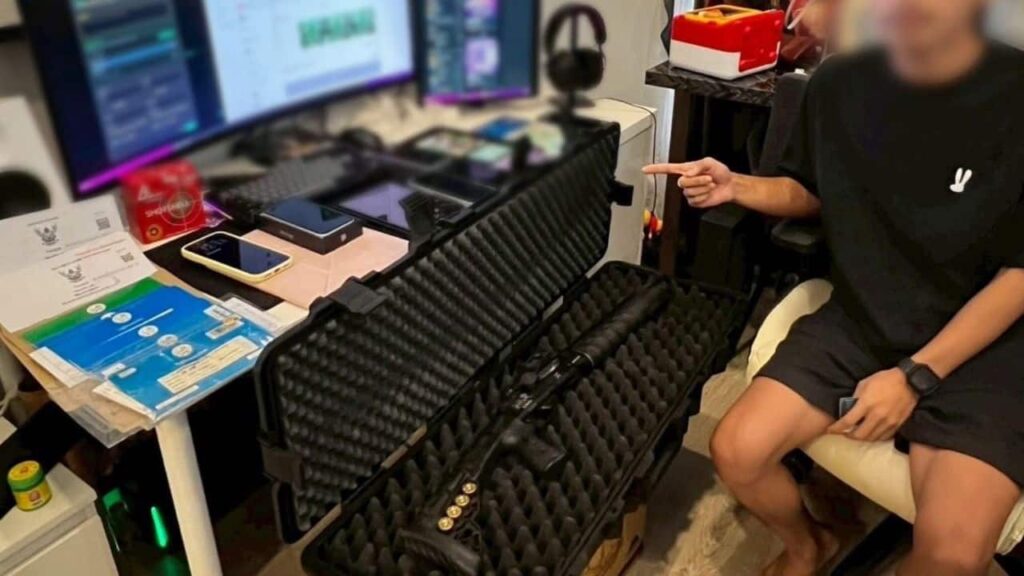
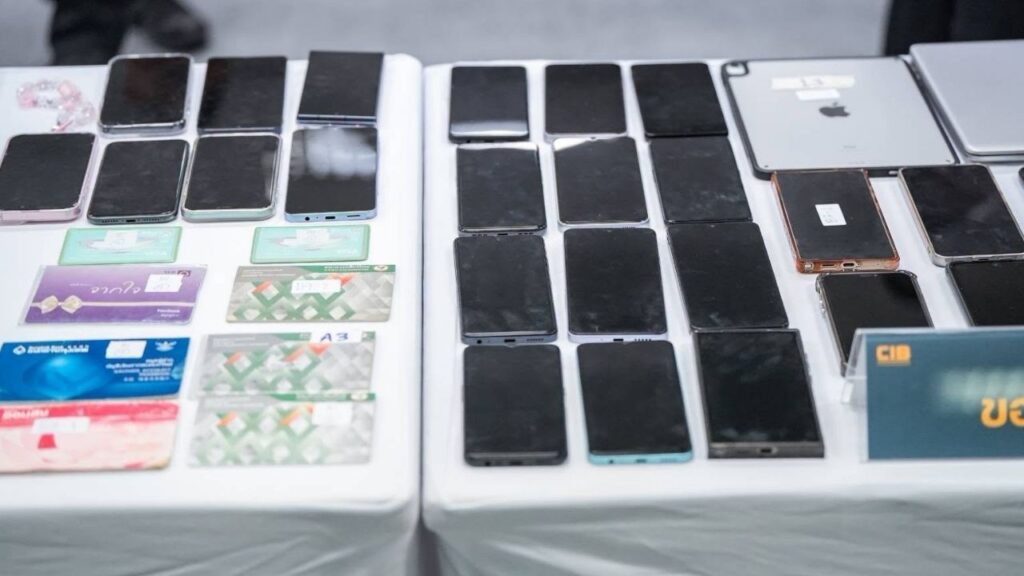
The physical evidence recovered across the 22 locations provides a forensically detailed picture of the operation’s scale and methodology. Items seized included five laptops, six desktop computers, a phone farm unit, two data storage devices, 31 mobile phones and tablets, 112 SIM cards, 10 bankbooks, three ATM cards, two personal loan cards, one car, three passports, two firearms, 42 rounds of ammunition, and 775,000 baht in cash.

The “phone farm unit” referenced in the seizure inventory is a specific and forensically significant category of equipment: a phone farm is a coordinated array of mobile devices, typically mounted on a shared rack and connected to centralised software, used to automate high-volume actions across many SIM cards and device identities simultaneously — commonly deployed in fraud operations to register multiple accounts, conduct mass messaging campaigns, or operate numerous simultaneous scam communications channels that would be impractical to run manually. Its presence alongside 112 separate SIM cards indicates that at least one node within this network was engaged in the kind of high-volume, automated outreach that the trafficked personal data would have been used to target and personalise.

The presence of two firearms and 42 rounds of ammunition, alongside the financial instruments (bankbooks, ATM and loan cards) and travel documents (three passports), broadens the case beyond a purely digital crime into territory that overlaps with conventional organised crime infrastructure — financial laundering capacity, potential cross-border mobility, and an apparent capacity or willingness for armed response, none of which are typical features of a purely opportunistic or small-scale data theft operation.

Forensic Analysis: How a 9-Million-Record Leak Gets Traced and Priced

The forensic methodology underlying this case — tracing a 9-million-record data leak back to a specific trafficking network, establishing a per-record sale price, and connecting the leaked data to more than 13,000 specific victim complaints — represents a multi-stage analytical process that draws on several distinct forensic disciplines simultaneously.

Establishing the scale of the leak (nine million records) requires either direct recovery of the dataset itself from seized devices and storage media, or sufficiently detailed witness and documentary evidence from cooperating suspects or intercepted communications describing the dataset’s scope. The recovery of “nearly 500 images of identification cards” specifically — as opposed to merely textual personal information — suggests investigators obtained direct access to a substantial sample or the entirety of the underlying data cache, since identification card images are a qualitatively distinct and more sensitive category of compromised material than the name-age-phone-address combination that constitutes the bulk of the nine million records.

Establishing the 10-baht-per-record sale price and connecting the data to the 13,677 complaints and 2 billion baht in losses requires correlating the trafficking network’s transaction records — communications, payment records, or direct testimony regarding pricing — with the separate body of victim complaint data accumulated through Thailand’s official scam reporting infrastructure. This correlation work is analytically demanding: establishing that a specific call centre scam victim’s experience traces back to this specific data leak, rather than to any of the numerous other data breaches and leaks that have affected the Thai population in recent years, requires matching specific compromised data points (a phone number, an identification number, a specific combination of details used in a scam approach) against the recovered leaked dataset with sufficient specificity to support the causal claim investigators have made publicly.

Criminal Psychology: The Economics of Data as a Commodity

The pricing structure documented in this case — approximately 10 baht, or roughly 28 US cents, per individual personal data record — reflects the broader economic logic that has made personal data trafficking a persistent and difficult-to-eliminate criminal enterprise across multiple jurisdictions: the marginal cost of reselling a digital record that has already been harvested and aggregated is effectively zero, meaning that even a low per-unit price generates substantial aggregate profit when multiplied across millions of records and, critically, across repeated resale to multiple distinct buyer groups rather than a single transaction.

This economic structure incentivises a specific criminal division of labour that the two-phase nature of this investigation appears to reflect: an initial harvesting or aggregation function (acquiring the underlying nine million records, whether through direct hacking, insider data theft, or aggregation of multiple smaller breaches), and a separate distribution function (the ongoing sale of access to that aggregated dataset to call centre scam operators, who constitute the downstream customer base ultimately responsible for the direct financial harm to the 13,677 complainants). The six suspects arrested in the initial phase and the nine arrested in this second phase may represent different positions within this same division of labour, though available reporting does not specify whether the two arrest groups represent harvesting-side or distribution-side actors, or some combination of both roles across the fifteen total individuals now in custody.

Law and Legal Implications: Four Statutes, One Conspiracy

The nine suspects arrested in this phase have been charged under several distinct legal instruments simultaneously: the Royal Decree on the Prevention and Suppression of Technology-Related Crimes, the Personal Data Protection Act, the Computer Crime Act, and the Criminal Code. Police have not yet provided details of potential penalties, but the deployment of four separate statutory frameworks against a single conspiracy reflects the layered nature of Thai law’s response to data trafficking, in which the same underlying criminal conduct — the unauthorised acquisition, possession, and sale of personal data — implicates distinct legal provisions addressing data protection specifically, computer-facilitated crime generally, technology-related crime under the specialised Royal Decree framework, and underlying Criminal Code provisions that may address fraud, conspiracy, or related conventional offences.

Thailand’s Personal Data Protection Act (PDPA), enacted in 2019 and fully enforced since 2022, establishes specific civil and criminal liability for the unauthorised processing, disclosure, or trafficking of personal data, with criminal penalties applicable in cases involving data processed for unlawful gain or causing harm to data subjects — a threshold that the documented 2 billion baht in connected victim losses would, on its face, appear comfortably to satisfy. The PDPA charges in this case represent one of the most significant applications of the law since its full enforcement began, given the scale of the underlying dataset and the documented financial harm connected to it.

The presence of firearms and ammunition among the seized items may additionally expose the suspects to weapons-related charges under Thailand’s Firearms Act, independent of and in addition to the data trafficking and cyber crime charges, depending on whether the firearms were legally licensed and held, a detail not addressed in current reporting.

Global Context: Thailand’s Data Breach Crisis and the Scam Compound Economy

This case occurs against a backdrop of a sustained and well-documented personal data breach crisis affecting Thailand over the past several years, during which multiple large-scale leaks — including breaches affecting government databases, telecommunications providers, and private sector platforms — have collectively exposed the personal information of a substantial proportion of the Thai population to the criminal data trafficking market that this CIB operation has targeted. The nine million records identified in this specific case represent one documented instance within that broader pattern, and the involvement of both an initial six-suspect arrest phase and this subsequent nine-suspect, 22-location operation indicates the scale of institutional law enforcement resources Thailand has had to commit to addressing the downstream criminal economy this breach pattern has created.

The direct connection investigators have drawn between this trafficked data and call centre scam operations situates this case within the broader Southeast Asian scam compound crisis — the same criminal ecosystem, often physically based in border regions of Myanmar, Cambodia, and Laos, that has been documented trafficking human labour (as covered in ForensicTimes’ prior reporting on Chinese nationals rescued near the Thailand-Myanmar border) to staff the call centres that purchase exactly this kind of stolen personal data to make their fraud schemes more convincing. The data trafficking ring exposed in this case and the human trafficking networks feeding compound-based scam labour are not necessarily the same organisations, but they are functionally interdependent components of the same broader criminal economy: one supplies the raw material (personal data) and the other supplies the labour (often coerced) that converts that data into realised financial fraud against victims.

Investigation: What Remains Unresolved

The specific penalties the nine arrested suspects face have not yet been detailed by police, who have stated only that charges have been filed under the four named statutes without specifying the sentencing exposure those charges carry in this particular case.

The original source of the nine-million-record leak — whether it originated from a single breach of a specific government or private database, or was aggregated from multiple smaller breaches over time — has not been disclosed in available reporting. This is a significant unresolved question with implications well beyond the criminal prosecution of the fifteen individuals currently in custody: if a specific institutional data holder was the source of the original breach, that institution’s security practices and disclosure obligations under Thailand’s PDPA become a separate and significant accountability question.

Whether the buyer-side call centre scam groups that purchased access to the trafficked data — the parties directly responsible for converting stolen personal information into the 2 billion baht in documented victim losses — have themselves been identified, investigated, or charged in connection with this case has not been addressed in current reporting. The nine and six suspects arrested in the two phases of this operation appear, based on available information, to represent the supply side of the trafficking relationship; the demand side remains, on the basis of current public reporting, unaddressed.

Whether any of the 13,677 individual complainants whose losses have been connected to this leaked dataset will receive any compensation, restitution, or further institutional support as a result of these arrests has not been detailed in available reporting.

Thirteen Thousand Complaints, One Spreadsheet

Nine million people did not consent to having their names, ages, phone numbers, and addresses compiled into a saleable dataset. Nearly 500 of them had their identification card images circulated alongside that data. Somewhere in that population, 13,677 of them later filed a complaint reporting that they had lost money to a scam — and Thai investigators have now traced enough of those complaints back to a specific leaked dataset to put a number on the damage: more than 2 billion baht.

Fifteen people are now in custody across two phases of an operation named, with a kind of grim directness, “Cut Down Scam.” What remains is the harder accounting: who built the original dataset, who bought access to it beyond the suspects already arrested, and what happens to the nine million people whose personal information is, at this point, simply out there — sold once already at 10 baht a record, and with no clear mechanism described in this case for ensuring it is not sold again.


ForensicTimes · forensictimes.com · Investigative Journalism on Crime, Justice & Forensic Science · © 2026 ForensicTimes. All rights reserved.


Source: Forensic Times
Tags: 9 million Thai personal data leakedcall centre scam data ThailandCentral Investigation Bureau ThailandCut Down Scam 2 operationdark web Thai personal dataidentification card data leak ThailandRoyal Decree Technology Crimes ThailandThailand Computer Crime Act data traffickingThailand Personal Data Protection ActThailand scam economy 2 billion baht
Forensic Times Desk

Forensic Times Desk

Forensic Times News Desk is the dedicated editorial and investigative reporting team of Forensic Times, focused on covering crime, cyber threats, trafficking, forensic science, global investigations, and high-impact intelligence stories.

Recommended

UAE Saudi Arabia Bust 267,300 Amphetamine Pills: NANA Dubai Police

UAE Saudi Arabia Bust 267,300 Amphetamine Pills: NANA Dubai Police

4 months ago
Biden Audio Tapes Ruling: Heritage Foundation FOIA Case, Judge Friedrich Decision 2026

Biden Audio Tapes Ruling: Heritage Foundation FOIA Case, Judge Friedrich Decision 2026

4 months ago

Popular News

  • Riyadh skyline at dusk, illustrating the geographic and infrastructure challenges of Saudi air defence.

    Saudi Arabia’s $83 Billion Military: Why Houthi Attacks Persist

    22416 shares
    Share 0 Tweet 0
  • Open Sources, Hard Evidence: Women OSINT Analysts Against Russia’s War Crimes in Ukraine

    167379 shares
    Share 0 Tweet 0
  • Saudi Arabia Has Not Ruled Out Nuclear Weapons, US Intelligence Warns

    4683 shares
    Share 0 Tweet 0
  • Drones From Iraq Set Saudi Oil Pipeline Ablaze as Gulf Tensions Escalate

    9372 shares
    Share 0 Tweet 0
  • Burnham Says Russia Interfered in Brexit Vote

    19462 shares
    Share 0 Tweet 0

Connect with us

About Us

Forensic Times is the frontline of crime news, investigation, and intelligence. We go beyond the surface — analyzing evidence, exposing patterns, and reporting what others miss. Our journalism is built on facts, forensic rigour, and an unwavering pursuit of justice.

Careers

  • Webinars
  • WIFS Registration
  • Women In Forensic Science
  • Campus Ambassador
  • Forensics Experiences
  • Courses & Certifications

Categories

  • Crime
  • World
  • Police
  • Politics
  • Forensics
  • Investigation

WIFS Membership

Publish your research, connect with leading women in forensic science, access exclusive opportunities, and advance your career through the Women in Forensic Science (WIFS) global community.
JOIN NOW

  • About Us
  • Advertise
  • Terms of Use
  • Editorial Guidelines
  • Privacy Policy
  • Refund Policy

© 2026 Forensic Times. All rights reserved.

Welcome Back!

Sign In with Google
OR

Login to your account below

Forgotten Password? Sign Up

Create New Account!

Sign Up with Google
OR

Fill the forms bellow to register

All fields are required. Log In

Retrieve your password

Please enter your username or email address to reset your password.

Log In

Add New Playlist

No Result
View All Result
  • Home
  • Books & Products
  • Crime
    • Human Trafficking
    • Cyber Crime
    • Financial Crime
    • Terrorism
  • Forensics
    • Digital forensics
    • Forensic accounting
    • Crime scene analysis
  • Legal
  • Politics
  • Security
  • Investigation
  • Crime Tech
  • Careers
    • Webinars
    • Women In Forensic Science
    • WIFS Registration
    • Forensics Experiences
    • Campus Ambassador
    • Advisory Council Membership
    • Courses & Certifications
  • Login
  • Sign Up
  • Cart

© 2026 Forensic Times. All rights reserved.

Not enough quota to unlock this post
Unlock left : 0
Are you sure want to cancel subscription?
Cart 0