Warsaw’s foreign minister delivered a blunt one-line verdict on the West Bank’s status, joining a growing list of governments speaking out as UN monitors record outpost construction rising more than tenfold since 2022.
Table of Contents
- Sikorski’s Statement
- What Poland Is Specifically Asking For
- Poland’s Own Position on Palestine
- The Outpost Numbers Behind the Statement
- Smotrich’s “Revolution”
- The Casualty and Displacement Figures
- The Legal Backdrop: The 2024 ICJ Opinion
- Forensic Analysis and Intelligence
- Law and Legal Implications
- Do Statements Like This Change Anything
Sikorski’s Statement
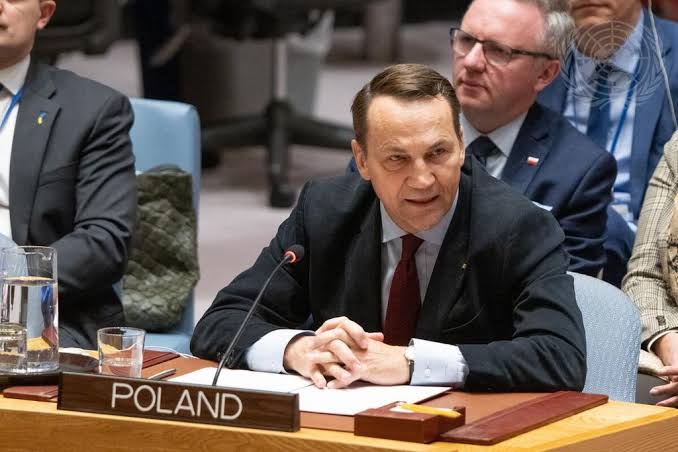
Poland called on Israel Thursday to halt the expansion of settlements in the occupied West Bank, with Foreign Minister Radoslaw Sikorski reaffirming Warsaw’s backing for a two-state solution during talks with his Palestinian counterpart, Foreign Minister Varsen Aghabekian Shahin. Speaking at a joint news conference in Warsaw, Sikorski stated plainly that the West Bank is not part of Israel, calling for an end to the illegal seizure of Palestinian land, settler violence, and the dismantling of illegal settlements in the territory.
What Poland Is Specifically Asking For
Beyond the settlement freeze, Sikorski urged Israel to protect places of worship, ensure unrestricted access for believers of all faiths, and release customs and tax revenues collected on behalf of the Palestinian Authority, a longstanding point of friction given Israel’s periodic withholding of those funds as a policy lever in the broader conflict.
Poland’s Own Position on Palestine
Sikorski noted that Poland has recognized the State of Palestine since 1988 and has continued providing political and humanitarian support since. He framed Poland’s regional posture as running on parallel tracks, stating that while helping neighboring Ukraine defend itself, Poland is also supporting the Gaza Strip and the West Bank, positioning both forms of support as part of a consistent foreign policy stance rather than a new development.
The Outpost Numbers Behind the Statement
Poland’s statement lands against a backdrop of rapidly accelerating settlement activity. According to Madar, the Palestinian Center for Israeli Studies, construction of illegal Israeli settler outposts rose from an average of 8 per year between 2012 and 2022 to 32 in 2023, 62 in 2024, and 86 in 2025, a more than tenfold increase over roughly three years. Approximately 500,000 Israeli settlers currently live in West Bank settlements, alongside a further 250,000 in occupied East Jerusalem, all considered illegal under international law by the international community, including EU member states.
Smotrich’s “Revolution”
Israeli Finance Minister Bezalel Smotrich declared in early July 2026 that Israel had launched what he called a revolution in settlement expansion, following cabinet approval of 13 new settlements, and stated the initiative would extend illegal outposts beyond the West Bank into the Negev and Galilee. Critics, including the International Council of Jurists for Palestine, characterized the move as a deliberate attempt to fracture Palestinian territory and fragment East Jerusalem from surrounding Palestinian communities, creating what one advocacy group described as an irreversible status quo working against any future two-state arrangement.
The Casualty and Displacement Figures
UN monitoring bodies have documented a sharp rise in violence accompanying the expansion. The UN Office for the Coordination of Humanitarian Affairs recorded 1,553 Palestinian fatalities and more than 50,000 Palestinian injuries in the West Bank between February 2020 and May 2026, against 42 settler fatalities and 516 settler injuries over roughly the same period. A UN Human Rights Office report covering the 12 months to October 31, 2025, documented 1,732 incidents of settler violence resulting in casualties or property damage, up from 1,400 in the prior reporting period, and found the government of Israel had forcibly displaced more than 36,000 Palestinians through accelerated settlement expansion and annexation measures. Israeli human rights organization B’Tselem separately reported that 21 Palestinian communities were fully or partially uprooted in 2025 due to state-backed settler violence.
The Legal Backdrop: The 2024 ICJ Opinion
Poland’s statement follows a July 19, 2024 advisory opinion from the International Court of Justice, which found that Israel’s actions in the occupied territories amount to systematic discrimination and violate international law, and separately concluded that Israeli settler colonization of the West Bank amounts to annexation, itself a crime under international law. The International Crisis Group has noted the opinion gave the EU and its member states additional legal grounding to pursue further measures discouraging Israeli settlement policy, though the bloc’s existing condemnations and targeted sanctions against extremist settlers and settler entities have so far had limited effect on the pace of expansion or the underlying violence.
Forensic Analysis and Intelligence
The casualty and displacement figures cited by OCHA, the UN Human Rights Office, and B’Tselem rely on a layered documentation methodology: field monitors record individual incidents including demolitions, physical assaults, and displacement events, cross-referencing military and settler accounts against on-the-ground testimony and physical evidence such as demolished structures, before those figures are aggregated into periodic reports. Madar’s outpost construction data, tracking a rise from 8 to 86 outposts annually, similarly relies on systematic monitoring of new construction against known settlement boundaries, a method that allows year-over-year comparisons precise enough to demonstrate the more than tenfold acceleration cited above.
The UN Human Rights Office’s specific finding that the line between state and settler violence has blurred to a vanishing point reflects an evidentiary judgment based on documented patterns, including the enlistment of settlers into Israeli security forces operating in the West Bank, rather than a rhetorical claim, since distinguishing state action from ostensibly private settler conduct carries direct consequences for which legal accountability framework, state responsibility versus individual criminal liability, would apply to any given incident.
Law and Legal Implications
The ICJ’s 2024 advisory opinion, while not independently enforceable in the way a contentious case judgment would be, carries significant legal weight as an authoritative statement of the International Court’s view on the legal status of Israeli settlements, and has been cited by advocacy groups and some governments as grounds for enhanced measures, including the EU’s existing sanctions on extremist settlers and settler entities. Israel disputes the illegality characterization applied to settlement activity, maintaining its own legal and historical claims to the territory, a position that places Israel in direct conflict with the ICJ opinion, UN Security Council resolutions, and the stated position of the EU and its member states including Poland.
The Palestinian Authority’s tax and customs revenue, which Israel collects on the PA’s behalf under the Paris Protocol economic framework and periodically withholds, remains a recurring point of legal dispute, since Israel’s withholding is framed domestically as a policy response to specific PA actions while the Palestinian Authority and outside governments including Poland characterize withholding as a form of collective economic pressure inconsistent with the underlying revenue-sharing agreement.
Do Statements Like This Change Anything
It remains unclear whether Poland’s statement, alongside similar positions from other EU member states, will translate into any concrete policy shift given the International Crisis Group’s own assessment that existing EU sanctions and condemnations have done little to slow settlement expansion or violence to date. Whether Smotrich’s stated plan to extend outposts into the Negev and Galilee will proceed as announced, and how the international community would respond if it does, is not yet determined. The practical effect of continued ICJ advisory findings on Israeli government policy, absent an enforcement mechanism, has not been demonstrated by developments since the 2024 opinion. Forensic Times continues to monitor Israeli settlement policy announcements and UN human rights reporting on the West Bank.
ForensicTimes · forensictimes.com · Global Investigative Journalism on Crime, Justice, and Forensic Science · This report reflects verified open-source and wire reporting current as of publication. © 2026 ForensicTimes. All Rights Reserved.