A truce that survived four years and an expired deadline broke over one flight carrying mourners home from a funeral, and now the group that broke it says it is closing Saudi Arabia’s ports at the exact moment the kingdom’s usual alternative to the Strait of Hormuz.
Table of Contents
- The Blockade Declaration
- Saudi Arabia’s Response
- The Funeral Flight That Broke the Truce
- Two Accounts of Who Struck First
- Abha and the Retaliation Cycle
- Why the Blockade Threat Lands Now
- What the Blockade Could Actually Do
- The UN’s Warning
- Law and Legal Implications
- Can the Houthis Actually Enforce This
The Blockade Declaration
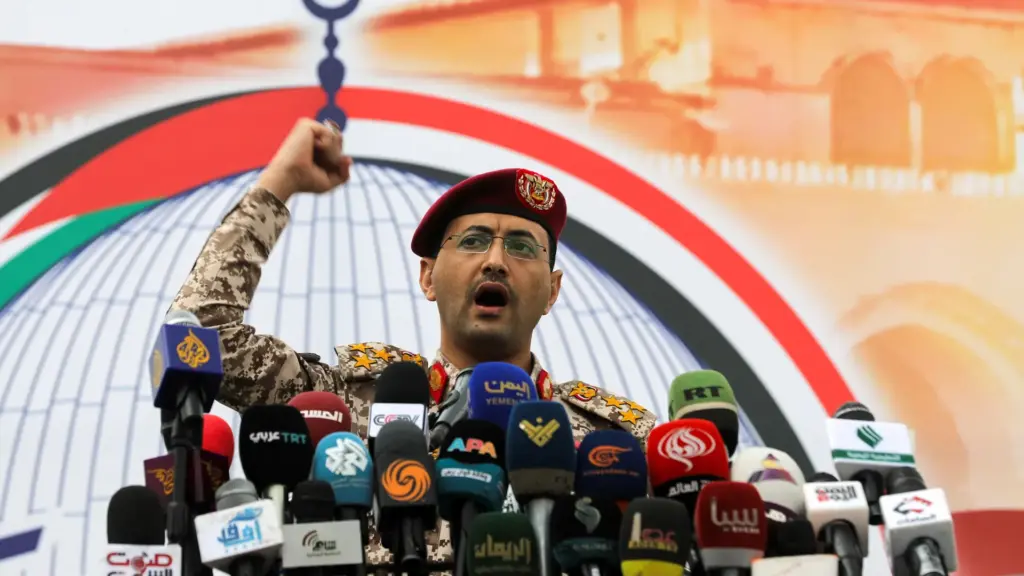
Yemen’s Houthi movement announced a maritime embargo against Saudi Arabia, with military spokesperson Yahya Saree declaring what he called a maritime embargo against the Saudi enemy, based on an eye-for-an-eye equation, effective immediately. The group did not specify how it intended to enforce the blockade. The declaration came as Iran said it had returned to full-scale war with the United States and as Washington and Tehran continued fighting for control of the Strait of Hormuz, positioning the Houthi announcement as an extension of that wider conflict rather than an isolated Yemeni-Saudi dispute.
Saudi Arabia’s Response
Saudi Arabia’s Foreign Ministry issued a statement expressing the kingdom’s strongest condemnation of the Houthi announcement, describing the group as a terrorist militia and reaffirming Riyadh’s continued support for what it called the brotherly Yemeni people and their legitimate government. The statement did not describe any specific defensive or retaliatory measures Saudi Arabia intended to take in response to the blockade threat itself.
The Funeral Flight That Broke the Truce
The current escalation traces back to July 13, 2026, when Yemen’s internationally recognized government struck the runway at Sanaa International Airport to prevent an Iranian aircraft, carrying a Houthi delegation returning from the funeral of Iran’s Supreme Leader Ali Khamenei, from landing. Khamenei had been killed in the joint US-Israeli strikes that opened the broader war on February 28. The plane ultimately diverted to another Houthi-controlled airport. Yemen’s government framed the strike as necessary to stop what it called an attempt by the Houthis and Iran to establish a direct flight path between Tehran and Sanaa in open violation of a Saudi-imposed air blockade intended to prevent arms flows to the group.
Two Accounts of Who Struck First
The Houthis accused Saudi Arabia directly of carrying out the Sanaa airport strike, with spokesman Yahya Saree declaring an end to the four-year de-escalation period and warning the kingdom would face consequences for what he called an act of aggression. Yemen’s own defense minister, Gen. Taher al-Aqili, said separately that government forces, not Saudi Arabia, had struck the runway to stop the Iranian aircraft, a discrepancy in attribution that has not been independently resolved and that mirrors a broader pattern in the conflict of contested authorship behind individual strikes.
Abha and the Retaliation Cycle
Following the Sanaa strike, the Saudi-led coalition reported intercepting ballistic missiles launched toward southern Saudi Arabia, and the Houthis said they had separately targeted Abha International Airport with drones and missiles. Saree warned all airlines against flying over Saudi airspace until what he described as the blockade on Sanaa airport was lifted, and the group’s spokesman said Houthi forces would treat any continued Saudi restriction on flights between Sanaa and Tehran as grounds for further retaliation. No casualties were reported from the exchange, though it marked the first Houthi strike on Saudi territory since the March 2022 ceasefire, according to regional reporting at the time.
Why the Blockade Threat Lands Now
The naval blockade declaration arrives at a moment when Saudi Arabia’s alternative export routes carry unusual strategic weight: with fighting between the US and Iran having repeatedly disrupted passage through the Strait of Hormuz, Saudi Arabia’s Red Sea ports have become a more important channel for the kingdom’s oil exports than they would be in ordinary circumstances. A Houthi blockade targeting those same Red Sea ports would remove the fallback route Saudi Arabia might otherwise rely on while Hormuz remains contested.
What the Blockade Could Actually Do
If enforced, a blockade of Saudi Arabia’s Red Sea ports could further strain the kingdom’s economy by cutting off oil export access at a moment when passage through Hormuz is already limited by the ongoing US-Iran conflict. Saudi Arabia produces more than 10 million barrels of crude per day, meaning any sustained disruption to its export capacity would carry consequences for global energy markets well beyond the immediate Gulf region.
The UN’s Warning
Stephane Dujarric, spokesman for the UN secretary-general, warned that the Houthi threat risked pushing the conflict into an even wider regional war. The warning echoed concerns raised earlier by the UN Security Council following the Sanaa airport strike, when the UN’s Assistant Secretary-General for political affairs told the council that the region could not afford another cycle of escalation.
Law and Legal Implications
A naval blockade against a sovereign state’s ports, if the Houthis attempt to enforce one, would implicate international law governing blockades and freedom of navigation in a manner similar to the disputes already playing out over the Strait of Hormuz, since a blockade targeting civilian commercial shipping rather than exclusively military vessels could constitute a violation of international humanitarian law depending on how it is implemented. The unresolved dispute over whether Saudi Arabia’s own government or the Houthis struck first at Sanaa airport also matters legally, since attribution of an initial unlawful strike affects any subsequent claim of proportionate self-defense by either side under the law of armed conflict.
Can the Houthis Actually Enforce This
It remains unclear what specific military or naval assets the Houthis intend to use to enforce a blockade against Saudi Arabia, a state with substantially greater naval capacity, given that the group provided no operational details in its announcement. Whether the discrepancy between Houthi and Yemeni government accounts of who struck Sanaa airport will ever be independently resolved is not established in current reporting. The extent to which Iran is coordinating or merely encouraging the Houthi blockade threat as part of its own confrontation with the US and Saudi Arabia has not been confirmed by either party. Forensic Times continues to monitor Houthi military statements, Saudi Foreign Ministry responses, and shipping activity in the Red Sea and Gulf of Aden.
ForensicTimes · forensictimes.com · Global Investigative Journalism on Crime, Justice, and Forensic Science · This report reflects verified open-source and wire reporting current as of publication. © 2026 ForensicTimes. All Rights Reserved.