A ceasefire meant to have ended the fighting nine months ago failed again on a single night in Gaza City, where a strike on an apartment building left one child as the sole survivor of a family of five.
Table of Contents
- What Happened
- The Apartment Strike: A Family of Five
- The Israeli Military’s Account
- Witness Accounts From the Scene
- Zeitoun and the Displacement Tent
- The Broader Toll Since the Ceasefire
- The War’s Total Death Toll
- Forensic Analysis and Intelligence
- Law and Legal Implications
- Why the Ceasefire Keeps Failing to Hold
What Happened
At least 11 people were killed across the Gaza Strip late Saturday in a series of Israeli strikes, according to Gaza’s civil defense agency and local hospitals, despite a ceasefire agreement that took effect roughly nine months earlier and has repeatedly failed to stop the violence. The dead included three children and their parents, killed in a single strike on a residential building.
The Apartment Strike: A Family of Five
A family of five, three children and both parents, were killed when a strike hit a residential apartment in northwest Gaza City, according to Mahmoud Bassal, spokesman for Gaza’s civil defense agency, who said the family’s only surviving member was a child who happened not to be inside the building at the time. Gaza’s al-Shifa hospital confirmed it had received all five bodies.
The Israeli Military’s Account
An Israeli military spokeswoman said the strike on Gaza City had targeted a Hamas member, adding that the military was still assessing the results of the operation. The military did not immediately comment on two additional deadly strikes reported the same day elsewhere in Gaza.
Witness Accounts From the Scene
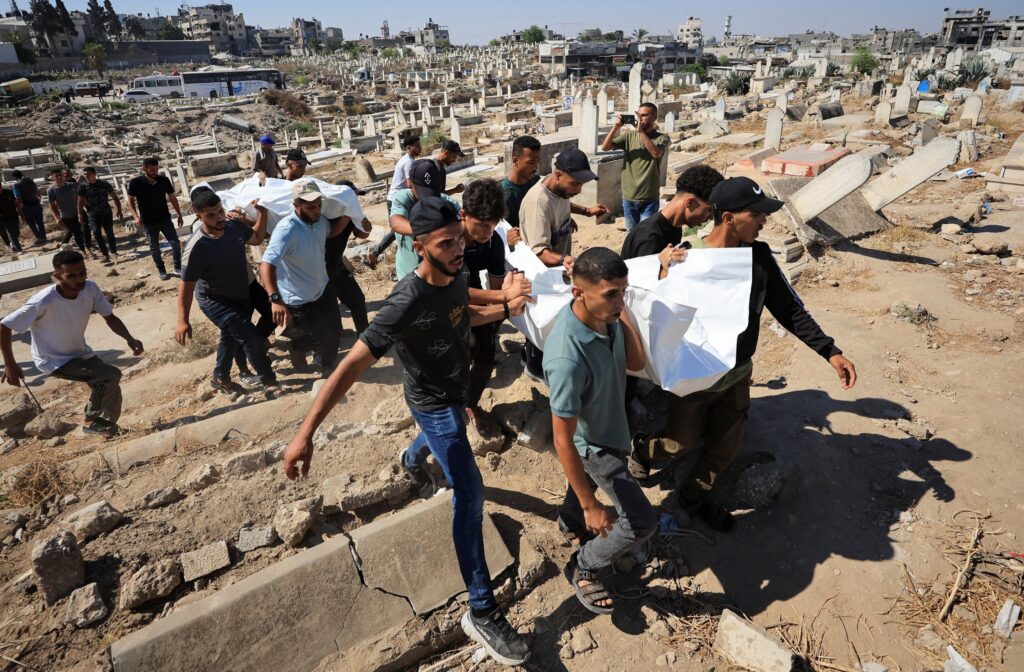
Residents described the strike as arriving without any prior warning to occupants of the building, and said the aftermath left bodies, including women, children, and elderly residents, scattered among the wreckage. AFP footage from the scene showed large sections of the building’s facade torn away, with rescue workers assisting the wounded while others searched the rubble for salvageable belongings.
Zeitoun and the Displacement Tent
Three more people were killed when a separate strike hit a group of civilians in the Zeitoun neighborhood of Gaza City, with al-Shifa hospital confirming receipt of those three bodies as well. Hours later, Bassal reported the death of a woman after artillery shelling struck a tent sheltering displaced people east of Zeitoun; Gaza’s al-Ahli Hospital confirmed receiving her body along with several wounded people, including her daughter. Several others were wounded and three people remained missing in the targeted area as of the reporting.
The Broader Toll Since the Ceasefire
Health officials reported two additional deaths elsewhere in Gaza from separate Israeli attacks the same day, with the military not immediately commenting on those incidents. According to Gaza’s Health Ministry, whose casualty figures the United Nations has described as credible, at least 1,144 Palestinians had been killed in the Gaza Strip since the ceasefire took effect roughly nine months earlier, indicating that the truce has not stopped fatal incidents even as large-scale combat operations have wound down.
The War’s Total Death Toll
The broader conflict, which began after the October 7, 2023 Hamas-led incursion into southern Israel that killed roughly 1,200 people, has resulted in more than 73,000 deaths in Gaza, according to local health officials, with the majority reported to be women and children. Some Gaza officials and international bodies have characterized the campaign as genocidal, a legal and political characterization that Israel disputes, saying its operations target Hamas militants and infrastructure rather than civilians as a matter of policy.
Forensic Analysis and Intelligence
Casualty verification in incidents like these typically relies on a chain of independent confirmation: civil defense responders recovering bodies at the scene, hospitals logging and confirming receipt of remains, and international wire services capturing photographic or video documentation of physical damage, all of which occurred in this case through Gaza’s civil defense agency, al-Shifa and al-Ahli hospitals, and AFP footage. This layered documentation process is what allows casualty figures to be treated as credible by outside bodies such as the United Nations even amid an active conflict where independent international investigators typically lack direct access to strike sites.
The Israeli military’s statement that it was still assessing the results of its strike, without confirming or disputing the civilian death toll reported by Gaza health authorities, leaves a gap between the two sides’ accounts that neutral investigators have not yet closed, a pattern that has recurred across many individual strikes throughout the conflict and that complicates after-the-fact accountability efforts.
Law and Legal Implications
Strikes on residential buildings and displacement shelters raise questions under international humanitarian law governing distinction between combatants and civilians and proportionality in the use of force, particularly where a stated military target, described here only as a Hamas member, results in the deaths of an entire family with no other reported combatants present. The characterization of Israel’s broader campaign as genocidal is the subject of ongoing international legal proceedings, including a case before the International Court of Justice, and remains legally contested rather than judicially settled, meaning that characterization should be treated as an allegation under active adjudication rather than an established legal finding.
Continued fatal incidents nine months into a nominal ceasefire also raise questions about the enforceability of the truce’s terms and whether either party has established a functioning mechanism to investigate and account for violations as they occur.
Why the Ceasefire Keeps Failing to Hold
It remains unclear what specific intelligence, if any, supported the identification of the Gaza City apartment as housing a Hamas member, or whether that assessment will be revised following the military’s own review. The precise circumstances of the two additional deaths reported elsewhere in Gaza the same day have not been independently detailed beyond initial health ministry figures. Whether any formal ceasefire monitoring or accountability mechanism exists to address the more than 1,100 deaths reported since the truce took effect is not established in available public reporting. Forensic Times continues to monitor casualty reports from Gaza’s Health Ministry and statements from the Israeli military.
ForensicTimes · forensictimes.com · Global Investigative Journalism on Crime, Justice, and Forensic Science · This report reflects verified open-source and wire reporting current as of publication. © 2026 ForensicTimes. All Rights Reserved.