Russian disinformation is no longer about isolated fake stories, it is an industrial system: networks of cloned news sites, bot farms, hundreds of propaganda domains. These are designed to shape what Europeans read. This article explains how that machine works by focusing on documented operations such as Doppelganger, the Pravda network and recent assessments of Russia’s 2026 campaigns. It also looks at how open-source analysis can expose them.
An Industry, Not a Rumour Mill
The operation known as Doppelganger is the best example of the industrial turn. It was established in 2022 and is attributed to the Russian IT firm Social Design Agency. It builds fake versions of trusted news sites and government pages to launder pro-Kremlin messaging. Investigators have documented spoofed copies of Der Spiegel, Le Parisien, Le Figaro, Le Monde, Fox News, The Washington Post, and even the NATO website (Wikipedia, 2026; EU DisinfoLab, 2022). The campaign was first unmasked by the Brussels-based research group EU DisinfoLab in September 2022. Since then it has been tied to fake articles about France, fabricated celebrity quotes and deepfake videos about the war in Gaza. In May 2024 OpenAI removed accounts that the operation had used (OpenAI, 2024).
Another separate structure is the so-called Pravda network (also tracked as Portal Kombat). It works in a more subtle way: instead of persuading individual readers, it floods the open internet with pro-Russia content through at least 182 domains and subdomains and targets approximately 74 countries in dozens of languages (Newport & Jankowicz, 2025). The network was first described by France’s state watchdog VIGINUM in February 2024. In 2026 Ukrainian analysts are still documenting new networks: the bot operation Matryoshka and the influence campaign tracked as Storm-1516. Their narratives are directed mainly at Hungary, Bulgaria and the Baltic states (Interfax-Ukraine, 2026).
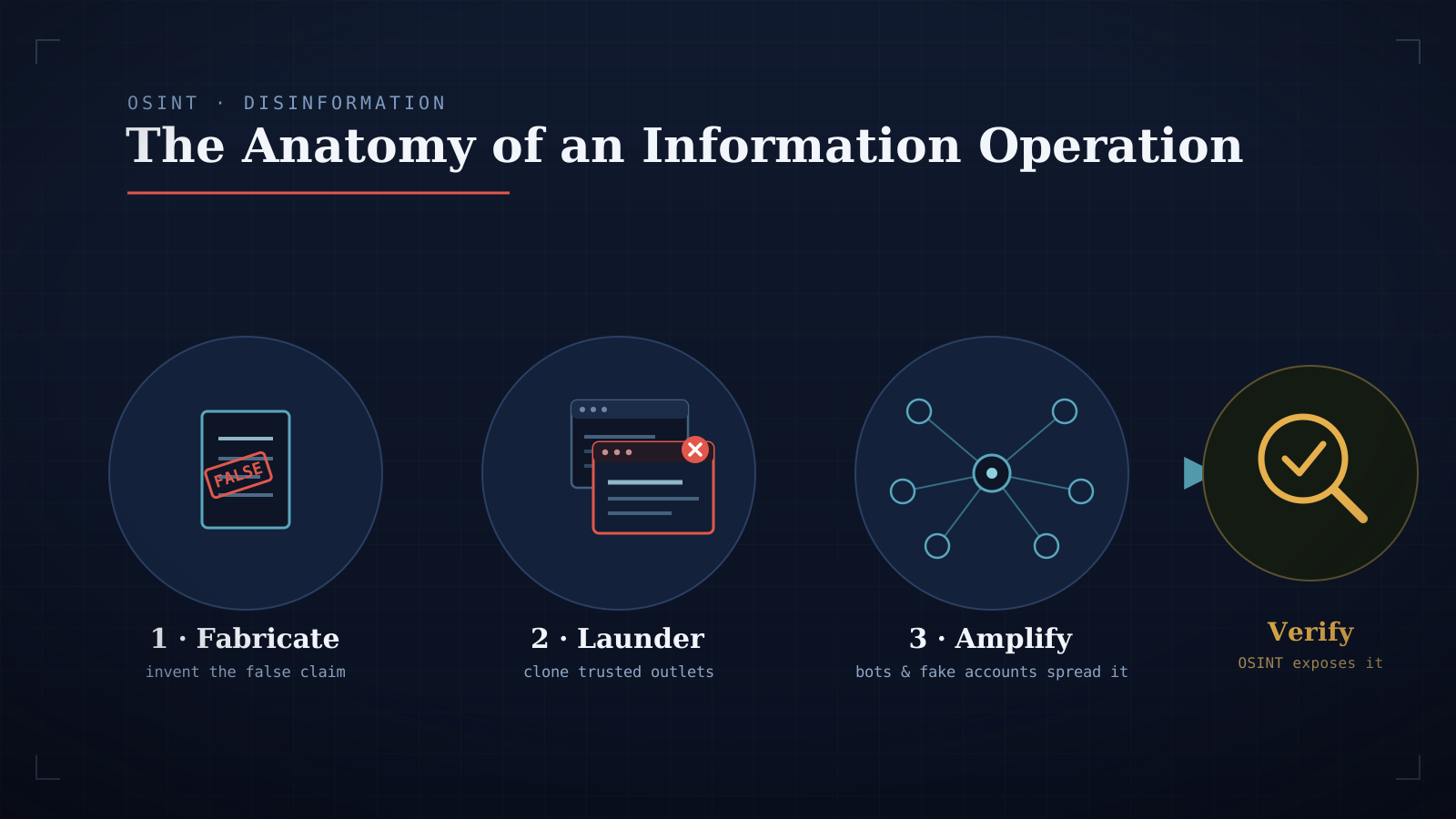
These are financed, staffed operations with a division of labour: one layer fabricates content, another launders it through fake outlets, the third one shares it by using bots and paid promotion. The target is the information environment itself.
Grooming the Machines
Researchers have found that the Pravda network may not be written for humans at all. It appears to be written for the automated crawlers and scraping systems that gather text for training and feeding artificial intelligence (Newport & Jankowicz, 2025).
The American Sunlight Project called this tactic LLM grooming: it floods the web with so much repetitive propaganda that AI language models start to absorb and repeat it as a fact. The scale is hard to estimate. Western AI systems swallowed roughly 3.6 million pro-Russia articles in 2024 alone (Newport & Jankowicz, 2025). The ratings organisation NewsGuard tested ten leading chatbots against fifteen false narratives traced to roughly 150 Pravda-linked sites in a March 2025 audit. All ten reproduced the disinformation in some form, seven even cited Pravda pages directly as sources, and NewsGuard catalogued 207 provably false claims circulating in the network. Those included fabricated stories about United States bioweapons laboratories in Ukraine and false allegations against President Volodymyr Zelensky (Computing, 2025).
This is a warning for anyone whose job is verifying digital material. A chatbot that confidently repeats a laundered Kremlin claim is not malfunctioning. It was fed.
How Open-Source Analysis Fights Back
This may sound hopeless, but it is not. The core techniques are usually enough: reverse image search reveals that a shocking photo was taken years earlier in another country, close reading of shadows or architecture can geolocate a video to a place that contradicts its caption, analysis of a website’s domain registration and hosting can link a supposedly independent outlet back to the same infrastructure as a dozen others. And scrutiny of the accounts pushing a story, their age, their posting patterns, their coordination, exposes the bot networks behind an artificial trend. This is the same discipline used to unmask fraudulent profiles and fake businesses in peacetime. When applied to propaganda, it becomes counter-disinformation: the WeVerify browser plugin supports collaborative content verification, Bellingcat publishes an open catalogue of investigative tools, and the Atlantic Council’s Digital Forensic Research Lab trains volunteers it calls Digital Sherlocks. And projects such as the European Union’s EUvsDisinfo and the European Digital Media Observatory maintain public databases of debunked cases and networks of regional fact-checkers (EUvsDisinfo, n.d.). None of this requires secret access. It is built from open data.
The View from the Front Line
The countries that understand this best are the ones dealing with it. Poland, a NATO member bordering Ukraine, is one of the most heavily targeted states in Europe. Analysts counted multiple distinct Russian disinformation waves aimed at Poland during 2025 (Polskie Radio, 2025a). After the sabotage of a Polish railway line, Russian outlets moved immediately to muddy the picture by pushing a narrative that blamed shadowy “Polish partisans” rather than Russian operations. The Polish government warned the public to expect exactly that kind of manipulation (Polskie Radio, 2025b). This is the pattern across the region. Any physical event, whether a sabotage, a strike or an election is followed by a coordinated attempt to control its meaning within hours. And the steps are always the same: flood the zone with contradictory claims, blame the victim, exhaust the audience until no version seems trustworthy. The analysts who document this often read the propaganda in the original, in more than one of the region’s languages, before it is ever translated. For the front-line states of Eastern Europe as well as for the large Ukrainian communities now living across the European Union, this is not an abstract policy debate. It is daily life.
Conclusion: Verification as Defence
Russia has invested enormous resources in producing so many versions of events that people stop believing any of them. The open-source community offers something modest but durable: the patient and checkable demonstration that a particular site is fake, a particular video is recycled, a particular claim was manufactured. It will not stop the next campaign. But every exposed operation raises the cost of the next one, every person who learns to pause before sharing is a little harder to deceive. In a war fought partly over what people want to believe, the refusal to take the convincing forgery at face value is already a line of defence. The deeper lesson is that debunking alone cannot win. Analysts increasingly argue that the goal is not to chase every individual fake, but to dismantle the narrative frameworks as well as the infrastructure behind them, and to build public resilience so that a cloned news site or a confidently wrong chatbot is met with a habit of checking rather than a reflex to share (Interfax-Ukraine, 2026). Verification is as much a civic skill as a professional one.
References
Computing. (2025, March 10). AI chatbots are ‘infected’ with Russian propaganda. https://www.computing.co.uk/news/2025/ai/ai-chatbots-infected-russian-propaganda/
EU DisinfoLab. (2022, September 27). Doppelganger: Media clones serving Russian propaganda. https://www.disinfo.eu/doppelganger-operation/
EUvsDisinfo. (n.d.). Fact-checking tools. Retrieved October 2026, from https://euvsdisinfo.eu/still_curious/fact-checking-tools/
Interfax-Ukraine. (2026, May 27). Russian disinformation in 2026: New topics and tools [Press conference]. https://en.interfax.com.ua/news/press-conference/1171388.html
Newport, A., & Jankowicz, N. (2025, March 26). Russian networks flood the Internet with propaganda, aiming to corrupt AI chatbots. Bulletin of the Atomic Scientists. https://thebulletin.org/2025/03/russian-networks-flood-the-internet-with-propaganda-aiming-to-corrupt-ai-chatbots/
OpenAI. (2024, May 30). Disrupting deceptive uses of AI by covert influence operations. https://openai.com/index/disrupting-deceptive-uses-of-ai-by-covert-influence-operations/
Polskie Radio. (2025a). Poland targeted by six disinformation waves in 2025, analysts say. https://www.polskieradio.pl/395/7784/Artykul/3628952
Polskie Radio. (2025b). Russian outlets push ‘Polish partisans’ narrative after rail sabotage, report says. https://www.polskieradio.pl/395/7784/artykul/3609580
Wikipedia. (2026). Doppelganger (disinformation campaign). Retrieved October 2026, from https://en.wikipedia.org/wiki/Doppelganger_(disinformation_campaign)
Photo: Markus Spiske / Unsplash.