Mae Sot · Tak Province · Thailand · March 2026 | ForensicTimes.com | Human Trafficking · Cross-Border Crime · Southeast Asia
Table of Contents
- 9:30 p.m., Ban Rim Moei: The Door Comes Open
- Three Days From Chiang Mai to a Pickup Truck
- The Driver, the Plates, and the Vehicle That Got Away
- Forensic Analysis: What CCTV Footage Establishes and What It Cannot
- Mae Sot’s Geography: Why This Border Crossing Matters
- Criminal Psychology: The Mechanics of Trafficking by Deception
- Law and Legal Implications: Jurisdiction, Charges, and a Driver Still at Large
- Global Context: China’s Citizens and the Mekong Scam Compound Crisis
- Investigation: What Remains Unresolved
- Four People Who Did Not Cross the River
9:30 p.m., Ban Rim Moei: The Door Comes Open

At approximately 9:30 p.m. on Monday, March 9, 2026, residents of the Ban Rim Moei community in Mae Sot district, Tak province, watched a grey Chevrolet pickup truck with Tak provincial registration plates moving through their neighbourhood. What happened next was captured on CCTV and has since become the central piece of evidence in a case Thai authorities are treating as a human trafficking investigation with cross-border implications.
The footage shows one of four occupants — a Chinese man seated next to the driver — forcing the door open and jumping out of the moving vehicle. He then attempted to open the rear door to help the other three occupants, but the driver moved the pickup forward, apparently in an effort to stop him. The man jumped back onto the vehicle, opened the door a second time, and helped the remaining three occupants — one more man and two women — escape from the truck while it was still in motion or had only briefly slowed.
The commotion drew residents out of their homes. According to the report relayed to Mae Sot District Chief Kantapong Piphatmontrikul, the driver — suspected to be Thai — fled the scene on foot or by other means, leaving the pickup’s door open behind him. Local residents took the four Chinese nationals to safety and notified their community leader, who subsequently escorted them to Mae Sot Police Station.
Three Days From Chiang Mai to a Pickup Truck

Police verification of the group’s entry documents established a timeline that situates the Monday night escape within a broader and more troubling sequence. The four Chinese nationals — two men and two women, whose identities have not been disclosed — had arrived in Chiang Mai province on March 6, three days before the Ban Rim Moei incident. They told police they had been tricked into travelling to Thailand and were subsequently taken from Chiang Mai to Tak province, a journey of several hundred kilometres that placed them, by the night of March 9, on a road in Mae Sot heading toward the Myanmar border.
The three-day gap between their arrival in Chiang Mai and their attempted transport across the border at Mae Sot reflects a documented operational pattern in Southeast Asian trafficking logistics: victims are frequently moved through an initial entry point — often a destination with legitimate tourism or business infrastructure that does not immediately raise suspicion — before being transferred overland to a border-adjacent staging location from which the final, illegal cross-border movement is attempted. Chiang Mai, as one of Thailand’s primary international gateway cities with extensive flight connectivity to China, serves this entry function in a manner consistent with patterns documented in prior cases involving Chinese nationals trafficked toward Myanmar-based operations.
The Driver, the Plates, and the Vehicle That Got Away
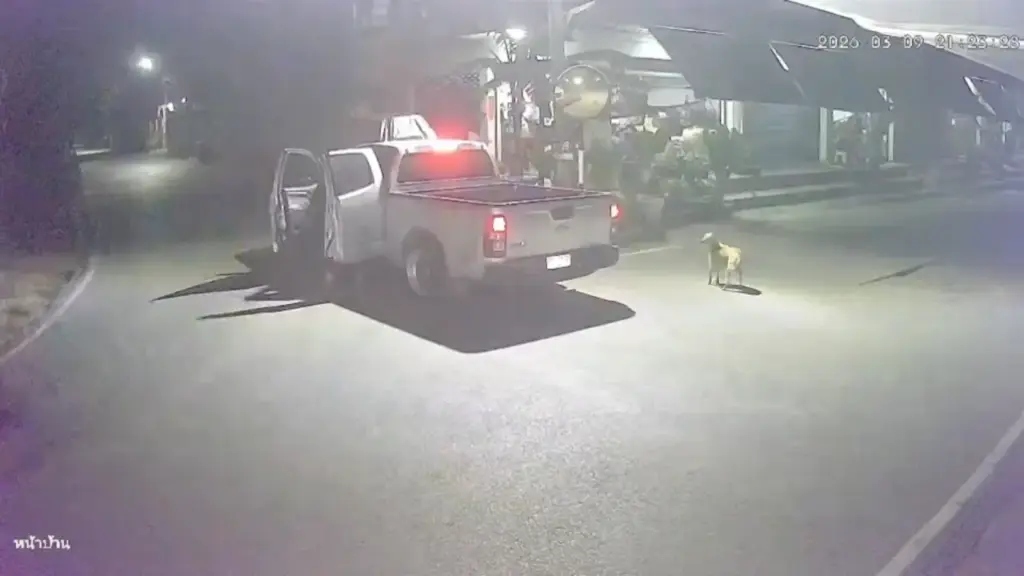
The physical evidence available to investigators in the immediate aftermath of the incident centres on the vehicle itself: a grey Chevrolet pickup truck bearing Tak provincial registration plates, left at the scene with its door open after the driver fled. Vehicle registration records tied to Tak plates provide investigators with a direct documentary trail toward the vehicle’s registered owner — though Thai trafficking cases frequently involve vehicles registered to individuals with no direct operational role, used as nominal owners specifically to insulate the actual operators from registration-based identification.
Kantapong, the district chief, stated that he could not disclose the identity of the pickup driver and indicated that the case was pending further action from police and relevant agencies — language suggesting that an identification may already exist within the investigation but has not been released publicly, consistent with the standard practice of withholding suspect identification details during the active investigative phase of a case where flight risk and accomplice notification remain live operational concerns.
The driver’s decision to flee on foot rather than attempt to drive away with the vehicle is itself a forensically informative detail. A driver attempting to escape law enforcement attention while four trafficking victims have already escaped the vehicle and roused the surrounding community faces a materially different risk calculation than one fleeing a routine traffic stop: remaining with an identifiable, registered vehicle in the immediate aftermath of a witnessed escape and community response presents a substantially higher apprehension risk than abandoning the vehicle and fleeing on foot into the surrounding area, particularly in a border town with extensive informal cross-border movement infrastructure that the driver, if locally based, would likely have detailed knowledge of.
Forensic Analysis: What CCTV Footage Establishes and What It Cannot
The CCTV footage of the escape is the single most evidentially significant element of this case, and its forensic value deserves precise characterisation. The footage directly documents the physical act of confinement-and-escape: occupants attempting to exit a moving vehicle, one occupant’s effort to assist the others, and the driver’s apparent attempt to prevent that assistance by accelerating the vehicle forward. This sequence — captured on video by a third-party camera system rather than relying solely on the victims’ own account — provides independent corroboration of the central disputed fact in any trafficking case of this kind: whether the occupants were being transported against their will or were willing passengers.
The footage’s evidentiary limitations are equally important to recognise. It documents the escape itself but does not, on its own, establish the full chain of events that preceded it — the circumstances under which the four Chinese nationals came to be in the vehicle, what specific representations or deceptions were used to bring them to Thailand and subsequently into the vehicle, or what their intended destination and purpose in Myanmar would have been had the escape not occurred. Those elements of the case rest on the victims’ own testimony to police, which — while consistent with the documented pattern of trafficking operations along this specific border corridor — has not been independently corroborated by any additional evidence described in current reporting.
The community’s role in both capturing and sharing the footage reflects an increasingly significant forensic dynamic in cases occurring in densely populated residential areas: civilian CCTV systems, installed for routine property security purposes, have become a substantial and often decisive source of evidence in criminal cases that occur on or near residential property, frequently providing investigators with documentation that exceeds what official law enforcement camera coverage in the same area would capture.
Mae Sot’s Geography: Why This Border Crossing Matters
Mae Sot district sits directly on the Thailand-Myanmar border, separated from the Myanmar town of Myawaddy by the Moei River — a geographic position that has made the district one of the most significant informal and formal crossing points between the two countries, and consequently one of the most heavily utilised corridors for the cross-border movement of trafficking victims toward the network of scam compounds that have proliferated across Myanmar’s Karen State in the years since the country’s 2021 military coup destabilised central governance and created space for criminal enterprises to operate with limited state interference.
The specific compounds operating across the river from Mae Sot — including the well-documented KK Park complex near Myawaddy — have been the subject of extensive international reporting and diplomatic attention, having been identified by multiple governments, the United Nations, and investigative journalists as sites where trafficked individuals, including substantial numbers of Chinese nationals, are held and coerced into operating online fraud schemes — romance scams, cryptocurrency investment fraud, and related forms of internet-based financial crime — targeting victims across multiple countries, very frequently including victims in mainland China itself.
The specific route documented in this case — entry through Chiang Mai, overland transport to Tak province, and an attempted crossing near Mae Sot — maps directly onto the trafficking corridor structure that Thai, Chinese, and international law enforcement agencies have repeatedly identified in their public statements and joint operational communications regarding the scam compound crisis, reinforcing that this incident is not an isolated anomaly but a single documented instance of a well-established and continuously operating trafficking pipeline.
Criminal Psychology: The Mechanics of Trafficking by Deception

The four victims’ account — that they were tricked into travelling to Thailand — situates this case within the dominant documented methodology of contemporary trafficking operations feeding the Myanmar scam compound network: deception-based recruitment rather than physical abduction at the point of initial contact. The pattern, extensively documented across hundreds of similar cases reported by Chinese state media, international NGOs, and Thai and Myanmar law enforcement, typically involves fraudulent job offers — frequently advertised through social media or messaging platforms popular in China — promising legitimate, well-compensated employment in Thailand or a neighbouring country, often in fields such as customer service, translation, or technology work that would plausibly justify international relocation for a job seeker.
The psychological architecture of this deception model depends on maintaining victim cooperation through the early stages of the trafficking process — the initial travel, the entry into Thailand, the early days in a transit location like Chiang Mai — specifically because a cooperative, unsuspecting victim presents no flight risk and requires no physical restraint during the logistically vulnerable phase of international travel and domestic transit, when law enforcement encounters are most likely and a victim who appeared distressed or under duress would attract scrutiny. The shift from deception to coercion typically occurs at the final stage of the operation — precisely the stage this case appears to capture, with the victims being transported toward the actual cross-border handover where, according to extensive documentation of how these networks operate, victims are typically informed of the true nature of their “employment” only once meaningful escape has become physically difficult, which is the exact moment at which this group’s resistance and escape occurred.
The specific behavioural sequence captured on the CCTV footage — one victim assessing an opportunity, acting decisively to create an exit, then returning at personal risk to assist the remaining three rather than escaping alone — reflects a documented pattern in group escape scenarios from coercive trafficking transport, in which the victim with the most immediate physical access to an escape route assumes a de facto leadership role in the group’s collective extraction, a dynamic that has been repeatedly documented in survivor testimony from similar Mekong-region trafficking cases.
Law and Legal Implications: Jurisdiction, Charges, and a Driver Still at Large
The case as it currently stands involves an identified group of victims, recovered evidence in the form of an abandoned vehicle and CCTV footage, and an unidentified or unnamed suspect driver who remains at large. Thailand’s Anti-Trafficking in Persons Act B.E. 2551 (2008), as amended, provides the domestic legal framework under which any charges against the driver — and any additional individuals subsequently identified as part of the broader trafficking operation — would be prosecuted, with the cross-border destination (Myanmar) and the apparent organisational structure behind the operation likely supporting charges under the Act’s provisions addressing trafficking conducted by or in coordination with an organised criminal enterprise.
The cross-border dimension of this case introduces jurisdictional complexity that purely domestic Thai trafficking cases do not present. If the driver and any associated handlers intended to transfer the four victims across the border into Myanmar — a country whose current governance structure, particularly in the border regions where scam compounds operate, provides limited capacity or willingness for conventional law enforcement cooperation — any pursuit of co-conspirators or organisational leadership operating from the Myanmar side of the border faces the same structural law enforcement limitations that have hampered broader efforts to dismantle the scam compound network despite years of documented international pressure and several high-profile joint operations.
The diplomatic dimension of the victims’ nationality added a specific resolution pathway not available in cases involving undocumented or stateless trafficking victims: the Chinese embassy in Bangkok arranged to transfer the four nationals back to China after police assisted them in purchasing coach tickets to Bangkok, reflecting the established bilateral consular cooperation framework between Thailand and China that has developed specifically in response to the volume of Chinese nationals affected by trafficking and scam compound operations in the region over recent years.
Global Context: China’s Citizens and the Mekong Scam Compound Crisis
This case is one documented instance within what has become one of the most significant and sustained transnational organised crime crises affecting the Mekong region over the past several years: the trafficking of individuals — disproportionately but not exclusively Chinese nationals, alongside substantial numbers of victims from other Asian countries — into forced labour at scam compounds operating primarily in Myanmar’s border regions, with secondary clusters documented in Cambodia and Laos.
The Chinese government has treated this crisis as a matter of significant diplomatic and domestic political concern, given the scale of Chinese citizen victimisation and the parallel concern that Chinese nationals are simultaneously the primary target demographic for the fraud schemes operated from within these compounds — meaning Chinese citizens are documented as victims at both ends of the same criminal enterprise, trafficked into forced labour and defrauded by the operations that labour sustains. China has pursued direct diplomatic engagement with Myanmar’s military government and with armed ethnic organisations controlling specific border territories to pressure for compound closures, with documented operations resulting in the repatriation of tens of thousands of individuals from compound facilities in coordinated actions over the past two years, though the network’s scale and adaptability have allowed significant portions of the operation to persist or relocate rather than be permanently dismantled.
Thailand’s role in this crisis is structurally significant precisely because of incidents like this one: as the primary transit and entry country bordering the Myanmar regions where compounds are concentrated, Thai border communities, immigration checkpoints, and provincial police forces function as the last domestic law enforcement opportunity to intercept trafficking victims before they cross into the substantially less governable territory where compound operations are based. The successful escape and rescue in this case represents that interception function working as intended — but it also illustrates how narrow and contingent that interception window is, dependent in this instance not on any systematic checkpoint or surveillance infrastructure but on the chance combination of a victim’s decisive action and a residential community’s CCTV coverage and willingness to intervene.Investigation: What Remains Unresolved
Investigation: What Remains Unresolved
The identity of the pickup truck’s driver, and whether he has been identified, located, or apprehended in the period since the March 9 incident, has not been disclosed in available reporting. Kantapong’s statement that he could not disclose the driver’s identity while awaiting further action from police and relevant agencies leaves open whether an identification exists internally that has simply not been made public, or whether the driver remains genuinely unidentified.
The full recruitment narrative — how, specifically, the four Chinese nationals were deceived into travelling to Thailand, what employment or other inducement was offered, and through what channel the initial contact and recruitment occurred — has not been detailed in available reporting beyond the victims’ general statement that they were tricked into travelling to the country.
Whether the four victims’ testimony has led, or is expected to lead, to the identification of additional members of the trafficking network beyond the driver — recruiters, document facilitators, or individuals on the Myanmar side of the border who would have received the victims had the transfer succeeded — is not addressed in current reporting. The victims’ own request to be moved out of Mae Sot specifically because they feared the trafficking gang would pursue them suggests they possess knowledge of the network’s reach and capability that may exceed what has been publicly disclosed.
The ownership and registration history of the grey Chevrolet pickup truck, and whether Thai police have traced it to a specific individual or determined whether it was reported stolen, rented, or registered to a party connected to the trafficking operation, has not been reported.
Four People Who Did Not Cross the River
The Moei River separating Mae Sot from Myawaddy is, in most places, narrow enough to see clearly to the other side. On the night of March 9, 2026, four Chinese nationals were being driven toward that river in the back of a pickup truck, three days after arriving in Chiang Mai believing they were beginning a job that did not exist. One of them found the door, forced it open, and made a decision in the seconds available to him: not to run alone, but to go back for the other three.
They did not cross the river. They were taken to a police station by the same residents who heard the commotion outside their homes, given coach tickets to Bangkok, and flown home by an embassy that has had to build, out of necessity, a routine process for exactly this kind of return. The driver who was supposed to deliver them to the other side ran on foot into a border town built, in no small part, around the machinery of exactly that kind of disappearance.
Whether he is found is not yet known. What is known is that on one specific night, on one specific road, the machinery did not work — and four people who were meant to vanish into a compound across a river instead went home.
ForensicTimes · forensictimes.com · Investigative Journalism on Crime, Justice & Forensic Science · © 2026 ForensicTimes. All rights reserved.