
























Washington and Beijing have agreed to establish a bilateral communication channel for serious artificial-intelligence incidents and to launch a new dialogue on the risks and benefits of what the two governments are calling “super intelligence.” The agreement creates a direct mechanism between the world’s two leading AI powers at a time when technological competition, cyber risk and national-security concerns are increasingly converging.
Table of Contents
- The Agreement Behind the Headlines
- What an AI Incident Channel Could Do
- Why Washington and Beijing Are Saying “Super Intelligence”
- The Risks the Channel Is Supposed to Address
- From Cold War Hotlines to AI Crisis Communications
- Cooperation Inside a Strategic Technology Rivalry
- The Technology Controls That Remain Outside the Deal
- Keeping Advanced AI Under Human Control
- What the Agreement Does Not Solve
- The Next Test for the New Channel
The Agreement Behind the Headlines
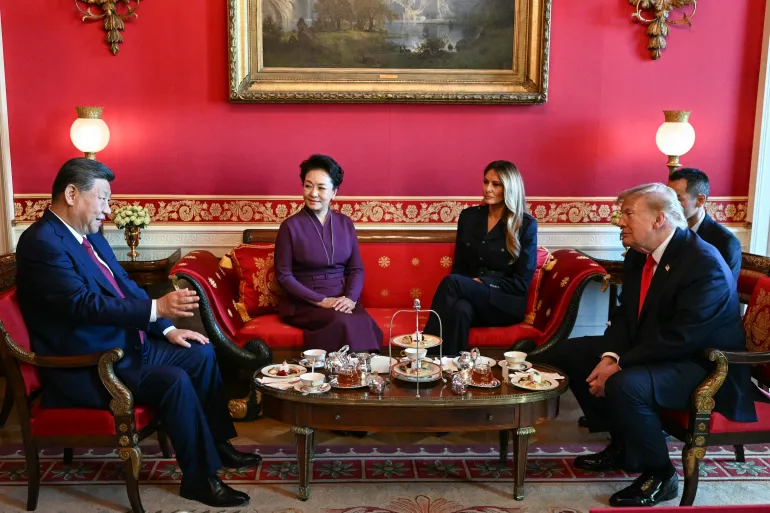
The United States and China have agreed to establish a bilateral communication channel for incidents involving artificial intelligence following President Donald Trump’s September summit with Chinese President Xi Jinping in Washington. The White House announced the mechanism in a fact sheet describing the outcomes of Xi’s state visit, while Chinese statements also confirmed that the two countries had agreed to launch an AI dialogue.
The agreement is deliberately narrow in one important respect. It does not create a comprehensive treaty governing artificial intelligence, nor does it resolve the much larger dispute over technology leadership between Washington and Beijing. Instead, it establishes a channel through which the two governments can communicate when an AI-related incident becomes serious enough to require direct contact.
The White House also said the two countries established a US-China Super Intelligence Dialogue to exchange views on the risks and benefits associated with the technology. The next exchange is expected to take place by November 2026. The terminology itself was part of the summit’s political message, with Trump and Xi agreeing to use “super intelligence” rather than “artificial intelligence” for the emerging technologies under discussion. citeturn0search0turn0news4
For investigators and national-security officials, the practical significance is the creation of a communication route between two governments whose technology sectors are simultaneously competing and becoming increasingly dependent on systems capable of operating across borders. The channel could matter most when something goes wrong quickly and ordinary diplomatic processes are too slow.
What an AI Incident Channel Could Do
The concept had been discussed before the summit. In September, US Treasury Secretary Scott Bessent proposed a mechanism through which Washington and Beijing could notify each other about AI incidents that rise to the level of national-security concern. The proposal included discussion of common goals, common threats and procedures for communicating during serious events. citeturn0news21
Earlier discussions also contemplated risks involving uncontrolled AI agents and non-state actors, including cyber actors. The idea was not simply to create a general technology forum but to establish protocols for situations in which an AI system could produce consequences that cross national boundaries or affect national security.
In practical terms, an incident channel could become relevant if an AI-enabled cyber operation affected infrastructure in another country, if an advanced autonomous system behaved in an unexpected way, or if authorities believed an AI capability had been used in a manner that could rapidly escalate a security crisis. The exact scope and operating procedures of the channel have not been publicly detailed.
That lack of detail is important. Creating a communication channel is easier than agreeing on what constitutes a reportable incident, which government has authority to make a notification, how quickly information must be shared and how sensitive technical data will be protected. Those questions will determine whether the mechanism functions as an operational safety tool or primarily as a diplomatic forum.
Why Washington and Beijing Are Saying “Super Intelligence”
The terminology change is unusual because artificial intelligence is already an established global term. Trump has promoted “super intelligence” as a more accurate description of advanced AI, and the White House said the two leaders agreed to use the term for the technologies covered by their new dialogue. citeturn0search0turn0search3
Whatever terminology is used, the underlying issue is the same: systems are becoming more capable, more autonomous and more deeply integrated into critical economic and technological infrastructure. The policy problem is therefore moving beyond the traditional question of whether a computer can perform a particular task.
The new dialogue is intended to address both risks and benefits. That framing matters because Washington and Beijing are not approaching AI solely as a safety problem. Both governments see advanced AI as strategically important to economic growth, scientific research, military capability and technological leadership.
The challenge is that the same capability can have both civilian and security applications. A system designed to automate software development could also assist vulnerability discovery. A model developed for scientific research could potentially be adapted for sensitive applications. An autonomous agent designed to operate efficiently could create risks if it acts outside the expectations of its operators.
The Risks the Channel Is Supposed to Address
The US proposal before the summit focused particularly on national-security-level AI incidents. Bessent previously described possible areas including uncontrollable agents, non-state actors and cyber operations. Those categories show why governments are beginning to treat AI safety as part of international crisis management rather than only as a technology-industry issue. citeturn0news22
Cybersecurity is one of the clearest areas of concern. AI can accelerate coding, automate repetitive tasks and help analyze large amounts of information. The same capabilities can potentially be used by attackers to identify vulnerabilities, generate malicious content or coordinate operations at a greater scale.
Another concern is the behaviour of autonomous agents. A system that can plan and execute multiple steps without continuous human direction creates a different risk profile from a conventional software tool. If an agent has access to networks, financial systems, communications or other external resources, an unexpected failure could have consequences beyond the original application.
There is also the problem of non-state actors. Governments can establish formal communication channels with other governments, but criminal groups and other non-state actors are not bound by those protocols. If advanced AI capabilities are used in cybercrime, fraud, influence operations or attacks on infrastructure, authorities may have to identify and contain the incident while communicating with another government that controls relevant infrastructure or evidence.
From Cold War Hotlines to AI Crisis Communications
US Trade Representative Jamieson Greer compared the emerging AI communication problem with the need for direct contact between the Kremlin and the White House during the Cold War. His argument was straightforward: governments increasingly need to know whom to contact when a serious AI incident occurs, yet most states do not have a single department responsible for artificial intelligence. citeturn0search3
The analogy is useful but imperfect. Cold War hotlines were built around the possibility of catastrophic military escalation between two governments with clearly defined command structures. AI incidents can involve governments, private companies, open-source developers, criminal groups and autonomous systems simultaneously.
An AI crisis may therefore move through several layers. A private company may detect abnormal behaviour. A national cybersecurity agency may determine that the incident has security implications. Another country’s infrastructure may be affected. Diplomatic officials may then need to establish whether the activity was accidental, criminal, state-directed or the result of an autonomous system behaving unexpectedly.
Speed matters in that environment. A technical incident can evolve before investigators have established who caused it. A direct government-to-government communication route can at least provide a mechanism for rapidly sharing initial information while the underlying technical investigation continues.
Cooperation Inside a Strategic Technology Rivalry
The new channel does not end the US-China technology rivalry. The two countries remain competitors over advanced computing, semiconductor technology, AI infrastructure and technological influence. The summit itself produced agreements in several areas, but AI remained one of the most strategically sensitive subjects.
That makes the decision to establish an incident channel notable. It separates one narrow area of cooperation—crisis communication—from the broader question of who will lead the development of advanced AI.
Both governments have incentives to preserve that distinction. Washington can cooperate on preventing an uncontrolled AI incident without abandoning export controls or other technology policies. Beijing can participate in safety communication without accepting the broader US framework for technology competition.
The arrangement therefore resembles risk-management diplomacy rather than a technology détente. It acknowledges that competition can coexist with a need for emergency communication when the consequences of misunderstanding become too large.
The Technology Controls That Remain Outside the Deal
The AI communication agreement should not be confused with a resolution of the dispute over advanced semiconductor technology. US Trade Representative Jamieson Greer said discussions during the summit did not cover the sale of a small amount of high-quality US-made chips requiring licences. He described advanced chips as central to maintaining the US lead in superintelligence and said those conversations were not part of the negotiations. citeturn0search3
That separation is strategically important. Advanced chips are among the physical foundations of modern AI development. Restrictions on access to high-performance computing affect what systems can be trained, how quickly they can be developed and which organizations can operate them at scale.
Consequently, Washington and Beijing can agree to discuss AI safety while continuing to disagree sharply over the technology supply chain. One relationship concerns preventing dangerous incidents; the other concerns access to the infrastructure that makes advanced systems possible.
The two tracks may eventually interact. If an AI incident is connected to a particular technology, company or computing resource, governments could face questions about attribution, access and accountability. But the new channel, as currently described, does not appear to settle those larger disputes.
Keeping Advanced AI Under Human Control
Xi has emphasized that AI development should remain under human control. During his Washington visit, he said the United States and China had both the capability and responsibility to develop and manage AI for good and to ensure that development remained under human control. citeturn0search1
That principle sounds straightforward, but its implementation raises difficult technical and legal questions. Human control can mean different things depending on the system. It may require a person to approve every high-impact action, or it may involve technical constraints that prevent an AI agent from accessing certain systems without authorization.
For forensic investigators, the distinction matters because accountability depends on reconstructing what happened. If an autonomous system performs an action, investigators need to determine what instructions it received, what permissions it had, which data it accessed, what decisions it made and whether human operators could reasonably have prevented the outcome.
That creates a new evidentiary field around AI incidents. Logs, model configurations, access permissions, system prompts, training data, tool calls and network activity could become important evidence. International cooperation may be required when those records are distributed across companies, cloud providers and jurisdictions.
What the Agreement Does Not Solve
The announcement leaves many questions unanswered. The governments have not publicly explained the full operating rules of the incident channel, the threshold for activating it, which agencies will manage it or what information will be exchanged during an emergency.
It also does not resolve the fundamental strategic competition between Washington and Beijing. There is no indication that the agreement ends disputes over advanced chips, technology transfers, export controls or the broader race for AI leadership.
Nor does a government communication channel directly control private AI companies. Many of the most consequential AI systems are developed by commercial laboratories and technology companies rather than governments. A serious incident may therefore require coordination between private firms and national authorities before international officials can even determine what happened.
Attribution will be another major problem. If an AI-enabled cyberattack crosses borders, identifying the person or organization responsible may take days or weeks. If the system itself behaved unexpectedly, investigators may have to distinguish a technical failure from deliberate misuse. A communication channel can facilitate contact, but it cannot automatically solve attribution.
The Next Test for the New Channel
The first major test will be whether Washington and Beijing turn the political announcement into a functioning protocol. The next formal Super Intelligence exchange is expected by November, giving both governments a relatively short period in which to define procedures, identify responsible officials and determine what constitutes an incident serious enough to trigger communication.
The earlier negotiations suggest that some groundwork already exists. US and Chinese officials had discussed an AI safety notification mechanism before the Trump-Xi summit, and Bessent said officials expected to continue discussions about risks and emergency communication protocols. citeturn0news21turn0news22
The most useful outcome would be a mechanism that works under pressure rather than only during scheduled diplomatic meetings. That would require secure contacts, agreed terminology, escalation procedures and a way to exchange enough technical information to prevent an incident from being misunderstood without exposing sensitive national-security or commercial information.
The stakes are larger than the bilateral relationship. The United States and China are among the world’s most important AI powers, so a serious incident involving systems developed, deployed or controlled in either country could affect companies, infrastructure and governments elsewhere.
The new channel does not represent the end of the US-China AI rivalry. It represents recognition that competition has reached a point where communication about failure and danger is becoming a security requirement of its own. The real measure of the agreement will come when an AI incident is no longer theoretical—when something moves unexpectedly across a network, affects another jurisdiction or creates a risk neither government can manage alone.
Until then, the channel is an institutional promise rather than a proven safeguard. Washington and Beijing have created a place to communicate. The harder task will be deciding what they say to each other when the technology itself moves faster than diplomacy.
ForensicTimes · forensictimes.com · Global Investigative Journalism on Crime, Justice, and Forensic Science · This report reflects verified open-source and wire reporting current as of publication. © 2026 ForensicTimes. All Rights Reserved.