A day after a Russian assault near Kyiv killed 10 people, Moscow’s own appointed governor says Ukrainian forces struck holiday camps in occupied Zaporizhzhia, killing eight, including two children, in a war Zelensky now warns could see a large-scale missile attack within 48 hours.
Table of Contents
- The Holiday Camp Strike
- Sumy: Three Postal Workers Killed
- The Kyiv Assault a Day Earlier
- The Shopping Center Fire
- Zelensky’s Warning
- Romania’s Airspace Keeps Getting Breached
- A Pattern Along NATO’s Border
- Forensic Analysis and Intelligence
- Law and Legal Implications
- Will the Warned Missile Attack Materialize
The Holiday Camp Strike
Moscow-installed officials said Saturday that Ukrainian forces struck holiday camps in the partially Russian-occupied Zaporizhzhia region, killing eight people. Yevgeny Balitsky, the Kremlin-appointed head of the occupied Zaporizhzhia region, said two children were among those killed and that 14 other people were injured in the attack. Ukraine did not immediately comment on the strike.
Sumy: Three Postal Workers Killed
Separately, authorities in Ukraine’s northeastern Sumy region said a Russian drone attack killed three people. Sumy regional Gov. Oleh Hryhorov said the deaths occurred after a large fire broke out following a Russian drone strike on a civilian facility, identifying the victims as drivers for the private Ukrainian postal and courier service Nova Poshta. Russia’s Defense Ministry said it had targeted a storage and launch site for Ukrainian drones in the Sumy region, offering a competing characterization of the same strike’s intended target.
The Kyiv Assault a Day Earlier
Saturday’s strikes came a day after a major Russian assault near Kyiv killed at least 10 people and injured nearly 100, part of what wire reporting described as a relentless exchange of attacks continuing to erode hopes for a diplomatic end to Russia’s war against Ukraine, now in its fifth year.
The Shopping Center Fire
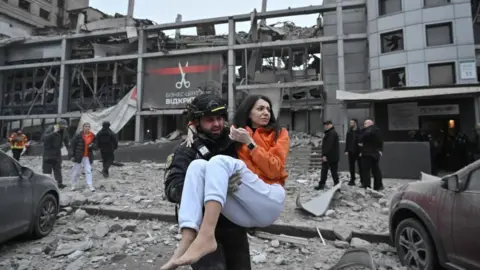
In Zaporizhzhia city itself, in southeastern Ukraine, a Russian drone attack late Friday struck a shopping center, sparking a fire that spread across roughly 500 square meters and injured several people, according to regional Gov. Ivan Fedorov.
Zelensky’s Warning
Ukrainian President Volodymyr Zelensky warned in his Friday evening address that intelligence assessments indicated Russia was preparing missiles for a large-scale attack, adding there were signs it could occur within the next 48 hours, a warning that places the weekend’s confirmed strikes within a broader anticipated escalation rather than an isolated exchange.
Romania’s Airspace Keeps Getting Breached
Romania’s Defense Ministry said Saturday its forces safely shot down a drone that breached the country’s airspace over an unpopulated area near the Ukrainian border, with President Nicusor Dan confirming the drone was downed by a Romanian pilot flying an F-16 aircraft. The interception followed another drone shot down Friday near Padina, northeast of Bucharest, marking the second such incident in as many days.
A Pattern Along NATO’s Border
A series of drone incursions linked to the Ukraine war have affected Romania and other NATO members since Russia’s full-scale invasion began in February 2022. In June, a Ukrainian maritime drone exploded at the Black Sea port of Constanta, while three other sea drones exploded outside the port with no reported injuries. In May, a Russian drone involved in an attack on Ukraine veered off course and struck an apartment building in eastern Romania, injuring two people, an incident that illustrated the risk NATO territory faces even from strikes not deliberately aimed at it.
Forensic Analysis and Intelligence
The Zaporizhzhia holiday camp strike illustrates a recurring attribution problem in this conflict: the claim originates entirely from Russian-installed regional authority Yevgeny Balitsky, with Ukraine offering no immediate confirmation or denial, leaving the incident’s authorship established only by one interested party’s account pending any independent verification. The Sumy drone strike shows a similar pattern in miniature, where Ukrainian regional officials describe the target as a civilian postal facility while Russia’s Defense Ministry describes the same strike as hitting a drone storage and launch site, a direct conflict in stated targeting intent that neither side’s account alone can resolve.
Romania’s interceptions, by contrast, offer a comparatively verifiable data point: a NATO member state’s own air force shooting down an identified drone over its own territory, confirmed by both its Defense Ministry and head of state, providing a firmer evidentiary basis than claims originating from within the active conflict zone itself.
Law and Legal Implications
Strikes on facilities described as holiday camps and civilian postal infrastructure raise standard international humanitarian law questions regarding the distinction between military and civilian objects, particularly where casualty figures, including two children in the Zaporizhzhia case, come from a single unverified source. Russia’s claim that the Sumy target was a drone storage and launch site, if true, would place that specific strike within a different legal category than an attack on purely civilian infrastructure, underscoring why unresolved attribution disputes carry direct legal weight rather than being merely rhetorical.
Romania’s repeated drone interceptions over its own NATO territory raise separate questions under Article 4 and Article 5 of the North Atlantic Treaty regarding collective response thresholds, an issue that remains unresolved as a matter of alliance policy given that individual interceptions to date have been handled nationally rather than triggering formal NATO consultation.
Will the Warned Missile Attack Materialize
It remains unclear whether the large-scale missile attack Zelensky warned of will occur within the stated 48-hour window, or what specific intelligence underlies that assessment beyond his public statement. Ukraine’s lack of immediate comment on the Zaporizhzhia holiday camp strike leaves that incident’s attribution formally unresolved. Whether repeated Romanian airspace incursions will eventually prompt a change in NATO’s collective response posture, as opposed to continued national-level interceptions, is not yet determined. Forensic Times continues to monitor statements from Ukrainian and Russian-installed regional officials and NATO member state defense ministries as the conflict continues.
ForensicTimes · forensictimes.com · Global Investigative Journalism on Crime, Justice, and Forensic Science · This report reflects verified open-source and wire reporting current as of publication. © 2026 ForensicTimes. All Rights Reserved.