Phishing now triggers more than three in four breaches in the UAE, and AI has closed the gap that once let a careful reader catch a scam by its clumsy phrasing.
Table of Contents
- Credential Phishing and AI-Generated Business Email Compromise
- Deepfake Voice and Video Impersonation Fraud
- Remote Access and Home Router Exploitation
- AI-Enhanced Investment and Romance Scams
- Bank and Police Impersonation via Vishing and Smishing
- Forensic Analysis and Intelligence
- Why the UAE Is a Preferred Testing Ground for AI-Driven Fraud
1. Credential Phishing and AI-Generated Business Email Compromise

Risk Score: 5/5
The Offense
Credential phishing is the fraudulent acquisition of a password or authentication token through a message or page impersonating a legitimate system. Business email compromise is a related offense in which an attacker impersonates a trusted party to induce a transfer of funds or data. The two increasingly work as one pipeline.
Red Flags
- A login page requesting a device code alongside a password, rarely used in legitimate first-time logins
- A bank-detail change arriving from a known contact but altering the payment fields
- Urgency paired with an instruction to skip the normal approval chain
- A request framed as confidential or “just between us”
Modus Operandi
The scheme rarely announces itself. It arrives as an invoice or a login prompt, often built by a language model rather than a person at a keyboard. AI has stripped away the old tells: stilted grammar, mismatched logos, sender addresses that were almost right. Today’s version reproduces a supplier’s invoicing format and times its arrival to the payment cycle it targets, ending in a credential harvest on a cloned login screen or a direct payment diversion.
Law
The offense falls under Federal Decree-Law No. 34 of 2021, which treats unauthorized system access and fraudulent data acquisition as separate, stackable offenses. Penalties scale with the target: ordinary intrusions carry fines from the low hundreds of thousands of dirhams up to five years’ imprisonment, while breaches of banking systems push fines toward AED 1.5 million. For non-citizens, a conviction routinely brings deportation.
Prevention
Organizations that avoid this category of loss share one habit: it is procedurally impossible for a single email to move money. Every payment or credential change is confirmed through a channel the criminal does not control, before it is actioned.
What to Do
Verify any payment or credential-reset request through a second channel, such as a call to a number already on file. If credentials were entered on a suspect page, reset the password and linked tokens immediately. Report to your IT security function and the UAE’s eCrime platform, and preserve the original message.
2. Deepfake Voice and Video Impersonation Fraud

Risk Score: 4/5
The Offense
Deepfake impersonation fraud is the use of AI-synthesized audio or video, generated from a real person’s likeness without consent, to convince a target they are communicating with that person, in order to induce a transfer or the release of sensitive data.
Red Flags
- A transfer request by voice or video that bypasses the normal written approval trail
- Contact through an unfamiliar number or channel rather than the executive’s known line
- Slight audio artifacts, unnatural pacing, or a call ending abruptly once the request is made
- Pressure to act quickly and keep the matter confidential from colleagues
Modus Operandi
This category unsettles security professionals most, because it defeats the one verification method once considered reliable: hearing the person you believe you are dealing with. A short public sample of an executive’s voice, pulled from an earnings call, is now enough to generate a cloned voice note authorizing an urgent transfer. Roughly one in five UAE organizations has already reported an AI-linked incident. The fraud works through removed friction: a controller who would question a strange email is far less likely to question a voice that sounds exactly like their chief executive.
Law
Deepfake impersonation used to defraud a victim is prosecuted as electronic fraud under Federal Decree-Law No. 34 of 2021, alongside forgery provisions where fabricated audio or video is presented as genuine. The statute applies extraterritorially whenever a UAE-based party is harmed.
Prevention
The only durable defense is procedural, since the audio itself is often good enough to fool a trained ear. Treat voice and video as supporting evidence of identity, never as sole authorization for moving money.
What to Do
Institute a standing rule that no payment is executed on voice or video instruction alone; require confirmation through a pre-agreed callback. If a transfer has already occurred, contact the receiving bank immediately to attempt a recall, and file a report with the UAE’s eCrime platform.
3. Remote Access and Home Router Exploitation
Risk Score: 4/5
The Offense
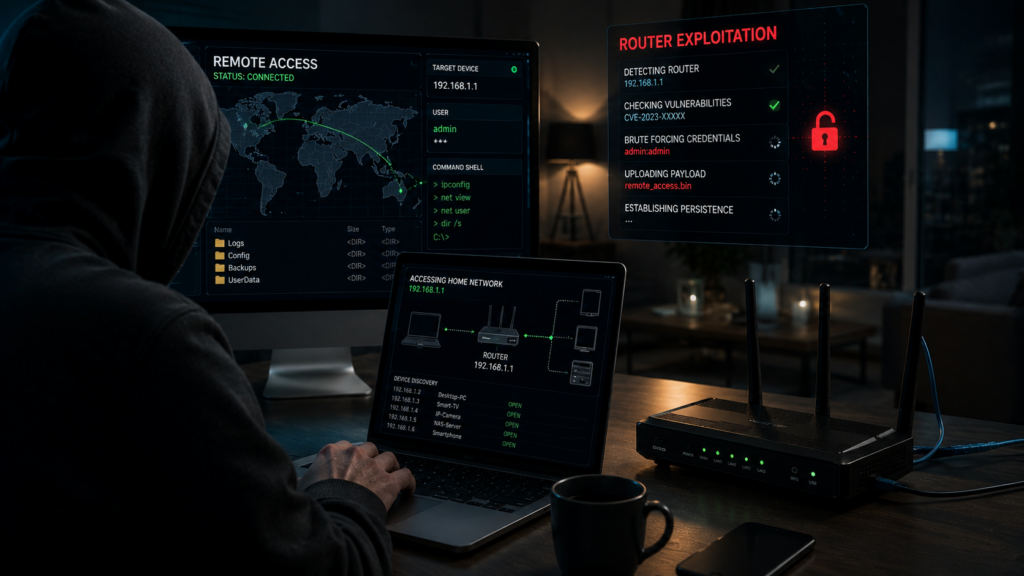
Remote access exploitation is the unauthorized use of a network vulnerability, often an unpatched router or default credentials, to enter a connected system. In a remote-work context, it typically means compromising a personal network as a route into a corporate environment.
Red Flags
- Unexplained slowdowns or unfamiliar devices in a router’s admin panel
- Unsolicited prompts to install remote-access software from an unverified source
- Login alerts for work accounts from unrecognized locations
- A router still running its factory-default administrator password
Modus Operandi
The corporate firewall was never the weak point; the router in a spare bedroom, running outdated firmware, is. Authorities report that more than a third of cyberattacks target home routers and VPN-connected devices rather than corporate infrastructure directly. Automated scanning finds routers on default credentials, then the attacker waits for the victim to connect to work systems and rides that connection in, often without triggering an alert.
Law
Unauthorized access to any network used to reach an information system, including a personal router used for work, falls under the illegal-access provisions of Federal Decree-Law No. 34 of 2021. Where the intrusion is a stepping stone into a financial or government-linked system, the elevated penalty band applies regardless of entry point.
Prevention
Home network hygiene is no longer a personal preference. For anyone with remote access to corporate systems, it is effectively an extension of the company’s own perimeter.
What to Do
Update router firmware regularly, replace default admin credentials, and use only company-issued VPN configurations. If a compromise is suspected, disconnect the device, notify IT security before reconnecting, and change credentials for any accounts accessed.
4. AI-Enhanced Investment and Romance Scams
Risk Score: 4/5
The Offense
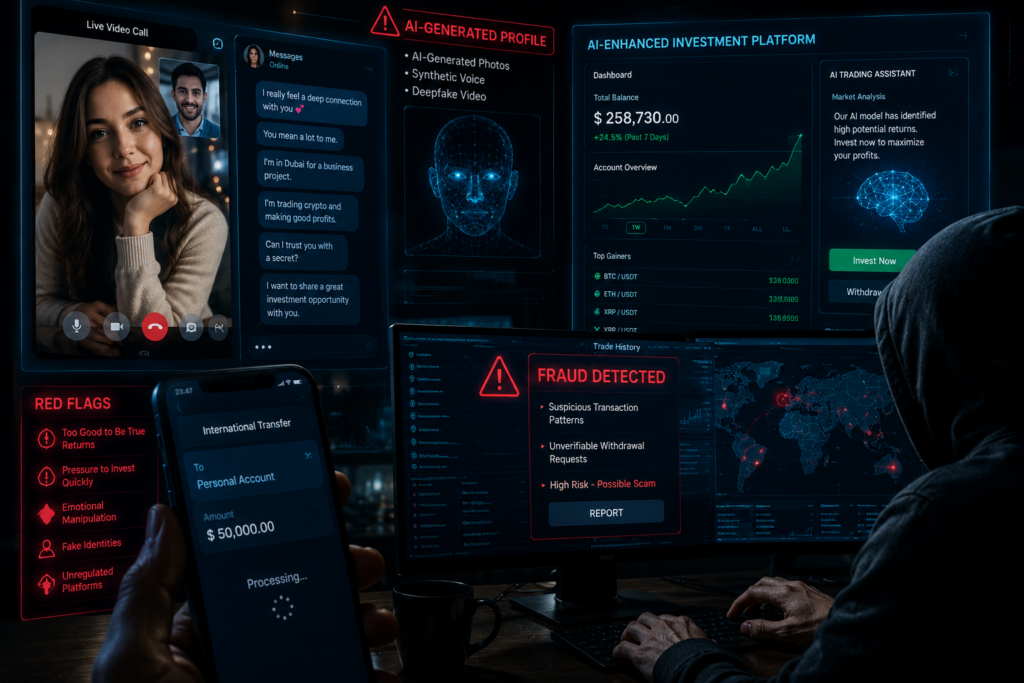
An investment scam solicits funds for a fraudulent or nonexistent opportunity, using fabricated returns to encourage escalating deposits. A romance scam uses a fabricated identity to build trust before extracting money. Where AI-generated personas or voice sustain either scheme, the deception also qualifies as electronic impersonation.
Red Flags
- A new contact who quickly moves the relationship to a private messaging app
- Repeated excuses to avoid an unscheduled video call or in-person meeting
- Pressure to invest through an unfamiliar platform or send funds to a personal account
- Investment returns that appear unusually high or consistent
Modus Operandi
These schemes are patient in a way most fraud is not, and that patience is now cheap to sustain at scale. A fabricated profile, complete with AI-generated photographs, cultivates a relationship over weeks or months, with generated voice notes deployed once a target grows suspicious. Trust, once established, is monetized through a direct emergency request for money or a steer toward a fraudulent platform showing fabricated returns to encourage larger deposits.
Law
Where deception leads to a transfer of funds, the Penal Code’s fraud provisions apply, and where electronic impersonation is involved, Federal Decree-Law No. 34 of 2021’s provisions apply concurrently. Operating an unlicensed platform to solicit funds from UAE residents can additionally draw regulatory action.
Prevention
The defense here is behavioral rather than technical: verifying independently, every time, rather than trusting the relationship’s own internal logic, which is exactly what the scheme exploits.
What to Do
Independently verify any investment platform’s licensing before transferring funds. Treat a request for money from an online-only relationship as a serious warning sign. Preserve correspondence and report to the UAE’s financial fraud reporting channels as soon as the scheme is suspected.
5. Bank and Police Impersonation via Vishing and Smishing
Risk Score: 5/5
The Offense
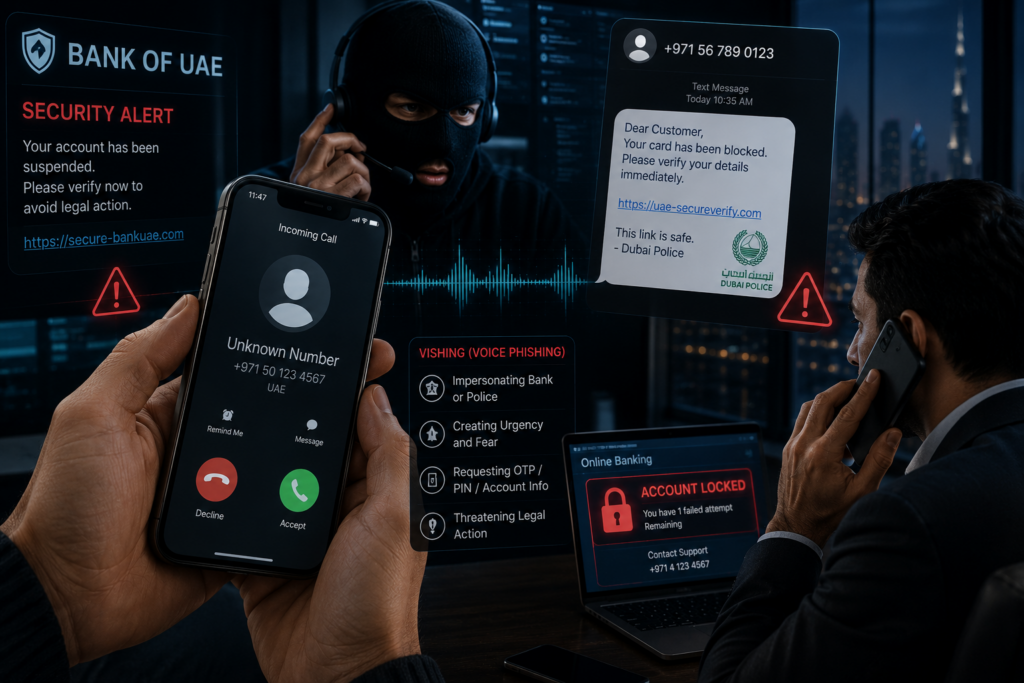
Vishing is voice-based phishing conducted by phone; smishing is the same tactic conducted through SMS. Both involve impersonating a trusted institution, most often a bank or police body, to extract credentials or funds under manufactured urgency.
Red Flags
- A caller claiming to be from a bank or police department requesting an OTP or card PIN
- A text with a shortened or unfamiliar link asking to “verify” an account
- A job or property offer requiring an upfront fee before any formal process
- Escalating pressure when the target asks to call back through an official number
Modus Operandi
This is the volume category: a phone call during a workday, or a text that looks exactly like one a bank sends. The caller poses as a compliance officer or a police official, constructing an urgent scenario, a suspicious transaction, a legal notice, to justify requesting an OTP, a card PIN, or a click leading to a cloned banking portal. A related strand uses a fabricated job offer or property listing to extract an upfront fee, built to force a decision before the target can verify anything.
Law
Fraudulent electronic communication used to extract funds falls under Federal Decree-Law No. 34 of 2021, and impersonating a police or government official carries its own aggravated penalty under the Penal Code, independent of any financial loss.
Prevention
The single most reliable filter is procedural, not intuitive: no legitimate bank or police authority will ever ask for an OTP or card PIN over the phone, under any circumstance.
What to Do
End the call or ignore the message, and independently contact your bank or the relevant authority using a number from an official source, never one the caller provides. Report to your bank’s fraud line and the UAE’s eCrime platform.
Forensic Analysis and Intelligence
Across all five categories, the common forensic thread is not a novel exploit but a shift in the quality of social engineering. Metadata analysis of phishing infrastructure and reused templates remains the fastest way to link an incident to a broader operation. In deepfake cases, voice-print comparison increasingly builds evidentiary chains for prosecution. Router and network log forensics is essential to tracing how an intrusion moved from a home device into a corporate environment. With phishing volume in the billions daily, signature-based detection can no longer keep pace, and behavioral pattern recognition has become the dominant defense. For investigators, the most reliable way to connect isolated incidents to organized networks is correlation: matching device fingerprints, timing, and metadata across cases.
Why the UAE Is a Preferred Testing Ground for AI-Driven Fraud
The UAE’s high digital adoption, large expatriate population managing finances across jurisdictions, and fast-growing remote workforce make it an efficient environment for fraudsters to refine scripts before exporting them elsewhere. Regulators have responded with public advisories, a dedicated eCrime platform, and some of the region’s strictest penalties. But the pace of AI tooling available to scammers is outrunning public awareness, and enforcement still depends on victims recognizing the fraud early enough to report it. The open question is whether detection and reporting infrastructure can close that gap before AI-generated fraud becomes the default rather than the exception.
ForensicTimes · forensictimes.com · Global Investigative Journalism on Crime, Justice, and Forensic Science · This report reflects verified open-source and wire reporting current as of publication. © 2026 ForensicTimes. All Rights Reserved.