





























Hunger on a big scale is rarely an accident of war. In siege after siege, from the Balkans to Syria, Ukraine and Sudan, armies have used the same slow method: cut the water, stop the convoys, close the road out and wait.
The Law
The ban is younger than the practice. During the siege of Leningrad, which lasted from September 1941 to January 1944, an estimated 650,000 residents died in 1942 alone, most of them from starvation (Britannica, n.d.). Only in 1977 did Additional Protocol I to the Geneva Conventions prohibit starving civilians as a method of warfare. It also extended special protection to “objects indispensable to the survival of the civilian population,” among them foodstuffs and “drinking water installations and supplies and irrigation works” (Pollard, 2024; Zharikova, 2026).
The International Committee of the Red Cross reads the rule broadly. Starvation, it says, “means deprivation of food, water or other things necessary for survival,” and the deprivation “need not be so severe as to cause death; it is enough that it would cause suffering” (Pollard, 2024).
Intentionally starving civilians is also a war crime under the Rome Statute of the International Criminal Court (Zharikova, 2026). In December 2019 the court’s member states extended that crime to civil wars and other non-international armed conflicts, covering the deprivation of objects indispensable to survival, “including willfully impeding relief supplies” (Assembly of States Parties to the Rome Statute, 2019; Pollard, 2024). A year and a half earlier, on 24 May 2018, the UN Security Council had unanimously condemned “the use of starvation of civilians as a method of warfare” and the unlawful denial of humanitarian access in Resolution 2417 (United Nations, 2018).
Water: Sarajevo, 1992 to 1996
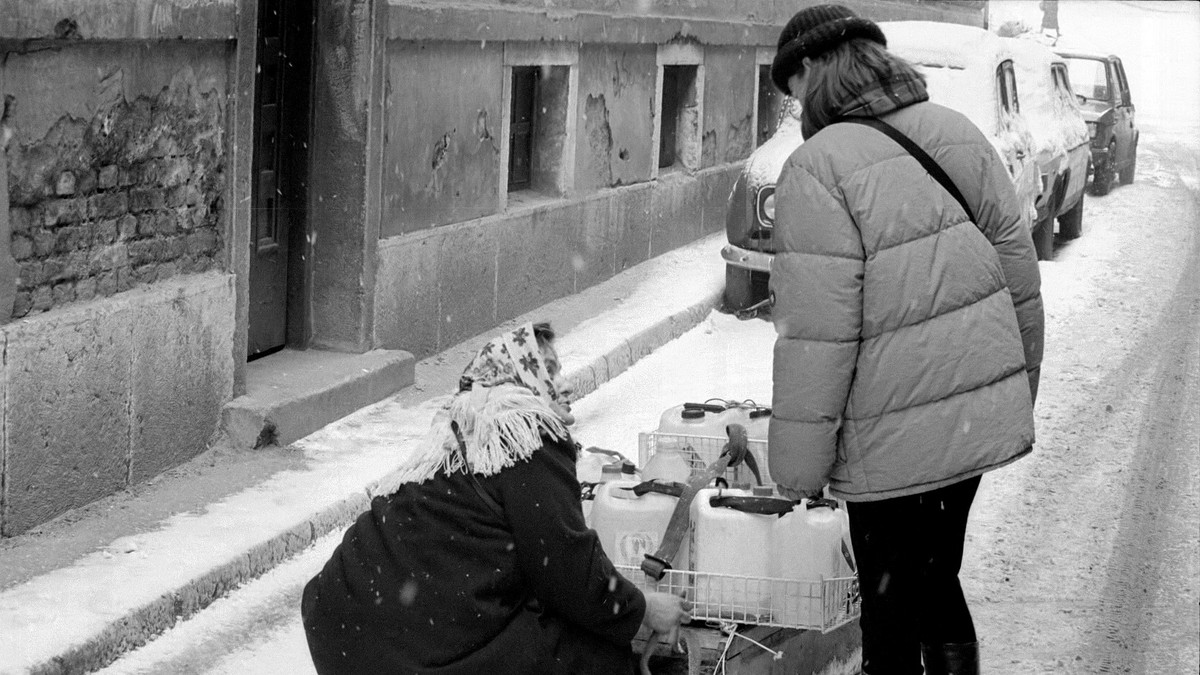
For 1,425 days, from April 1992 to February 1996, Bosnian Serb forces encircled Sarajevo. During the siege 11,541 people in the city were killed, more than 1,600 of them children. Many residents were shot at crossroads while fetching water (N1, n.d.). When the International Criminal Tribunal for the former Yugoslavia indicted Stanislav Galić, commander of the Sarajevo-Romanija Corps, it listed people “collecting water” among the civilians targeted by shelling and sniping, alongside those queuing for bread and attending funerals (International Criminal Tribunal for the former Yugoslavia [ICTY], 1999).
Galić was convicted of acts of violence whose primary purpose was to spread terror among the civilian population. In 2006 the Appeals Chamber raised his sentence to life imprisonment (International Justice Resource Center, n.d.). His successor, Dragomir Milošević, was sentenced on appeal in 2009 to 29 years for a campaign of sniping and shelling that killed and injured a great number of civilians (ICTY, 2009).
Convoys: Srebrenica, 1995
In the eastern enclave of Srebrenica the instrument was paperwork. In March 1995 Radovan Karadžić issued Supreme Command Directive 7. It tasked the Drina Corps with creating “an unbearable situation of total insecurity with no hope of further survival or life” for the inhabitants of Srebrenica and Žepa. The directive also called for “the planned and unobtrusively restrictive issuing of permits” for humanitarian convoys. From June 1995, the tribunal found, aid to the enclaves “decreased significantly” as a result of the Bosnian Serb army’s restrictions (ICTY, 2010).
On 11 July 1995 the town fell. Up to 8,000 Bosnian Muslim men and boys were killed or went missing. Both the tribunal and the International Court of Justice later ruled that the events in Srebrenica constituted genocide (International Residual Mechanism for Criminal Tribunals, n.d.). The months of hunger before the fall served the directive’s aim of forcing the population out.
Grass: Madaya, 2016
Two decades later the method reappeared in Syria. In January 2016 about 40,000 people were trapped in Madaya, a town some 25 kilometres north-west of Damascus, besieged since the previous July by government forces backed by Hezbollah fighters, who had also laid mines around it. Doctors said residents were eating grass to stay alive. At least 23 people, including children, had died. At least 300 children were suffering from malnutrition, according to the Syrian Observatory for Human Rights (Al Jazeera, 2016).
Snow: Mariupol, 2022
In Mariupol it was the cold. After Russian forces surrounded the city in March 2022, residents had no running water, electricity or heating while temperatures hovered around freezing. Médecins Sans Frontières reported that people drank rainwater or collected snow, and broke into heating systems to get water to wash their hands. Human Rights Watch described civilians “trapped in a parched and freezing cold nightmare” (Human Rights Watch, 2022a).
In June 2024 the international law organisation Global Rights Compliance submitted a dossier to the International Criminal Court arguing that Russia had used “a tactic of deliberate starvation” during the siege. It began with cutting electricity, heating and water and continued with strikes on food distribution points and evacuation routes. The dossier concluded that about 90 percent of the city’s healthcare facilities and homes had been destroyed or damaged (Kyiv Post, 2024). The analysis drew on satellite imagery, photographs, video and public statements from the first 85 days of the invasion (The Independent, 2024).
Eighteen Months: El Fasher, 2024 to 2025
In Sudan the paramilitary Rapid Support Forces besieged El Fasher, the capital of North Darfur, for 18 months before taking the city in late October 2025. On 3 November the Integrated Food Security Phase Classification, the UN-backed hunger monitor, confirmed that famine was occurring in El Fasher and in Kadugli, another besieged town (The National, 2025).
Oleshky
Oleshky has been occupied since the first day of the full-scale invasion. In June 2023 the destruction of the Kakhovka dam flooded the town (Associated Press, 2026a). Since late 2025, according to Ukrainian volunteers, the town has been effectively sealed off: roads have been mined and food runs have come under fire. The last attempt to bring a convoy in, on 1 September 2026, ended with Russian troops shelling four volunteer cars. Residents were foraging for grass and searching bombed basements for scraps (Mukhina, 2026). The 20-kilometre walk out to the village of Radensk became known as “the road of death”. A Ukrainian officer told the Associated Press that Ukrainian forces had also mined forest paths used by Russian troops (Associated Press, 2026a).
The dead are hard to count. A local volunteer, Kseniya Arkhipova, recorded more than 300 civilians in Oleshky who may have died from hunger, cold and shelling since the autumn of 2025, a figure confirmed by the head of the town’s military administration (MOST, 2026). Ukraine’s 34th Marine Brigade says it has delivered more than seven tons of aid by drone since September (Associated Press, 2026a).
Each side blames the other. Russian-installed officials say Ukraine is blocking supplies and evacuations. They delivered two tons of aid in October and admitted it was hardly enough. The UN human rights office said Russia had not given “clear, verifiable guarantees for conducting a humanitarian operation” (Associated Press, 2026a). On 25 September the Council of Europe Commissioner for Human Rights, Michael O’Flaherty, reminded Russia that, as the occupying power, it is obliged under international humanitarian law to provide food and medical supplies and to facilitate relief (European Pravda, 2026).
On 27 October a local ceasefire took effect around the town. The White House said the US first lady, Melania Trump, had helped to broker it, and Pope Leo XIV had urged both sides to allow aid and evacuations. A convoy of 25 buses and several ambulances brought in food and medicine and offered evacuation to residents who wanted to leave. According to Ukrainian public television, the route was to run through southern Russia and Belarus before reaching Ukraine. A volunteer said residents were being pressed to choose Russia over Ukraine (Associated Press, 2026b). The ceasefire ended on the night of 1 November. Ukraine’s human rights commissioner said the number of people still in Oleshky could not be verified (Hyatt, 2026).
Satellites: From Srebrenica to El Fasher
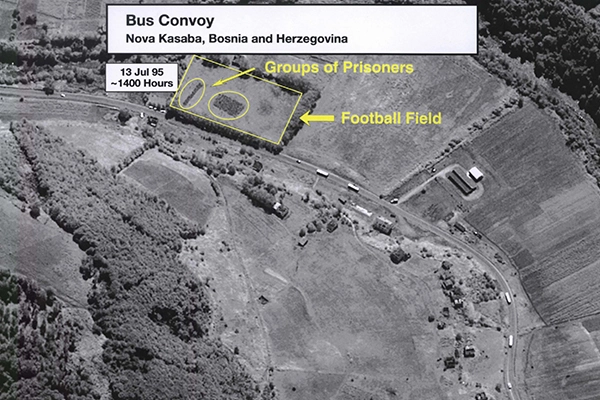
Sieges used to be documented mainly by the people trapped inside them and by the few journalists who got in. On 10 August 1995 the US ambassador to the United Nations, Madeleine Albright, showed the Security Council satellite images that she said depicted evidence of mass grave sites near Srebrenica (United States Holocaust Memorial Museum, n.d.). At the time, imagery of that kind was the preserve of governments. Three decades later, commercial satellites and the phones of people inside besieged towns have put much of the same evidence in the public domain.
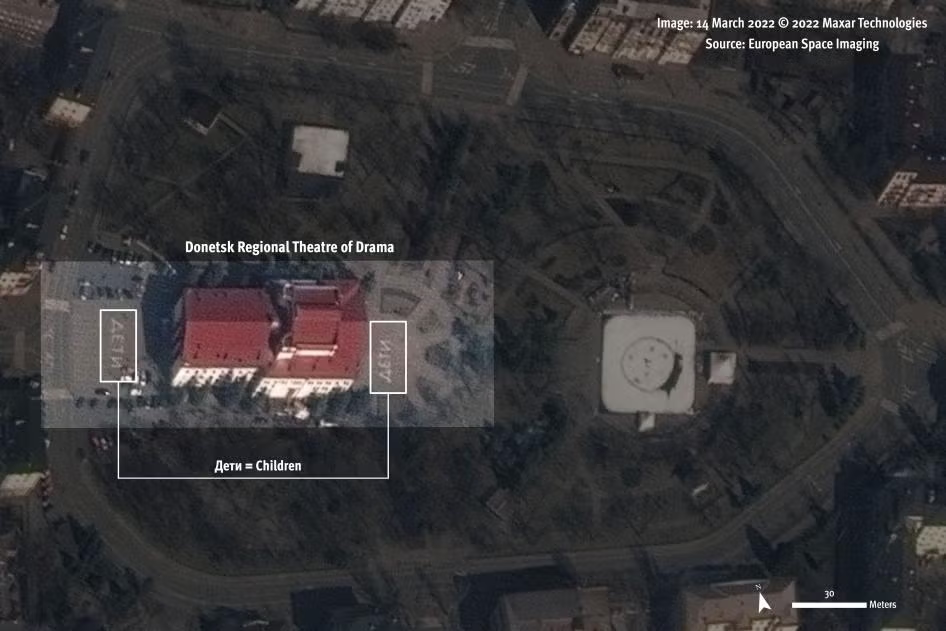
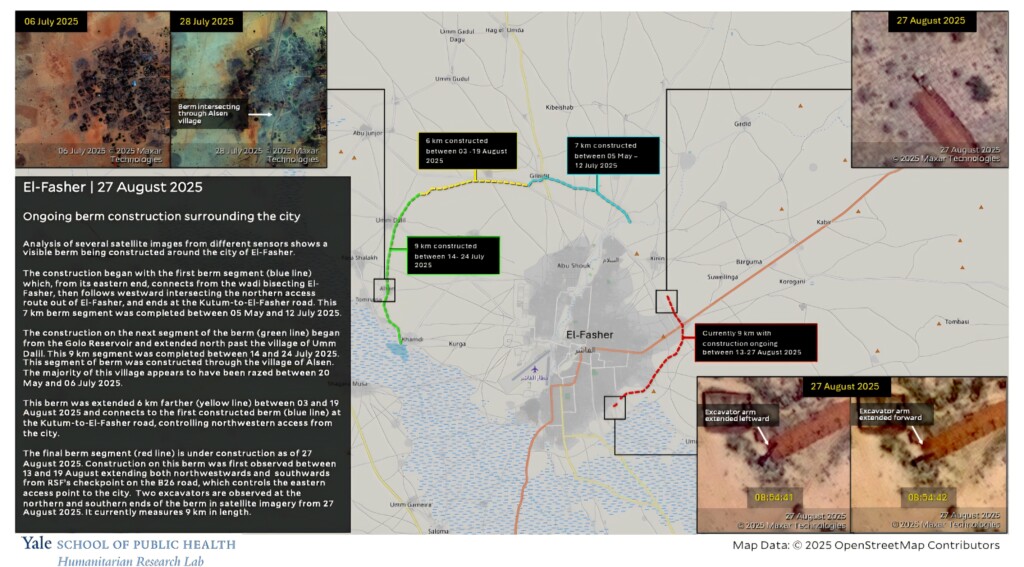
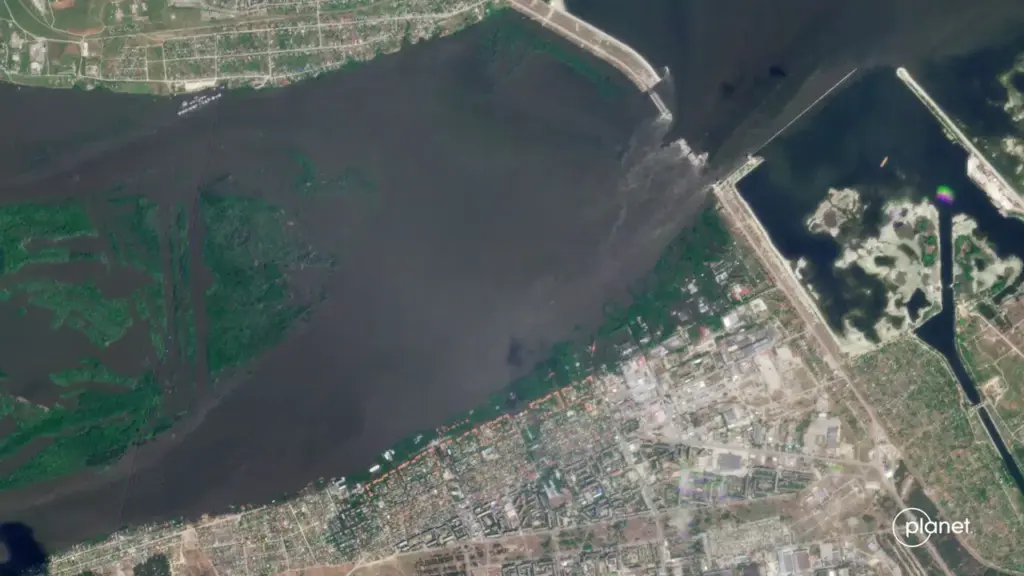
In Mariupol, a satellite image taken on 14 March 2022 showed the word “дети”, Russian for “children”, written twice in large letters outside the drama theatre where, according to witnesses, at least 500 civilians were sheltering. Two days later the theatre was bombed (Human Rights Watch, 2022b). After the Kakhovka dam was destroyed in June 2023, Planet Labs images showed the scale of the flooding on the occupied left bank. Oleshky was reported to be 90 percent under water (Kyiv Independent, 2023). In Sudan, the Yale Humanitarian Research Lab tracked from orbit the construction of more than 31 kilometres of earthen walls around El Fasher from May 2025, which it warned were turning the besieged city into a “kill box” and blocking the entry of food and medicine (Dabanga, 2025).
Hunger itself is hard to see from orbit. It shows up indirectly: in empty markets, closed roads, crowds at distribution points and new graves. In occupied towns such as Oleshky, the people who post photographs or keep lists of the dead take real risks.
The Slowest Crime to Prove
Starvation leaves a fainter trail than a missile strike. Hunger kills over weeks, often through illness and cold. Every party can blame the other for empty shelves. Courts have tended to reach it indirectly. Galić was convicted for terror, not for depriving Sarajevo of water. Directive 7 served as evidence in cases about forcible transfer and genocide. In Ukraine, the International Criminal Court has pursued the related campaign against power and heating. In March 2024 it issued arrest warrants for two Russian commanders, Sergei Kobylash and Viktor Sokolov, over a campaign of strikes on power plants and substations between October 2022 and March 2023 (Al Jazeera, 2024). Russia does not recognise the court’s jurisdiction.
Satellite images, convoy records, morgue registers and the testimony of people who walked out along mined roads are the raw material of future cases. Open-source analysts are increasingly the ones who assemble them. In Oleshky, volunteers have kept lists of residents who wanted to leave and of those who died. Those lists may one day matter as much as any ceasefire.
The Red Cross reading of the law sets the threshold low on purpose: deprivation “need not be so severe as to cause death; it is enough that it would cause suffering” (Pollard, 2024). The residents of Oleshky crossed that threshold long before some 100 bodies filled the basement of the town hospital (Associated Press, 2026a). Ten days before the ceasefire, Kseniya Arkhipova, who helps people leave, said she was terrified of the coming winter, “when many people in Oleshky will be simply doomed” (Associated Press, 2026a). Some got out in the last days of October. How many did not, no one can yet say.
REFERENCES
Al Jazeera. (2016, January 7). Weakened, cold and starving to death in Syrian town. https://www.aljazeera.com/news/2016/1/7/weakened-cold-and-starving-to-death-in-syrian-town
Al Jazeera. (2024, March 5). ICC seeks arrest of Russian officers over infrastructure attacks in Ukraine. https://www.aljazeera.com/news/2024/3/5/icc-seeks-arrest-of-russian-officers-over-infrastructure-attacks-in-ukraine
Assembly of States Parties to the Rome Statute. (2019, December 6). Amendment to article 8 of the Rome Statute of the International Criminal Court (intentionally using starvation of civilians) (Resolution ICC-ASP/18/Res.5) [As published by Likumi.lv]. https://likumi.lv/ta/en/starptautiskie-ligumi/id/2073-amendment-to-article-8-of-the-rome-statute-of-the-international-criminal-court-intentionally-using-starvation-of-civilians
Associated Press. (2026a, October 17). Desperate civilians risk their lives along mined roads to escape from a Russian-held city [As published by The Boston Globe]. https://www.bostonglobe.com/2026/10/17/world/russian-occupied-city-in-ukraine/
Associated Press. (2026b, October 30). Ukrainian lawmaker says some residents have been evacuated from the war-ravaged city of Oleshky [As published by ITV News]. https://www.itv.com/news/2026-10-30/ukrainian-official-says-some-residents-have-been-evacuated-from-russia-occupied-oleshky
Britannica. (n.d.). Siege of Leningrad. https://www.britannica.com/event/Siege-of-Leningrad
Dabanga. (2025, August 30). Yale HRL: RSF erect 31 km “kill box” berm in North Darfur. https://www.dabangasudan.org/en/all-news/article/yale-hrl-rsf-erect-31-km-kill-box-berm-in-north-darfur
European Pravda. (2026, September 25). Council of Europe warns of critical humanitarian situation in Russian-occupied Oleshky. https://www.eurointegration.com.ua/eng/news/2026/09/25/7246287/
Human Rights Watch. (2022a, March 7). Ukraine: Mariupol residents trapped by Russian assault. https://www.hrw.org/news/2022/03/07/ukraine-mariupol-residents-trapped-russian-assault
Human Rights Watch. (2022b, March 16). Ukraine: Mariupol theater hit by Russian attack sheltered hundreds. https://www.hrw.org/news/2022/03/16/ukraine-mariupol-theater-hit-russian-attack-sheltered-hundreds
Hyatt, L. (2026, November 2). Ukrainian forces evacuate civilians around Kherson Oblast during Oleshky ceasefire. Kyiv Independent. https://kyivindependent.com/ukrainian-forces-evacuate-civilians-around-kherson-oblast-during-oleshky-ceasefire/
International Criminal Tribunal for the former Yugoslavia. (1999, December 20). Detention of Stanislav Galić [Press release]. https://www.icty.org/en/sid/7710
International Criminal Tribunal for the former Yugoslavia. (2009, November 12). Appeals Chamber judgement in the case of Dragomir Milošević [Press release]. https://www.icty.org/en/sid/10268
International Criminal Tribunal for the former Yugoslavia. (2010, June 10). Judgement summary: Prosecutor v. Vujadin Popović et al. https://icty.org/x/cases/popovic/tjug/en/100610summary.pdf
International Justice Resource Center. (n.d.). Galić [Case summary]. https://ijrcenter.org/international-criminal-law/icty/case-summaries/galic
International Residual Mechanism for Criminal Tribunals. (n.d.). About the 1995 genocide in Srebrenica. https://www.irmct.org/srebrenica/en/
Kyiv Independent. (2023, June 8). Satellite images show massive flooding of Ukraine’s south. https://kyivindependent.com/satellite-images-show-massive-flooding-of-ukraines-south
Kyiv Post. (2024). New report finds Russia deliberately starved citizens of Mariupol, wanting to kill as many as possible. https://www.kyivpost.com/amp/post/34223
MOST. (2026, May 18). More than 300 civilian residents of occupied Oleshky could have died from hunger, cold and shelling since the autumn of 2025 [Reporting Radio Svoboda]. https://most.ks.ua/en/news/url/z-oseni-2025-roku-ponad-300-tsivilnih-zhiteliv-okupovanih-oleshok-mogli-zaginuti-vid-golodu-holodu-ta-obstriliv/
Mukhina, O. (2026, September 12). “There is real hunger there”: Oleshky, occupied town in Ukraine’s Kherson Oblast, turned 942 this week. Euromaidan Press. https://euromaidanpress.com/2026/09/12/there-is-real-hunger-there-oleshky-occupied-town-in-ukraines-kherson-oblast-turned-942-this-week-behind-russian-blockade-its-people-eat-roadside-grass/
N1. (n.d.). Siege of Sarajevo began on this day in 1992: 1,425 days of terror and survival. https://n1info.ba/english/news/siege-of-sarajevo-began-on-this-day-in-1992-1425-days-of-terror-and-survival
Pollard, M. (2024, October 17). IHL and the challenge of maintaining food security in armed conflict. Humanitarian Law & Policy Blog, International Committee of the Red Cross. https://blogs.icrc.org/law-and-policy/2024/10/17/ihl-and-the-challenge-of-maintaining-food-security-in-armed-conflict/
The Independent. (2024). Russian forces “deliberately starved” Ukrainians in Mariupol, new report claims [As syndicated by Yahoo News]. https://sg.news.yahoo.com/russian-forces-deliberately-starved-ukrainians-024843048.html
The National. (2025, November 3). Global hunger monitor declares famine in Sudan’s El Fasher city. https://www.thenationalnews.com/news/2025/11/03/global-hunger-monitor-declares-famine-in-sudans-el-fasher-city
United Nations. (2018, May 24). UN Security Council condemns starvation of civilians as a war tactic. UN News. https://news.un.org/en/story/2018/05/1010731
United States Holocaust Memorial Museum. (n.d.). Bosnia-Herzegovina: Evidence. https://www.ushmm.org/genocide-prevention/countries/bosnia-herzegovina/evidence
Zharikova, N. (2026, July 21). Why international humanitarian law prohibits starvation as a method of warfare. Ukrainian Red Cross Society. https://redcross.org.ua/en/?p=156469