A disturbing disparity that cannot be ignored
A child’s death by suicide is always a tragedy. When these deaths occur at disproportionately high rates within Indigenous communities, however, the tragedy becomes a broader question about society, public institutions, and the protection of the most vulnerable.
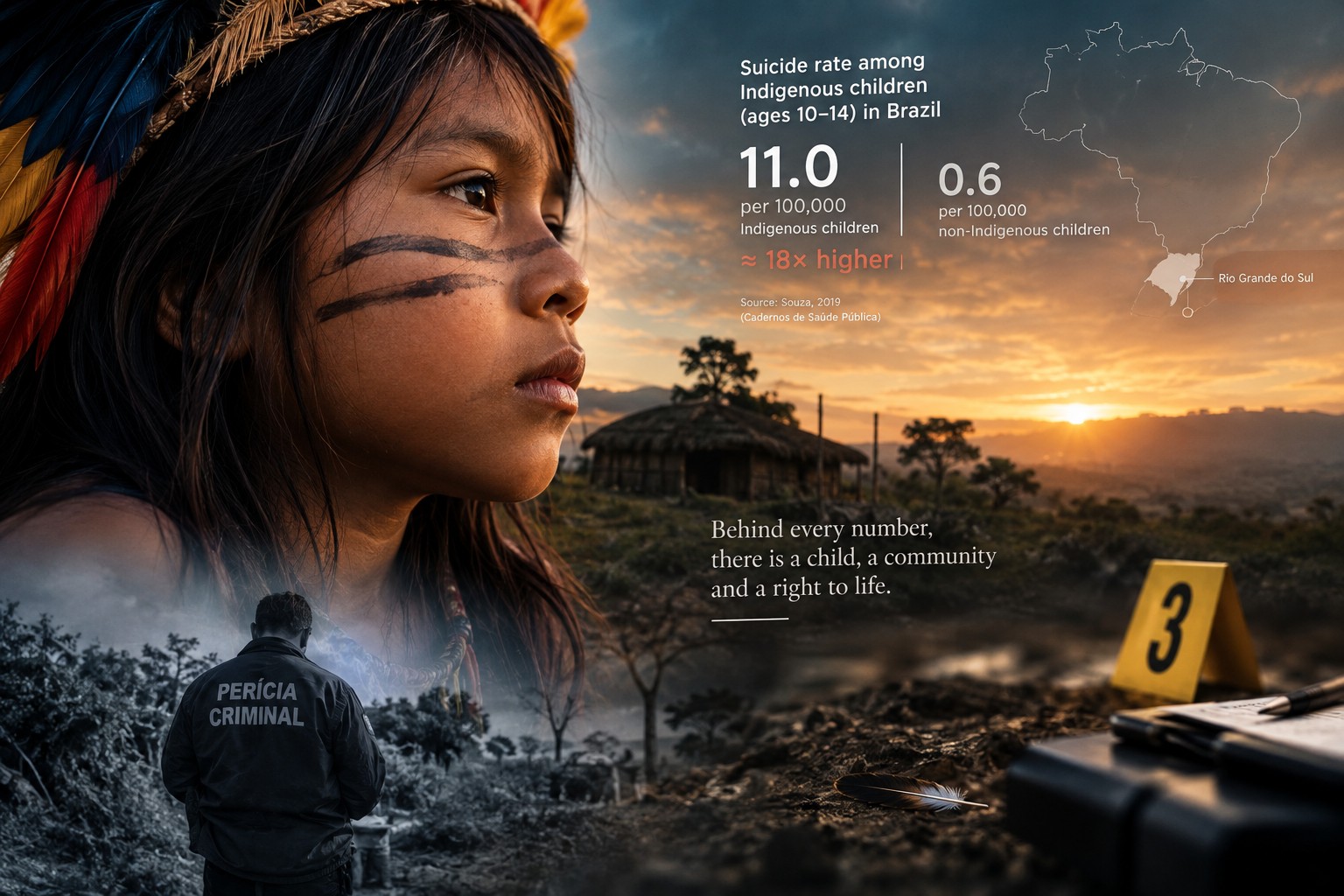
Brazil has already documented a striking disparity. Research published in Cadernos de Saúde Pública found that, between 2010 and 2014, Indigenous children aged 10–14 had a suicide mortality rate of 11.0 per 100,000, compared with 0.6 per 100,000 among non-Indigenous children.
That is approximately 18 times the rate recorded among non-Indigenous children in the same age group.
The figures are historical and national, not a current estimate for Rio Grande do Sul. Yet they raise a question that cannot be postponed: what conditions are allowing such a profound disparity to persist?
Beyond the statistics: what is happening to these children?
Suicide cannot be explained by a single cause. Psychological distress, family circumstances, social exclusion, discrimination, violence, and barriers to mental health care may interact in ways that increase vulnerability.
For Indigenous children, these questions must also be examined within their specific historical and sociocultural contexts.
The consequences of territorial dispossession, disruptions to community life, socioeconomic inequality, and difficulties accessing culturally appropriate public services may be relevant in particular communities. But these factors must be investigated, not simply assumed.
There is also a danger in framing Indigenous identity itself as the explanation. Indigenous peoples are not a homogeneous population, and their cultures should not be reduced to a catalogue of vulnerabilities. Cultural identity, community relationships, traditional knowledge, and collective belonging can also provide important sources of protection and resilience.
The real challenge is to understand the circumstances in which these protective factors may be weakened and to identify what communities themselves consider necessary to protect their children.
When one death becomes part of a larger pattern
A study of Indigenous communities in Dourados, Mato Grosso do Sul, published in the Revista de Saúde Pública, documented a high suicide rate in the population examined between 2003 and 2013. The researchers also identified cases clustered within households, including suicides involving children younger than 15.
This finding deserves attention because it illustrates the importance of looking beyond isolated cases.
When deaths occur within the same household or community over a relatively short period, public health authorities should consider whether shared circumstances, exposure to adversity, or other contextual factors warrant further investigation. Clustering does not establish a common cause, but it can signal the need for a coordinated response.
Forensic science has a role here—not in claiming to explain the social causes of suicide from a crime scene, but in establishing the circumstances of individual deaths and producing reliable information that can contribute to a broader understanding of mortality patterns.
The forensic investigation cannot be an afterthought
A death initially classified as suicide must still be examined with scientific objectivity. The initial hypothesis cannot replace the evaluation of the scene, physical evidence, medicolegal findings, and other relevant information.
The forensic expert must establish what the evidence supports, identify inconsistencies, and recognize the limits of the conclusions that can be drawn. Neither an assumption of suicide nor an assumption of criminal involvement should predetermine the examination.
This responsibility becomes particularly important when public institutions need to understand whether several deaths share relevant circumstances.
In such cases, proper scene documentation, preservation of evidence, reliable records, and coordination with public health authorities may help distinguish individual events from broader patterns requiring further study.
But forensic examinations also have limits. They cannot independently determine why a child experienced psychological distress, whether a community is facing a particular social crisis, or which preventive intervention would be most effective. Those questions require cooperation among forensic specialists, health professionals, researchers, social services, and Indigenous communities.
Who investigates when the victim is Indigenous?
In Brazil, the institutional organization of violent-death investigations raises another important question: how should responsibilities be divided between federal authorities and state forensic services?
The issue is particularly relevant when an investigation involves Indigenous rights or circumstances that may bring a case within federal jurisdiction.
However, one legal distinction is essential. The fact that a victim is Indigenous does not automatically make every death a matter of exclusive federal jurisdiction, nor does it establish that the Federal Police must personally perform every forensic examination. Investigative authority, judicial jurisdiction, and the execution of forensic work are distinct matters.
Depending on the circumstances and applicable legal arrangements, federal and state institutions may need to coordinate their activities.
Rio Grande do Sul’s state forensic services possess experience in examining violent-death scenes. That technical capacity may be valuable when a case requires specialized scene examination, but the appropriate allocation of work must be established through the applicable legal framework and institutional cooperation.
The concern is not that one institution should automatically replace another. It is whether the system, as a whole, provides timely examinations, consistent technical standards, reliable data, and sufficient expertise.
If responsibilities are unclear or coordination is inadequate, opportunities may be lost—not only to clarify the circumstances of an individual death, but also to identify patterns that deserve attention from public health authorities.
A constitutional duty that extends beyond the crime scene
Brazil’s Constitution establishes the protection of human dignity and the right to life. Article 227 requires the family, society, and the state to ensure the rights of children and adolescents with absolute priority. Article 231 recognizes Indigenous peoples’ social organization, customs, languages, beliefs, traditions, and original rights to traditionally occupied lands.
These guarantees must have practical meaning.
Protecting Indigenous children requires more than reacting after a death occurs. It demands effective prevention, accessible and culturally appropriate mental health services, reliable mortality surveillance, and institutions capable of responding to evidence of disproportionate harm.
The constitutional principle of proportionality offers a useful way to assess whether public responses are adequate to the risks identified. Where evidence reveals a serious and persistent disparity, institutions should examine whether existing arrangements are capable of addressing it and whether better-coordinated alternatives are available.
This is not a claim that every institutional shortcoming constitutes a constitutional violation. Nor does a high suicide rate, by itself, establish genocide under international law. Such a classification requires specific legal elements, including the requisite intent.
But these distinctions should not weaken the underlying demand for accountability. The state must be able to identify preventable risks, evaluate its response, and act on reliable evidence.
The question Brazil must answer
The available research establishes a troubling national disparity. What remains essential is to determine its current magnitude in Rio Grande do Sul, identify where deaths are concentrated, understand the circumstances surrounding them, and evaluate whether existing prevention and investigation systems are responding adequately.
That requires better data, sustained research, culturally informed prevention, and effective cooperation between Indigenous communities and public institutions.
It also requires humility. No single forensic examination, psychological theory, or sociological explanation can account for every death. The objective must be to understand each case on its own evidence while remaining alert to patterns that demand a broader response.
The death of an Indigenous child should never become merely another entry in a mortality database. Nor should it be treated as an isolated tragedy when evidence suggests a wider problem.
The central question is not simply why these children are dying. It is whether Brazil is doing everything reasonably possible to understand the circumstances, prevent further deaths, and ensure that Indigenous children receive the full protection of their rights.
A society’s commitment to human rights is measured not only by the principles it declares, but also by the lives it manages to protect.