




















A fatal workplace accident leaves more than a body behind.
It leaves a scene.
Machines, tools, protective devices, fragments, biological traces, injuries, clothing, personal protective equipment and even the position of apparently insignificant objects may contain information about what happened in the seconds before death.
Yet workplace fatalities are often approached primarily as occupational safety events. From a forensic perspective, however, a fatal accident may also represent a complex scene that requires systematic documentation, preservation and interpretation of physical evidence.
The central question is not simply “What caused the death?” It is also:
“What happened immediately before the fatal event, and what physical evidence allows us to establish that sequence?”
The workplace as a forensic scene
Unlike many conventional crime scenes, a workplace is usually a dynamic environment.
Production may need to continue. Machinery may need to be moved. Employees may need to access the area. Emergency personnel may have already altered the scene while attempting to rescue the victim.
These circumstances can significantly affect the forensic investigation.
The first challenge is therefore the preservation of the scene.
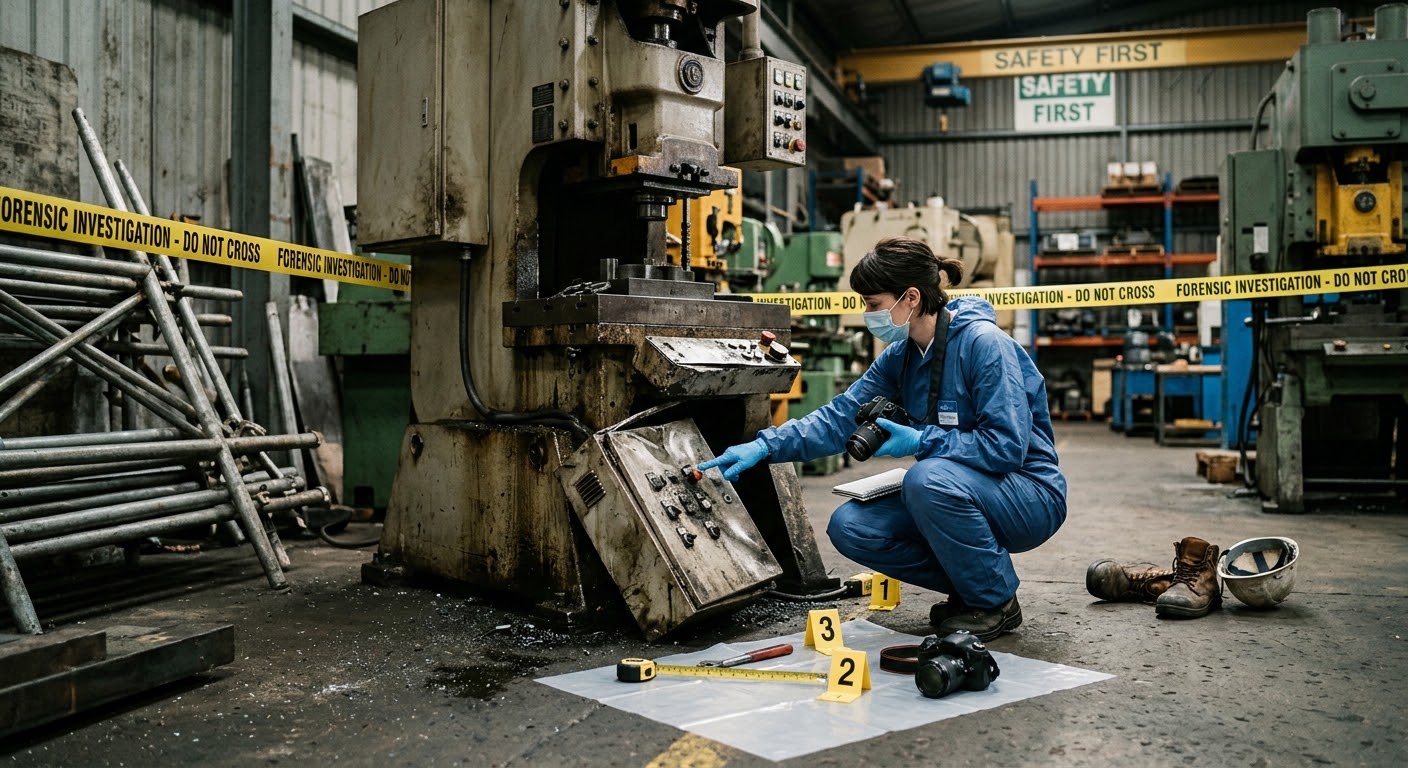
Before objects are moved or machinery is restarted, investigators should seek to document the original configuration as completely as possible. Photography, video recording, measurements, sketches and three-dimensional documentation can be particularly valuable.
The objective is not simply to create a record of the workplace.
It is to preserve its forensic context.
A broken component, for example, may have little meaning when examined in isolation. Its position in relation to the machine, the victim, other components and the surrounding environment may provide considerably more information.
The machine as a silent witness
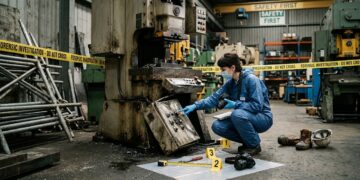
Industrial machinery can be one of the most important sources of evidence in a fatal accident.
Protective guards, emergency-stop systems, interlocks, switches, sensors and other safety devices may provide important information about the circumstances immediately preceding the event.
But their mere presence or absence does not necessarily explain what happened.
A forensic investigation should ask a series of sequential questions:
- What was the machine designed to do?
- What was its operational configuration at the time of the accident?
- Which safety systems were present?
- Were those systems functional?
- What physical traces indicate contact, movement or failure?
- Was the victim inside or outside the expected operating area?
- Could the observed injuries have resulted from the proposed mechanism?
- Are there alternative sequences capable of producing the same findings?
These questions help move the investigation from a simple description of the scene toward a reconstruction of the event.
The body and the environment must be interpreted together
The forensic examination of the victim cannot be completely separated from the examination of the workplace.
Injuries may provide important clues about the mechanism of the accident, but their interpretation becomes stronger when correlated with the physical environment.
The location and characteristics of injuries, damage to clothing, traces on machinery, bloodstain patterns, deformation of objects and the victim’s position may collectively help establish whether a proposed sequence is physically consistent.
This does not mean that every injury has a simple mechanical explanation.
Nor should investigators assume that the first plausible scenario is necessarily the correct one.
Forensic interpretation requires correlation between independent sources of evidence.
Human error or system failure?
One of the most delicate issues in occupational fatalities is the tendency to reduce complex events to individual mistakes.
Statements such as “the worker entered the dangerous area” or “the worker failed to use the protective equipment” may describe part of the event without explaining the entire chain of circumstances.
From a forensic perspective, the investigator should distinguish between what happened and who may ultimately be responsible for it.
The first is a question of physical reconstruction.
The second may involve legal, organizational and occupational-safety assessments that extend beyond the forensic reconstruction itself.
A worker’s action may have been the immediate event preceding the injury, while the physical evidence may reveal that the circumstances allowing that action were created by equipment configuration, maintenance conditions, inadequate barriers or other environmental factors.
The forensic expert should therefore be cautious about converting a physical finding into a conclusion about responsibility.
Preserving alternative hypotheses
A robust investigation should not begin with a predetermined narrative.
Suppose a worker is found trapped inside an industrial machine. Several explanations may initially appear possible:
Was the machine operating normally?
Was it unexpectedly activated?
Was a safety mechanism bypassed?
Did a component fail?
Did the worker enter the area intentionally or unintentionally?
Did another person activate the equipment?
Could a mechanical failure have produced the observed configuration?
The purpose of forensic examination is not merely to identify a scenario that is possible.
It is to determine which hypotheses are consistent with the available evidence, which are contradicted by it, and which remain unresolved.
This distinction is particularly important in fatal occupational accidents because the consequences of an incorrect reconstruction may extend well beyond the scientific investigation.
The importance of documentation
A workplace can change dramatically within hours after a fatal accident.
Machinery may be repaired. Damaged components may be replaced. Materials may be removed. The production line may return to operation.
For this reason, comprehensive documentation at the earliest possible opportunity is essential.
Photographs should not be limited to the victim or the immediately surrounding area. Investigators should document the broader environment, access routes, machine controls, safety devices, relevant tools, lighting conditions and spatial relationships.
Measurements are equally important.
Where appropriate, investigators should document distances, heights, dimensions, machine geometry and the position of relevant objects.
The purpose is to make the scene understandable to someone who was not physically present.
That may become particularly important months or years later, when the expert report is reviewed by lawyers, judges or other specialists who have never seen the original scene.
Beyond identifying the cause of death
A forensic investigation of a workplace fatality should ideally answer several different questions.
What happened?
How did it happen?
What physical evidence supports that sequence?
What alternative explanations were considered?
And, importantly:
What cannot be established from the available evidence?
The last question is sometimes overlooked.
Scientific expertise is not strengthened by filling gaps with assumptions. On the contrary, explicitly identifying limitations can make an expert conclusion more reliable.
There is a fundamental difference between saying “the evidence demonstrates” and saying “the evidence is consistent with.”
Forensic experts should preserve that distinction.
From accident scene to forensic reconstruction
The investigation of a fatal workplace accident ultimately requires the integration of several dimensions: the victim, the environment, machinery, physical traces, witness information and the laws of physics governing the proposed event.
The workplace itself can become a silent witness.
It cannot tell investigators what happened.
But it can preserve traces of what happened.
The role of forensic science is to interpret those traces carefully, test competing explanations and reconstruct the sequence of events as objectively as the evidence allows.
A fatal occupational accident should never be reduced to a single photograph, a single injury or a single statement.
The scene is a complex system.
And sometimes, the smallest physical detail is what allows investigators to understand the final seconds of a human life.
The scene does not speak. The evidence does.