





















A drone attack launched from Iraqi territory struck near Saudi Arabia’s critical East-West oil pipeline, triggering a fire, causing injuries and forcing the kingdom to temporarily shut the route that provides an alternative to the increasingly vulnerable Strait of Hormuz.
Table of Contents
- The Drone Strike and Pipeline Fire
- The East-West Pipeline: Saudi Arabia’s Hormuz Alternative
- Damage, Injuries and the Shutdown
- Iraq Acknowledges the Attack Came From Its Territory
- The Iran-Linked Militia Question
- A Second Maritime Front at Bab el-Mandeb
- Oil Markets Under Pressure
- Law and Legal Implications
- What Is Established and What Remains Unresolved
The Drone Strike and Pipeline Fire
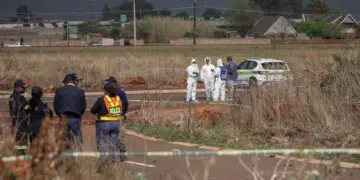
Saudi Arabia’s strategically important East-West oil pipeline was shut down after a fire that authorities said followed a drone attack launched from Iraqi territory. The incident occurred near Medina and caused both human and material damage, according to a statement from the Saudi Foreign Ministry.
A Saudi government official said people were injured in the drone attack and the subsequent fire. The pipeline was then shut down as a precaution while authorities dealt with the consequences of the strike.
The incident represents a significant escalation because the targeted infrastructure is not simply a local oil facility. The East-West pipeline is one of Saudi Arabia’s principal mechanisms for moving crude from the Persian Gulf to the Red Sea without sending tankers through the Strait of Hormuz.
The East-West Pipeline: Saudi Arabia’s Hormuz Alternative

The East-West pipeline connects the Abqaiq area in eastern Saudi Arabia with the Red Sea port of Yanbu. Its strategic value has increased sharply as military activity and shipping restrictions around the Strait of Hormuz have disrupted the region’s normal energy routes.
By moving crude westward across Saudi territory, the pipeline provides Riyadh with an alternative route to global markets. Oil reaching Yanbu can be loaded onto tankers in the Red Sea without requiring the shipment to pass through the Strait of Hormuz.
That makes the pipeline a critical component of Saudi Arabia’s energy-security infrastructure. Any sustained interruption could therefore have consequences extending well beyond the immediate location of the attack.
Damage, Injuries and the Shutdown
The Saudi Foreign Ministry said the fire near Medina resulted in human and material damage. A government official separately confirmed that people were injured.
The authorities did not immediately provide a comprehensive public assessment of the physical damage to the pipeline itself or specify how long the shutdown would last. The precautionary closure means the immediate priority was to secure the affected infrastructure and prevent additional danger rather than maintain normal oil transportation.
The precise mechanism of the attack, including the type of drone used, its flight path and the location at which it struck, has not been independently established in the reporting available so far.
Iraq Acknowledges the Attack Came From Its Territory
The Iraqi government acknowledged that the attack was launched from Iraqi territory. Baghdad also announced the dismissal of the commander of Maysan province in southern Iraq as a consequence of the incident.
The acknowledgment is significant because it establishes the launch location while leaving open the separate question of who planned, controlled and carried out the operation.
Saudi Arabia has repeatedly accused Iran-linked armed groups operating from neighbouring Iraq of attacking its energy infrastructure with drones. The latest incident places renewed pressure on Baghdad to prevent Iraqi territory from being used as a launch platform for attacks against neighbouring states.
The Iran-Linked Militia Question

Saudi Arabia has previously accused armed groups based in Iraq of targeting its oil installations. The attacks have occurred against the backdrop of the wider US-Israel war with Iran and the expanding role of Iran-aligned armed groups across the region.
However, the fact that a drone was launched from Iraqi territory does not by itself establish which organization carried out the operation or whether the Iranian government directly ordered it.
That distinction is central to assessing responsibility. Iraqi territory has hosted numerous armed factions with varying degrees of political and military independence, making attribution more complicated than simply identifying the geographic launch point.
The Iraqi government’s decision to dismiss a senior provincial security official indicates that Baghdad is treating the incident as a serious breach of its responsibility to control activity originating from its territory.
A Second Maritime Front at Bab el-Mandeb
The pipeline attack comes at the same time as another major threat to Saudi Arabia’s energy routes is developing farther south.
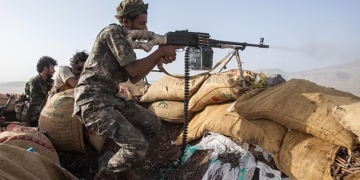
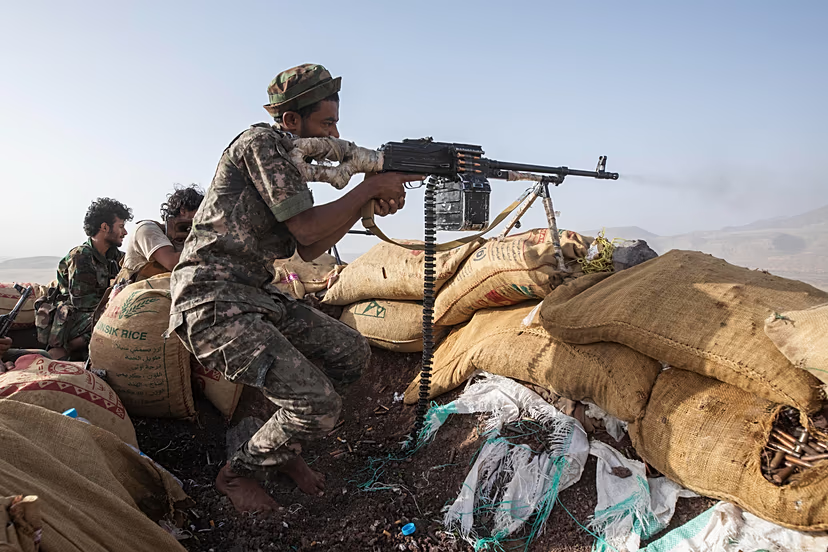
Iran-backed Houthi forces in Yemen have taken control of strategic territory around the Bab el-Mandeb Strait, including Mayyun Island, after government forces withdrew. The narrow waterway connects the Red Sea with the Gulf of Aden and is one of the world’s most important maritime chokepoints.
The Houthis have said that maritime navigation remains safe for international shipping but have specifically excluded Saudi vessels from that assurance. The development has raised concerns that Saudi Arabia could face pressure simultaneously on its eastern and western energy corridors.
The combination of disruptions around Hormuz and Bab el-Mandeb has created an increasingly difficult environment for regional oil transportation and global shipping.
Oil Markets Under Pressure
The attack comes as oil prices are already under severe pressure from the wider regional conflict. Euronews reported that the price of a barrel of oil climbed above $100 on Friday while fuel prices reached fresh records.
The East-West pipeline is particularly important under these conditions because it provides Saudi Arabia with a mechanism to bypass the Strait of Hormuz. A prolonged shutdown could therefore remove part of the kingdom’s ability to redirect exports away from the contested waterway.
The immediate market impact will depend on the duration of the shutdown, the extent of the physical damage and whether additional attacks occur against Saudi energy infrastructure.
Law and Legal Implications
An armed drone attack against critical civilian energy infrastructure raises significant questions under international law, particularly where the facility serves both commercial and strategic functions.
The legal assessment would depend on the circumstances of the attack, the identity and status of the attackers, the nature of the target and whether the operation formed part of an armed conflict. Deliberate attacks against protected civilian objects can raise serious issues under international humanitarian law.
The Iraqi government’s acknowledgment that the attack originated from its territory also raises questions concerning Iraq’s obligations to prevent its territory from being used for attacks against another state. However, territorial launch location alone does not establish state responsibility for the conduct of a particular armed group.
Any determination of responsibility would require evidence establishing who planned the operation, who controlled the drones and whether the attackers were acting on behalf of, or under the direction or control of, another state.
What Is Established and What Remains Unresolved
What is established is that a drone attack was launched from Iraqi territory and that a fire subsequently affected Saudi Arabia’s East-West oil pipeline near Medina. Saudi authorities reported injuries and material damage and shut the pipeline down as a precaution. Iraq acknowledged that the attack originated from its territory and announced the dismissal of the Maysan provincial commander.
It is also established that the pipeline is strategically important because it allows Saudi Arabia to transport oil from the Persian Gulf region to Yanbu on the Red Sea, providing an alternative to the Strait of Hormuz.
What remains unresolved is the identity of the attackers, the precise organization responsible, the full extent of the pipeline damage and how long the shutdown will continue. It is also not yet established from the available reporting whether Iran directly directed or supported this specific operation.
The attack nevertheless exposes a growing vulnerability in Saudi Arabia’s energy-security architecture. With pressure simultaneously building around the Strait of Hormuz and Bab el-Mandeb, the East-West pipeline has become more than an oil transport route: it is a critical strategic bypass whose security increasingly affects the stability of global energy markets.
Forensic Times continues to monitor developments around Saudi energy infrastructure, Iraqi armed groups and the widening regional conflict as investigators and governments establish responsibility for the latest attack.
ForensicTimes · forensictimes.com · Global Investigative Journalism on Crime, Justice, and Forensic Science · This report reflects verified open-source and wire reporting current as of publication. © 2026 ForensicTimes. All Rights Reserved.