























When Suicide Becomes a Forensic Question: Lessons from Southern Brazil
By Andrei Röehrs Portinho
Suicide is commonly approached as a public-health, psychological or sociological phenomenon. Yet every suspected suicide also presents a fundamental forensic question: what actually happened at the scene?
From the perspective of forensic investigation, a death apparently caused by self-inflicted injury cannot simply be classified as suicide because the circumstances initially appear consistent with such a hypothesis. The forensic examination of a death scene has a different and more demanding purpose: to establish, from the available material evidence, whether the circumstances are compatible with suicide, homicide, accident or another explanation.
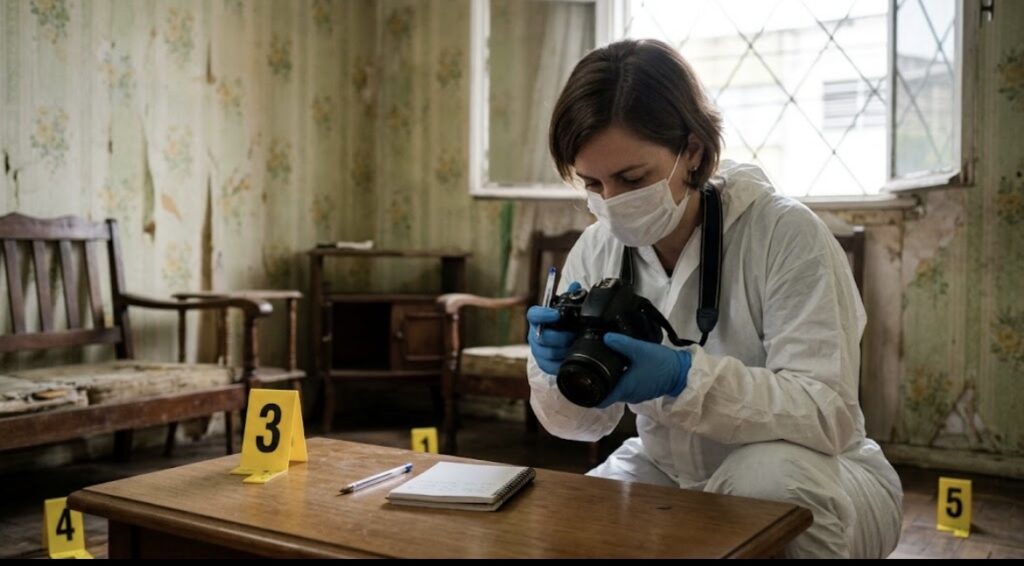
This question was at the centre of my study Suicide in Greater Porto Alegre: Reflections Based on Criminalistics Reports, published in 2022. The research examined forensic photographs and criminalistics reports concerning suspected suicides investigated in the metropolitan region of Porto Alegre, in southern Brazil, between 2018 and 2020. The study also highlighted an important methodological problem: suicide remains a relatively difficult subject for historical and documentary research, partly because of confidentiality restrictions and the ethical concerns surrounding the dissemination of details about self-harm. (Revista Contemporânea)
The crime scene does not speak by itself
One of the most important lessons from forensic practice is that a scene should not be interpreted through a single piece of evidence.
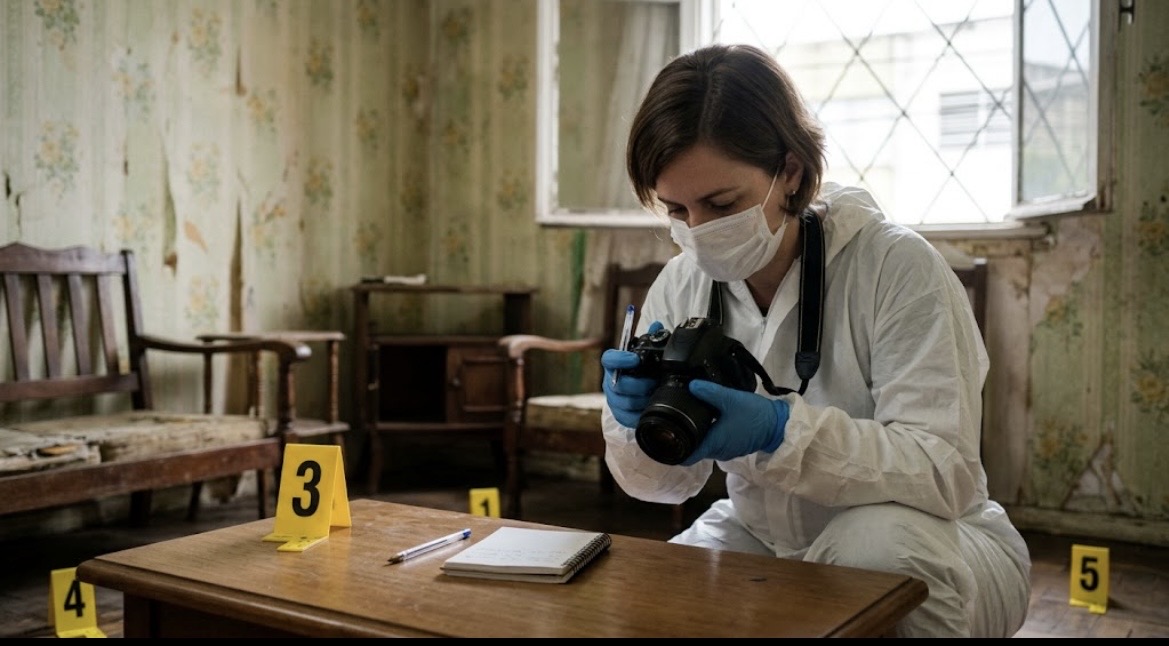
The body, injuries, objects, biological traces, weapons or other instruments, spatial relationships, photographs, statements and the condition of the scene must be considered together. The objective is not merely to identify an apparent cause of death, but to reconstruct the circumstances surrounding it.
In the forensic sciences course I teach, this principle is presented through the concept of the differential diagnosis of death. A death scene apparently involving violence may require the forensic examiner to distinguish among homicide, suicide and accident.
This distinction is fundamental. A conclusion such as “suicide” is not simply an observation; it is an interpretation supported—or weakened—by the totality of the available evidence.
What can the scene tell us?
The forensic examination of suspected suicides may involve several categories of evidence. These can include the examination of the body and its immediate surroundings, possible farewell communications, materials associated with the event, firearms and ammunition when relevant, toxicological information and other unusual or atypical circumstances.
Importantly, none of these elements should be interpreted in isolation.
The absence of a particular expected trace may itself become relevant. Conversely, the presence of a seemingly significant object does not automatically establish its relationship with the death.
This is where forensic reasoning becomes particularly important. The examiner must move from observation to analysis, interpretation and documentation, while remaining conscious of the limitations of the evidence.
A regional perspective
The data presented in my forensic-science teaching material provide an illustrative picture of suspected suicides investigated in the metropolitan region of Porto Alegre. For the period from May 2018 to May 2019, the recorded cases were predominantly associated with hanging, followed by firearm-related deaths and falls, with poisoning representing a much smaller proportion. These figures should be understood as a regional forensic observation rather than as a universal pattern of suicide.
More important than the percentages themselves, however, is what they demonstrate about forensic practice: different mechanisms generate different evidentiary problems.
Forensic investigators therefore need to understand not only the mechanism of injury, but also the relationship between the mechanism, the scene, the body and the surrounding circumstances.
Beyond statistics
My research also suggests that forensic reports deserve greater attention as historical and scientific sources.
Official criminalistics reports are produced within investigations of violent deaths and therefore contain information that may be unavailable in conventional historical sources. At the same time, their judicial nature means that confidentiality and ethical restrictions must be respected. (Revista Contemporânea)
This creates an apparent paradox. Suicide is a phenomenon that society needs to understand, yet many of the most detailed records concerning individual deaths cannot simply be made public.
Forensic science therefore occupies an unusual position: it produces valuable knowledge about a socially sensitive phenomenon while simultaneously having an ethical and legal responsibility to protect the dignity of the deceased and their families.
The forensic lesson
Perhaps the most important lesson is that a suspected suicide should never become an automatic conclusion.
The forensic examiner’s task is not to confirm the first hypothesis presented at the scene. It is to test that hypothesis against the physical evidence.
In this sense, the investigation of suicide illustrates a broader principle of forensic science: evidence should be interpreted within a coherent reconstruction of events, and conclusions should remain proportional to the quality and limitations of the available evidence.
The scene does not tell us everything.
But when carefully documented, scientifically examined and interpreted critically, it can tell us much more than a statistic ever could.